A military escort over Berlin, a state banquet, €40 billion in announced additional investment, 30 corporate agreements and the long-awaited daily Emirates link between BER and Dubai: the first state visit by a President of the United Arab Emirates to Germany was far more than ceremonial diplomacy. It delivered a concrete blueprint for investment, technology, energy, mobility and a much closer relationship between both countries.
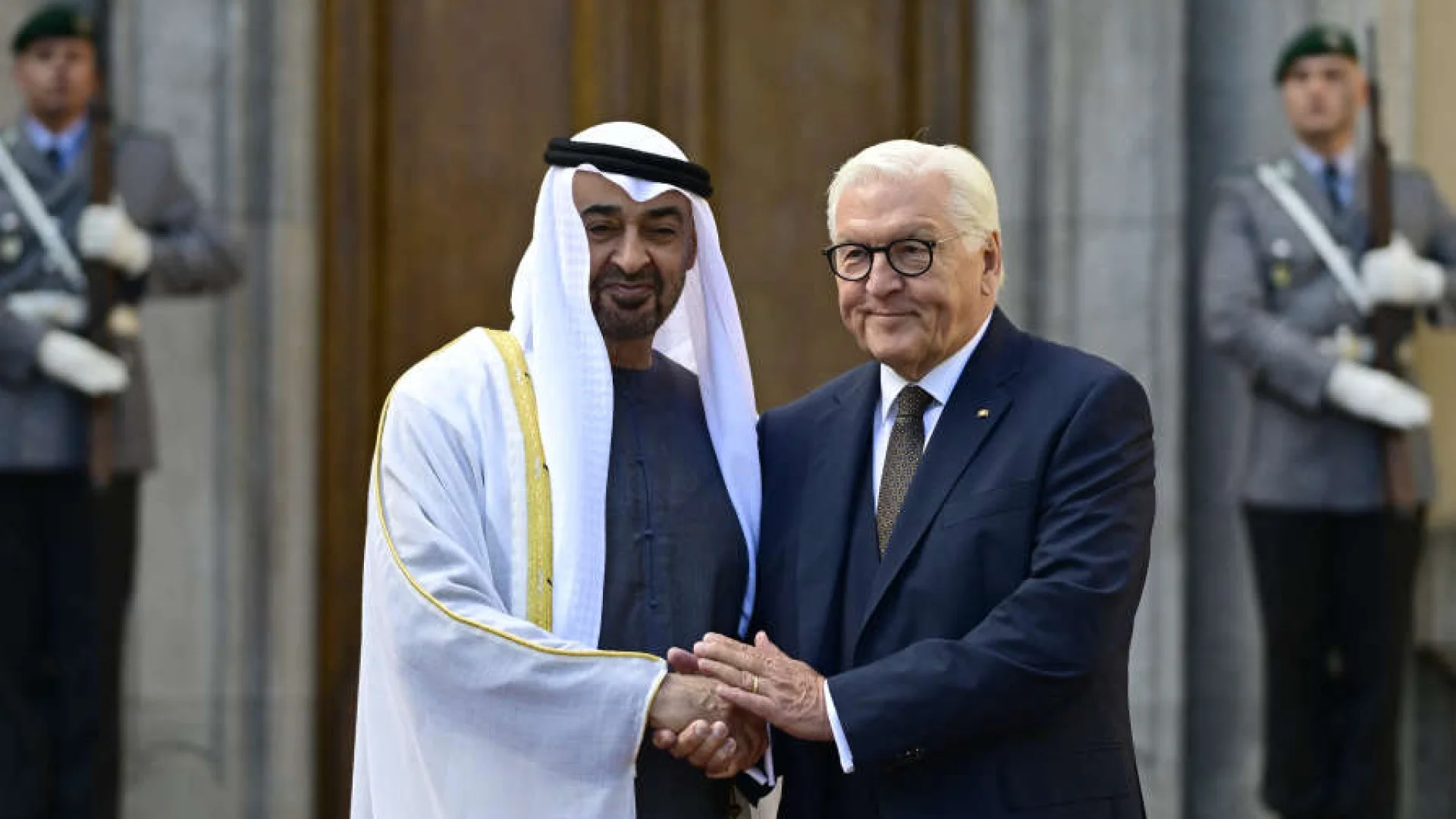
The arrival alone made one thing clear: this was no ordinary appointment. When the aircraft carrying His Highness Sheikh Mohamed bin Zayed Al Nahyan entered German airspace on 9 September 2026, German military jets formed an escort. A 21-gun salute and guard of honour followed on the ground. Berlin witnessed state protocol on its grandest scale – followed by two days of political and economic announcements whose numbers were exceptional even by the standards of a state visit.
From the welcome by Federal President Frank-Walter Steinmeier at Villa Borsig to the signing of Berlin’s Golden Book at the Red City Hall, the meeting with Chancellor Friedrich Merz and the Germany–UAE Business Forum in Munich, the visit from 9 to 11 September was the first state visit to Germany by a President of the United Arab Emirates. It became a highly visible statement of how closely Abu Dhabi, Dubai and Germany intend to work together.
The UAE announced an additional, long-term investment package of €40 billion for Germany. Precision matters here: this is not a gift, nor is it €40 billion transferred overnight. It is an investment commitment aimed at future projects, on top of an existing Emirati investment footprint in Germany worth about €34 billion.
The new capital is intended for industry, advanced technology, artificial intelligence, digital infrastructure and energy. A full €10 billion is earmarked for investment in Bavaria. One major component is the development of state-of-the-art data centres with planned capacity of approximately one gigawatt. This is about more than capital: it is about industrial competitiveness, skilled jobs and the infrastructure required for the next phase of digital growth.
€40 billion is no footnote. It is a vote of confidence in German technology, industry and expertise – and the starting signal for a new generation of German–Emirati projects.
The joint declaration issued on 10 September initially recorded 29 agreements and memoranda between companies from both countries, with a combined value exceeding €9.356 billion. At the business forum in Munich the following day, reports put the total at 30 agreements and commercial partnerships worth approximately €9.66 billion. The different figures are not contradictory; they are snapshots taken at two points during a visit that was still producing results.
The range is striking: renewable energy and clean infrastructure, oil and gas, AI and advanced technology, industry and manufacturing, logistics, ports and aviation, healthcare and life sciences, agriculture, food security and consumer goods.
According to the companies, the partnerships announced by ADNOC, XRG and Masdar during the visit alone could enable more than €5 billion of investment in Germany’s energy and industrial sectors.
For many people in Berlin, Brandenburg and eastern Germany, this is the most tangible and emotional result of the visit. Germany has added a fifth destination to the route schedule for one UAE national carrier, enabling Emirates to offer a daily long-haul service between Berlin Brandenburg Airport and Dubai.
Emirates currently serves Frankfurt, Munich, Düsseldorf and Hamburg. Berlin will become the fifth German point, while frequencies at the existing four airports for this carrier remain capped at their current level. At the editorial cut-off, no public launch date for the new BER–DXB service had been confirmed. The traffic rights, however, are now in place after years of debate.
The importance goes far beyond holidays and private travel. Dubai is one of the world’s most powerful international hubs. A daily service gives Berlin and eastern Germany more direct access to markets across Asia, Africa and Oceania, increases air-cargo options and shortens routes for investors, companies, science and tourism.
Behind the headline numbers lies a new institutional architecture. A German–UAE Investment Council is designed to connect capital, companies and public authorities, remove barriers and accelerate viable projects. A new Strategic Dialogue will revitalise the strategic partnership established in 2004 and coordinate work across foreign and security policy, defence, trade, energy, climate, technology, transport, the environment, culture and education.
Further arrangements cover data centres, secure data hosting and so-called data embassies, EasyPASS access for UAE citizens at German airports, mutual legal assistance in criminal matters, the fight against crime, and cooperation in culture, the environment, security and defence. The German government counts eleven intergovernmental instruments, while the Emirati announcement lists twelve documents. In substance, both describe the same exceptionally broad package.
The UAE is Germany’s most important trading partner in the Gulf. Bilateral non-oil trade reached approximately $15.5 billion in 2025, more than 14 per cent higher than in 2024. Germany contributes industrial depth, research, engineering and technology. The UAE contributes patient capital, delivery speed, energy expertise and access to growth markets across the Gulf, Asia and Africa.
That combination can be especially powerful where Germany needs large-scale investment quickly: data centres, grids, storage technology, offshore wind, industrial plants, logistics and the decarbonisation of energy-intensive production. For property and locations, this creates opportunities but no automatic guarantee of rising values. Demand is most likely to favour capable industrial and logistics sites, energy-secure plots, data-centre locations, and offices and homes in regions where announcements become real projects and jobs.
A credible account must include the criticism. German airlines and the Verdi trade union warned that additional Emirates rights could shift traffic and jobs towards a Gulf hub. Supporters in Berlin and Brandenburg regard the route as a long-overdue location advantage and a significant improvement in global connectivity. The UAE’s role in Sudan also prompted protests and political questions; according to the German government, Sudan was discussed alongside Iran, Gaza, Israel and Ukraine.
The joint declaration therefore extended well beyond business. Germany and the UAE emphasised diplomacy and dialogue, condemned attacks on civilian infrastructure and interference with shipping in the Strait of Hormuz, reaffirmed support for a negotiated two-state solution and recognised the Emirates’ mediation in prisoner exchanges between Ukraine and Russia.
The visit leaves images that many people saw: military jets in the sky, the motorcade through Berlin, the red carpet, the Golden Book and the flags of both nations. What matters most are the numbers and structures behind them: €40 billion in announced additional investment, 30 corporate agreements worth around €9.66 billion, an investment council, a strategic dialogue and the new BER–Dubai air bridge.
Now comes the part by which success will be measured. Which investments will be committed, and when? Where will data centres, energy infrastructure and jobs be created? When will the daily Emirates flight begin? The state visit opened the doors. Germany and the UAE must now walk through them together – with speed, reliability and the ambition to turn big announcements into an even bigger reality.