
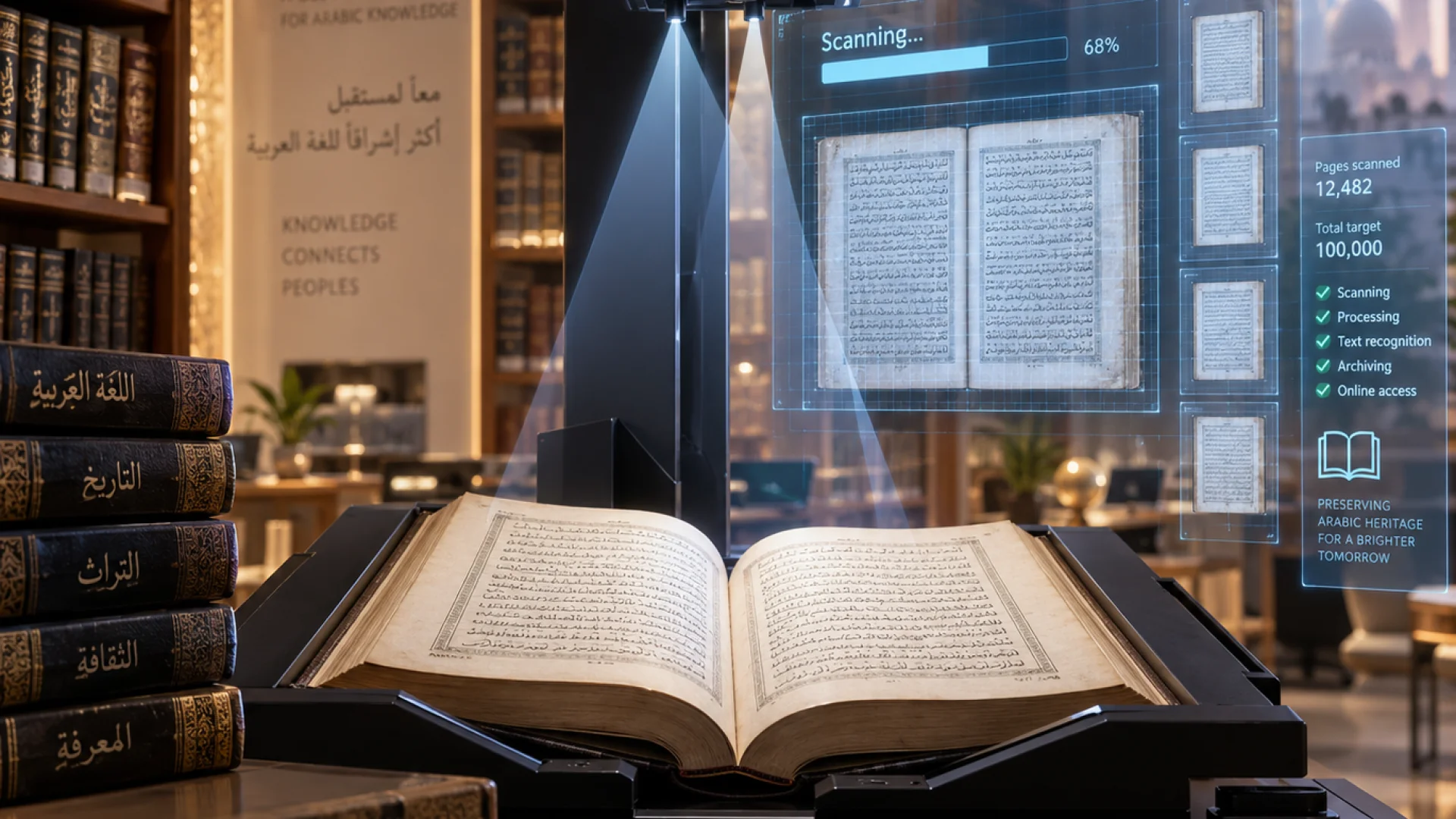

A quiet transformation is beginning in Abu Dhabi: around 100,000 Arabic books are set to be digitised in cooperation with Amazon. The initiative aims to preserve valuable literary and cultural material, make collections easier to search and bring Arabic knowledge to readers, students and researchers around the world. Shelves of paper are becoming a connected digital library.
The scene is almost silent: a page turns, a scanner hums, a cursor flashes. Yet in Abu Dhabi, those small sounds are part of a project with global reach. Around 100,000 Arabic books are being prepared for digitisation. Page by page, the contents of shelves are moving into a form that can travel far beyond the library walls.
An old book can feel almost alive in the hand. Its paper may be yellowed. Its binding may be fragile. Its title may be available in only a handful of libraries. A leak, a fire or simple age can place an entire work at risk. Digitisation offers a way to protect the information inside while reducing the need to handle vulnerable originals.
Abu Dhabi is working with Amazon on the initiative. At its heart is the digital capture of a substantial collection of Arabic books, allowing them to be stored, searched and accessed more easily. A reader will no longer necessarily have to travel to a particular archive. A researcher will be able to consult material across borders, provided the relevant digital access is available.
“The reader no longer has to be in the same room as the book.” That is the simple promise. A student studying Arabic literature, a scholar examining history or a family seeking stories in its own language can all benefit from a collection that is easier to reach.
Digitisation sounds mechanical. In practice, it is a careful chain of decisions. Books must be selected, assessed and prepared. Pages must be captured without damaging the originals. Digital files must then be organised so that users can find what they need. Arabic adds its own technical demands: the script runs from right to left, and older typography can be difficult for modern recognition systems to interpret.
A useful digital archive is therefore more than a folder filled with page images. It needs structure. Titles, authors, dates and other information must be recorded consistently. Where possible, text-recognition tools can make the material searchable. That matters enormously. No student wants to open hundreds of pages simply to locate one quotation or historical reference.
The project brings together two very different worlds. One is physical, patient and tactile: paper, ink, bindings and quiet shelves. The other is fast, networked and scalable. Amazon contributes experience in digital technology and large-scale data systems. Abu Dhabi contributes the cultural mission and the collections that give the project meaning. Together, they create a bridge between archive and platform.
Arabic is one of the world’s major languages of culture and knowledge. Its literary heritage includes classical poetry, religious works, novels, essays, children’s books and academic publications. Yet many titles remain difficult to access outside the Arab world. Copies may be rare. Some works may be out of print. Specialist libraries may be far away.
Digital access can lower those barriers. A student can discover a historical text from home. A researcher can compare editions without booking an expensive trip. A member of the Arab diaspora can reconnect with language and literature. A young writer can encounter a much wider cultural inheritance than the nearest bookshelf might otherwise allow.
Preservation is equally important. Digital copies do not replace original books, but they can protect them from unnecessary use. If a rare volume can be consulted online, the physical copy can remain safely stored for future generations. The original survives, while its contents continue to circulate.
The initiative fits Abu Dhabi’s wider effort to develop culture, education, technology and international knowledge networks. Museums, libraries and research institutions are increasingly being treated not only as places that preserve the past, but also as digital gateways to it.
That is why the significance of the project goes beyond the headline number. Abu Dhabi is presenting itself as a place where knowledge is collected, modernised and shared. The message is clear: culture is not an alternative to technology. In the right hands, it becomes one of technology’s most meaningful uses.
On a screen, a digitised book looks modest: a rectangle, a page, a search box. Behind it, however, are an author, a period, an argument and a memory. Multiply that by 100,000 and the result resembles a digital city built from language. Its streets are not made of stone. They are made of words, references and stories.
The project’s success will not be measured only by the number of books scanned. The crucial question is whether people can find, read and use the material. A book that has been technically captured but remains difficult to discover is only partly digitised. The work continues with cataloguing, access and presentation that invite curiosity.
One day, a student far from Abu Dhabi may open a book on a laptop that once sat in a local archive. A reader may discover a novel that belonged to an earlier generation. A scholar may find the missing reference for a major piece of research. At that moment, technology becomes culture.
For Abu Dhabi’s property and investment market, the initiative offers a useful signal. Digital culture projects do not automatically create new buildings, but they strengthen the ecosystem in which knowledge economies grow. Libraries, archives, universities, media companies and technology partners need skilled professionals, high-quality offices and well-connected urban locations.
Investors often look at knowledge infrastructure as an indicator of long-term place quality. Where education, culture and technology meet, demand can emerge for offices, flexible workspaces, serviced apartments and well-located homes. Districts near universities, cultural institutions and transport links may benefit as these networks deepen.
The digitisation of 100,000 Arabic books is first and foremost a cultural project. It also shows how Abu Dhabi is broadening its economic identity: from a city defined mainly by physical infrastructure to one where research, data and intellectual property create value. Some of the Emirate’s most important future spaces may not be made of concrete. Some will live in the cloud.