
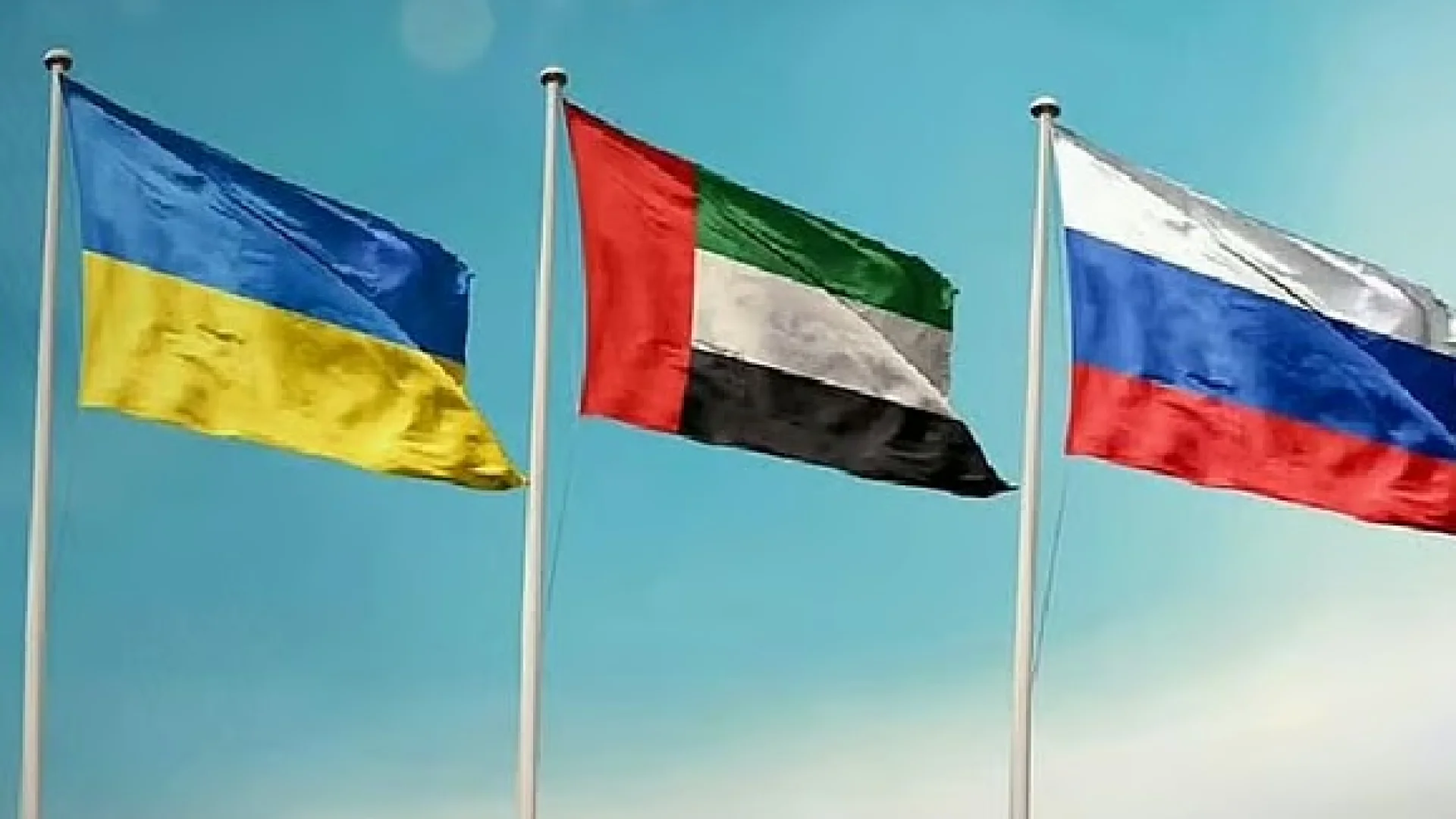

In a city built on quiet confidence and polished discretion, Abu Dhabi is again hosting sensitive diplomacy tied to the war in Ukraine. Delegations from Russia and the United States have gathered in the UAE for talks described as trilateral in format, with the Emirates providing the venue and a bridging role. The discussions point to a familiar reality of modern geopolitics: even when positions harden, channels still need to stay open. For the UAE, the meetings underline its ambition to be more than a business hub—an address where rivals can talk without turning the encounter into a spectacle.
The first thing you notice is the cold.
Outside, Abu Dhabi shimmers—sun on glass, heat on stone, the air itself trembling above the road. Inside the hotel lobby, the temperature drops so fast your skin tightens. Suit jackets look suddenly necessary. Voices soften. Shoes make polite, controlled sounds on marble.
A man steps away from the reception desk, phone pressed to his ear, speaking in a low tone that sounds like it has been trained. Two aides stand half a pace behind him, eyes forward, as if the hallway is a river and they’re watching for ripples. A bellhop glides by with luggage that carries no logos. Everything is clean, expensive, and—most importantly—quiet.
This is how high-stakes diplomacy often looks in Abu Dhabi: not like a summit, not like a photo-op, but like a city holding its breath in air-conditioning.
News reports say delegations from Russia and the United States have come to the UAE for talks connected to the war in Ukraine, described as taking place within a trilateral framework. The phrasing matters. “Trilateral” suggests a structured setting with the Emirates not merely renting out a room, but shaping the conditions—hosting, facilitating, keeping the tone pragmatic.
No one walks out announcing peace. No one promises a breakthrough. The public language around such contacts is careful, almost minimalist. But the very fact of the meeting carries weight. When Moscow and Washington sit in the same city to discuss a conflict that has redrawn Europe’s security map, it signals something simple and rare: the line is still open.
A security guard at the entrance watches badges flicker as people pass. He keeps his face neutral. Then, as the doors slide shut behind another small group, he mutters—more to himself than to anyone else: “The important things don’t happen in the loud rooms.”
Abu Dhabi has spent years cultivating a specific kind of influence: the influence of being useful to everyone.
The UAE maintains strong ties with Western partners, deep commercial links across regions, and a reputation for delivering logistics, security, and discretion. It is a place where global money moves easily, where conferences run on time, where hotels can host a major delegation without turning the lobby into a circus.
In today’s hyper-visible world—where a single handshake becomes a headline—Abu Dhabi offers something rare: a meeting place that doesn’t automatically force either side into a public performance. For rivals, that matters. For mediators, it’s gold.
In the elevator, two men in dark suits stand facing the doors, shoulders squared. Another pair enters, pauses, then chooses the opposite corner as if the floor plan has invisible borders. No one smiles. No one frowns. The doors close. The elevator hums upward. Diplomacy, sometimes, is just shared oxygen and disciplined silence.
A trilateral setting is more than a headcount. It hints at a role for the host state: convening, buffering, managing the room.
The war in Ukraine is not a neat two-party dispute. It is a knot of security guarantees, sanctions regimes, energy flows, military calculations, and domestic politics. Any contact between Russia and the US sits inside that larger knot. So the conversations that happen in Abu Dhabi are likely to be practical and sensitive—more about managing risk than rewriting history.
In a nearby corridor, a hotel staffer sets down a tray of small cups—coffee dark as polished wood. He doesn’t look at the people in the corner. Not because he’s afraid. Because he knows the rule: the less you notice, the more valuable you are.
Backchannels are not romantic. They are not scenes from a movie where one perfect sentence ends a war.
They are, more often, about preventing accidents.
In conflicts of this scale, misunderstanding can become escalation. A misread signal, a misinterpreted move, a domestic political speech aimed at one audience but heard by another—any of it can harden positions. A channel, even a narrow one, is a way to ask: “Did you mean that?” before the world reacts.
That is why meetings that look small can matter. They reduce the risk of two nuclear-armed powers drifting into a collision they didn’t plan. They create space for technical clarifications: humanitarian issues, detainees, security incidents, sanctions-related tangles, future contact points. The public may never see the details. The results may be invisible. But invisible results can still be real.
For the UAE, hosting such talks fits a broader strategy: being a global platform.
Platforms don’t need to be loud. They need to be reliable. They need airports that work, hotels that can handle high-security stays, financial systems that can support international business, and a political posture flexible enough to keep doors open.
Abu Dhabi’s diplomatic hosting also feeds into its reputation economy. Every successful, discreet meeting strengthens the city’s image as a place where the world’s serious people come to do serious things—whether that’s energy deals, investment summits, cultural openings, or conflict-related dialogue.
Step outside again and the heat hits you like a wall. Cars slide past, glossy and silent. The sea is a bright strip beyond the buildings. Abu Dhabi looks calm, almost too calm. But the calm is not emptiness. It is design.
The Ukraine war has forced governments and markets to redraw assumptions: about energy security, about supply chains, about alliances, about the costs of interdependence. In that world, “connector states” gain value—places that can speak to multiple camps and keep commerce moving.
Abu Dhabi positions itself in precisely that lane. It is not neutrality as a moral posture; it is neutrality as an operational capability. And capability attracts attention.
In a conference room somewhere above the lobby, someone crosses out a word and replaces it with a softer one. Someone else circles a date, then leaves it uncircled. These edits don’t look like history. But history is often made of edits.
For real estate investors, the UAE’s role as a host for sensitive, high-level diplomacy is not just a headline—it’s a market signal about stability, positioning, and capital gravity.
1) “Stability premium” and safe-haven behavior: When geopolitical risk rises, global capital tends to favor jurisdictions perceived as operationally stable, internationally connected, and predictable in infrastructure delivery. Abu Dhabi’s repeated appearance as a venue for complex diplomacy reinforces its image as a calm, controlled hub—supporting a stability premium that can translate into sustained demand for prime residential, Grade-A office, and hospitality assets.
2) Institutional demand and the diplomacy ecosystem: High-level meetings bring a long tail of activity: consultancies, security services, legal and communications teams, protocol staff, and visiting executives. Over time, that ecosystem supports demand for:
3) Macro channels: energy, inflation, and government spending: The Ukraine war continues to influence energy markets and inflation expectations. For an energy-linked economy, periods of higher revenues can expand fiscal capacity—often benefiting infrastructure pipelines and urban development. Investors should watch how public investment priorities feed into specific districts, transit corridors, and mixed-use masterplans.
4) Compliance sensitivity and transaction structuring: Any Russia-adjacent geopolitical activity also raises scrutiny around sanctions compliance, banking corridors, and due diligence. For property investors, that elevates the importance of clean capital stacks, transparent counterparties, and documentation that supports both financing and eventual exit liquidity.
5) Practical investor takeaways:
The takeaway is straightforward: when a city becomes a place where rivals can still talk, it gains more than diplomatic relevance. It gains economic stickiness—and real estate markets tend to like places that the world can’t afford to ignore.