
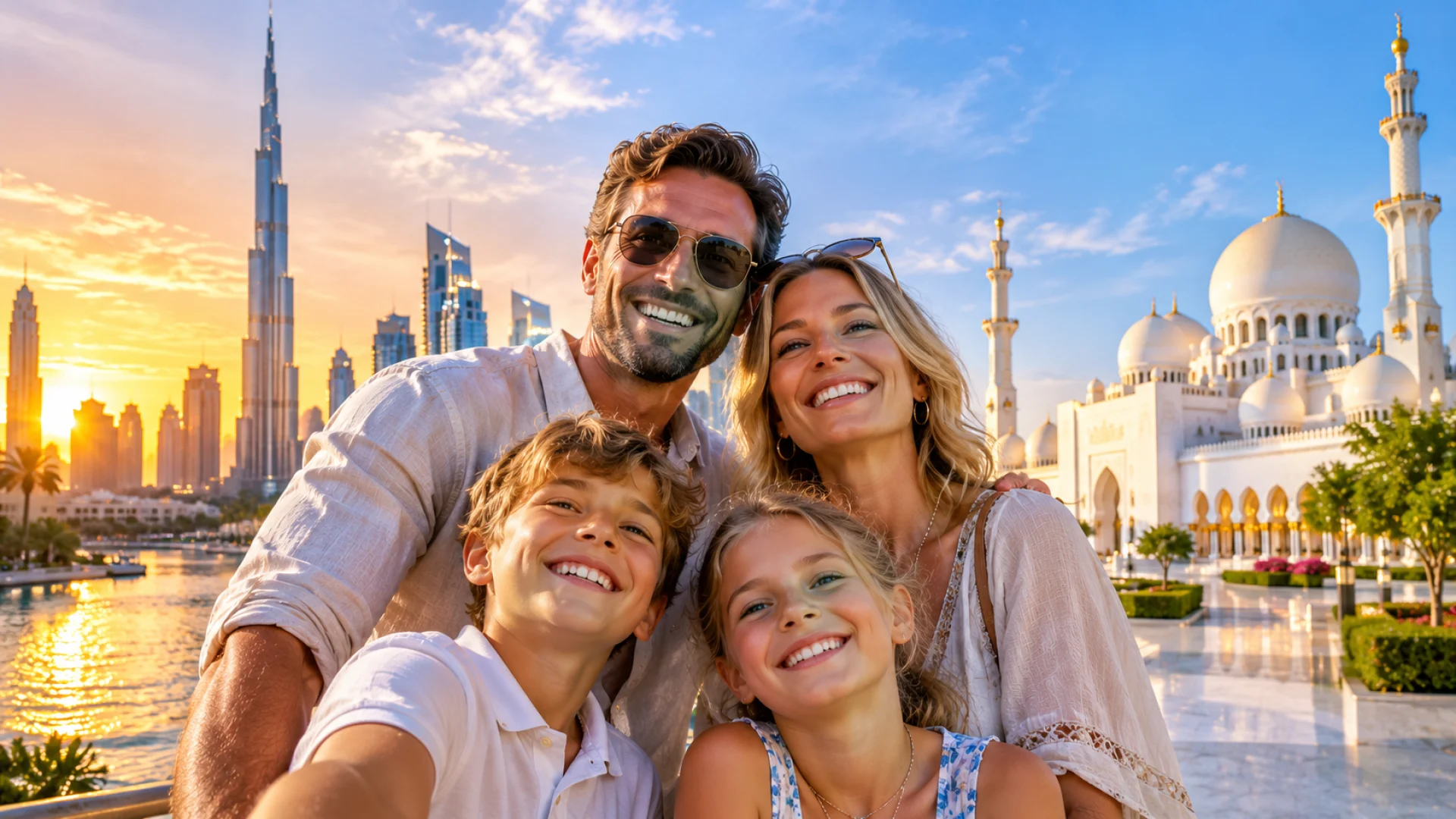

A family holiday in the United Arab Emirates can begin on a beach, continue in a museum, cross the desert and end beneath a glittering skyline. Abu Dhabi and Dubai are now ranked among the world’s five leading destinations for family tourism. Their appeal lies in the rare combination of major attractions, reliable infrastructure, high service standards and enough variety to keep every generation engaged.
The first thing children notice is usually the light. It pours across the airport glass, turns the buildings gold and makes the skyline look almost unreal. Then come the questions. Where is the beach? How high is that tower? Can we go to the water park today? In Abu Dhabi and Dubai, the answers tend to be yes.
A recent international ranking places both emirates among the world’s top five destinations for family tourism. It is a striking result. The United Arab Emirates are no longer simply a stop for business travellers, luxury shoppers or long-haul visitors in transit. They have become a complete family playground, combining urban spectacle, cultural discovery, outdoor adventure and easy comfort.
“Can we do it again?” a child asks outside a water attraction. The adults exchange the familiar look of parents whose carefully planned schedule has already disappeared. That is part of the charm. The cities offer so much that a family can change direction without losing the day.
Dubai is energetic and vertical. Its towers, vast malls and illuminated boulevards create a sense of constant movement. A visit to the Burj Khalifa can be paired with an aquarium, an indoor entertainment venue or a meal overlooking the fountains. Large attractions are often close enough to combine, which matters when small legs begin to tire.
Abu Dhabi is more spacious and measured. Its beaches, waterfront promenades and cultural landmarks give the capital a calmer rhythm. On Yas Island, major leisure attractions sit within a compact destination. Families can move from motorsport to rides, from a theme park to dinner, without spending the entire day in transit.
The two emirates also tell different cultural stories. The Sheikh Zayed Grand Mosque in Abu Dhabi rises in white marble and reflective pools, creating a moment of quiet after the noise of the city. At Louvre Abu Dhabi, sunlight filters through the famous dome in patterns often compared with rain. Children may not remember every label, but they remember the feeling of walking beneath that light.
Few family destinations offer such an immediate change of scenery. In the morning, a four-wheel-drive vehicle climbs a desert dune. Sand slides beneath the tyres. A guide points towards the horizon. By afternoon, the family may be floating in a hotel pool or watching the sea from a broad sandy beach.
This range is one of the strongest reasons for the emirates’ ranking. Families rarely travel as a single-minded group. One parent wants rest. Another wants to explore. A child wants speed and noise. A teenager wants photographs, food and a place that feels new. Dubai and Abu Dhabi make those differences manageable.
Family-friendly travel is not defined only by spectacular attractions. It is also the practical detail behind the scenes: clear transport, clean public spaces, child-friendly menus, spacious hotel rooms and staff accustomed to international visitors. These small advantages reduce the friction of travelling with children.
The climate rewards planning. During the hottest hours, families often move indoors, take a pool break or return to the hotel. Early mornings and evenings are different. The air softens, the promenades become lively and the city begins to sparkle. A walk along Abu Dhabi’s Corniche can be as memorable as a major attraction. In Dubai, the evening skyline turns a simple family dinner into an event.
That balance between excitement and ease is central to the destinations’ appeal. A family can fill a day with headline attractions, or slow down and let the city come to them. There is room for both approaches.
The ranking reflects a broader transformation. Over the past years, Dubai and Abu Dhabi have expanded their tourism offer far beyond shopping and luxury hotels. They have invested in museums, public spaces, leisure islands, transport links and attractions designed for international audiences.
For families, the result is a destination that feels unusually adaptable. A holiday can be educational without becoming formal, adventurous without becoming difficult, and luxurious without requiring every hour to be structured. Parents find convenience. Children find stories. Teenagers find a landscape made for discovery and images.
At sunset, the contrasts become clearest. A dune turns amber. The sea catches the last light. Far away, towers begin to glow. In one day, a family may have seen a mosque, a museum, a roller coaster and a desert camp. That compressed variety is the real attraction.
Abu Dhabi and Dubai are not identical, and that is precisely why they work so well together in the international imagination. Dubai provides speed, height and spectacle. Abu Dhabi offers space, culture and a gentler pace. Together, they create a family destination with unusual depth.
The rise of family tourism also has consequences for property markets. Hotels, serviced residences, holiday apartments and mixed-use communities benefit when visitors stay longer and travel with larger groups. Locations near beaches, leisure islands, theme parks, shopping districts and efficient transport links are especially well positioned.
Family demand broadens the investment story. Travellers often need more space than a traditional hotel room, along with kitchens, pools, play areas and easy access to restaurants. Developments that respond to those needs can appeal to both holidaymakers and residents.
For investors, the ranking is therefore more than a tourism headline. It signals continuing demand for accommodation and communities built around leisure, convenience and international connectivity. As Abu Dhabi and Dubai strengthen their position on the family travel map, residential, hospitality and short-stay real estate may all benefit from the same underlying shift: the emirates are becoming places where people do not merely visit, but plan entire experiences.