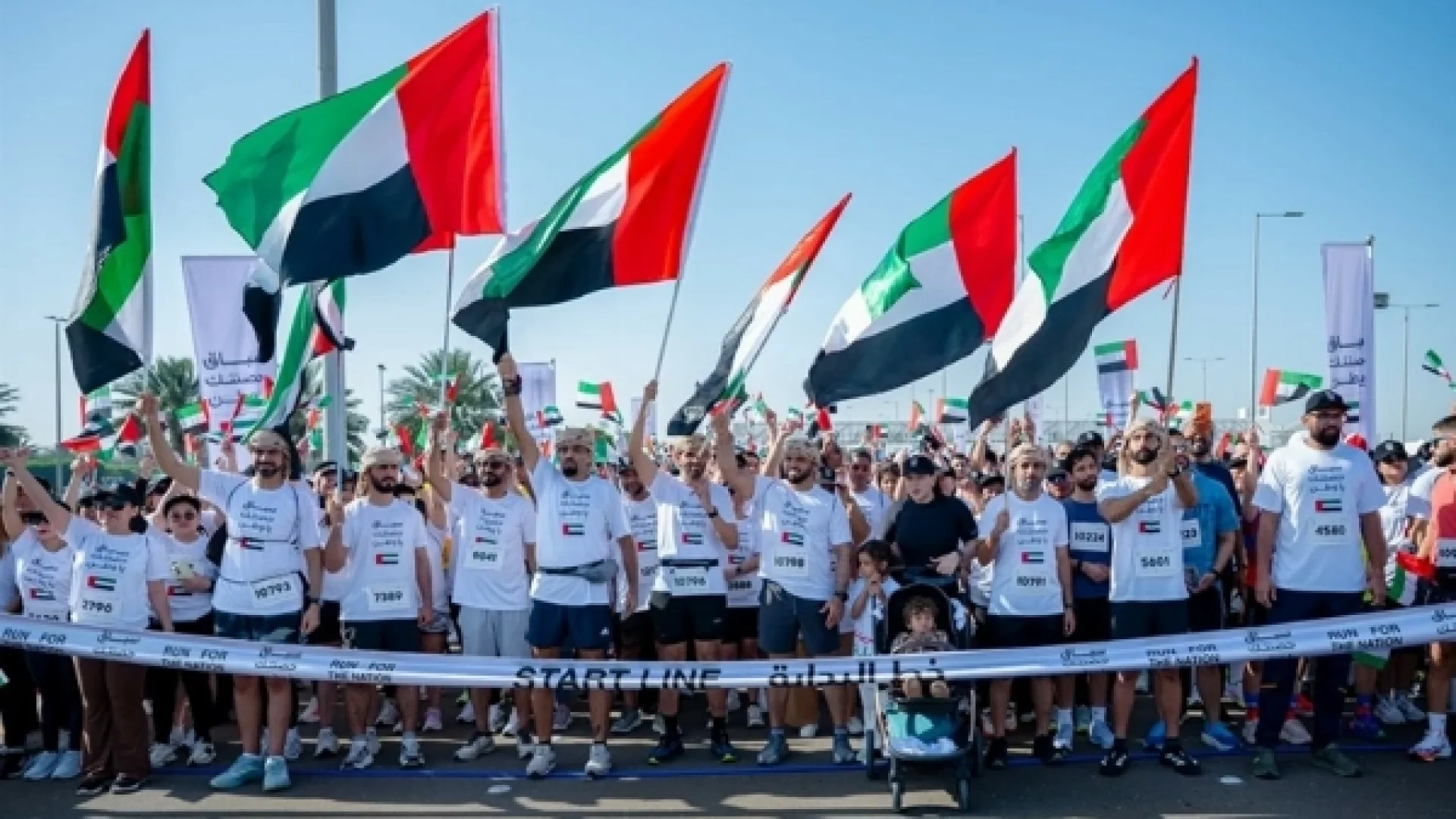
Before the day fully warmed, Abu Dhabi was already in motion: more than 25,000 participants poured into the “Run for the Nation,” from first-timers and school groups to serious runners chasing splits. The event showcased the capital’s ability to stage large, safe, city-scale experiences that feel both festive and personal. Beyond medals and finish lines, it projected a message of unity, health, and civic pride—images that travel far beyond the route. For a city competing on livability, tourism, and talent, those images matter—and they ripple into real estate demand and investment narratives.
Dawn in Abu Dhabi has a particular kind of hush—cool air, clean light, the city holding its breath before the heat arrives. The road surface still looks slightly wet, as if the night refused to leave without a signature. Then the sound begins: bib numbers fluttering, barriers clinking, a thousand small conversations braided into one steady hum.
Someone behind me says, “Did you tighten your laces?” A teenager answers, “Relax. I’m not racing.” His mother raises an eyebrow that clearly means: you are absolutely racing.
At the start line, the crowd doesn’t feel like a crowd so much as a living map of the city. And when the moment comes—when the countdown hits its last beat—Abu Dhabi moves as one. This year’s “Run for the Nation” drew more than 25,000 participants, a number that stops being statistics the instant you’re inside it. You feel it in the shoulder-to-shoulder energy, in the collective inhale, in the sudden percussion of shoes on asphalt.
“Run for the Nation” is, of course, a race. But it’s also something else: an urban story performed live. Along the route, you see every pace and every reason. Competitive runners glide forward with that disciplined quiet—short strides, eyes fixed, their breathing measured like metronomes. Just behind them comes the wide, human river: friends in matching shirts, colleagues turning a fitness goal into a team ritual, families with children bouncing like sparrows at the edge of control.
Abu Dhabi has become fluent in big events, and the fluency shows in the details. The route feels carefully choreographed—clear signage, orderly movement, volunteers ready with water and encouragement. Safety and logistics are present without stealing the scene, which is exactly how a well-run city wants it: functional, calm, confident.
On the sidelines, spectators make the city warmer than the weather ever could. A father holds a hand-painted sign that reads, “YOU’VE GOT THIS,” the letters wobbling with love. A cluster of volunteers claps in rhythm—steady, relentless, like they’re pushing runners forward with sound alone. Every cheer lands like a small promise: keep going, you’re not alone.
Not everyone came to chase a personal best. Many came to belong to a moment. I fall into step near a pair of friends who are clearly negotiating pace in real time.
“We start easy,” one says.
“Easy is not your thing,” the other shoots back.
They laugh, and for a second you can see why events like this work: the city becomes a shared joke, a shared effort, a shared memory being created on the move.
A little farther on, a school group runs in bursts—ten seconds fast, ten seconds giggling, ten seconds trying to look serious again. A man in traditional attire moves with unhurried steadiness, as if the road has turned into his private promenade. Two teenagers playfully overtake each other, then stop to wait—friendship beating speed, every time.
“Why do you do it?” I ask a runner who has stepped aside to stretch his calves, his face flushed with the honest work of effort.
He looks at his bib like the answer might be printed there. Then he says, “Because today you feel part of something. And because Abu Dhabi looks different when it’s running.”
More than 25,000 participants is a headline-worthy figure, but its real meaning is softer—and bigger. It suggests a capital that’s comfortable inviting people into public space, comfortable turning streets into a stage for community. It’s a city signaling that wellness isn’t a private hobby; it’s a civic value.
It also shows how Abu Dhabi positions itself internationally: modern, open, organized, safe. These aren’t abstract qualities. They are photographed, posted, shared, and remembered. In a world where cities compete for tourists, talent, and investment, those impressions become a kind of currency.
At the finish area, the atmosphere shifts from tension to release. Runners cross the line and immediately become different versions of themselves—lighter, louder, sometimes emotional. Medals clink against water bottles. Friends collapse into hugs. A child holds up a finisher medal like it’s a treasure recovered from a sea. Nearby, a woman wipes sweat from her forehead and says to nobody in particular, “I didn’t think I could do it.”
Her friend answers without missing a beat: “You did. That’s the point.”
After a few hours, the city begins to reset. Barriers come down. The asphalt returns to traffic. But the event leaves a residue—an emotional one. Participants carry home the feeling of having claimed a piece of the city with their own effort. Spectators remember the faces, the variety, the collective momentum.
And there’s a quieter after-effect that planners and investors track closely: major public events act like magnets. They fill hotels and cafés, test mobility systems, and—most importantly—strengthen place identity. Not the kind invented in brochures, but the kind built through lived experience.
Near the edge of the finish zone, a man sits on the curb, shoes in hand, socks dark with sweat. He watches the late finishers come in and shakes his head—not in disbelief, more like admiration.
“So many,” he says. “So many people doing something good for themselves today.”
Then he stands, as if making a private deal with next year.
For real estate investors, events like Abu Dhabi’s “Run for the Nation” are not just feel-good headlines—they’re signals. A city that can mobilize 25,000+ people for a safe, well-managed public event demonstrates operational capacity: crowd control, transport coordination, public-space stewardship, and a reliable security framework. These “soft” indicators increasingly influence how global occupiers and capital assess livability, which in turn affects residential absorption, rental resilience, and long-term liquidity.
1) Premium shifts toward lifestyle infrastructure: Demand is rising for neighborhoods that are walkable, park-adjacent, waterfront-connected, and rich in everyday amenities. Large wellness events reinforce this preference by putting public realm quality on display. Over time, that can support price premiums in mixed-use districts and master-planned communities that offer shaded promenades, safe crossings, cycling paths, and accessible green space.
2) City branding as an investment tailwind: The strongest impact is often indirect: repeatable, shareable imagery of an organized, inclusive, health-forward capital. That brand effect supports tourism and business travel (benefiting hotels and serviced apartments) and also helps attract talent—an important driver for higher-end rental demand, corporate leasing, and executive housing.
3) A live stress-test for mobility and services: Major runs reveal whether key corridors, parking strategies, and public transport links can handle surges. Smooth delivery reduces perceived execution risk—something institutional investors price into development and operational models. Neighborhoods that consistently host or connect to large events may see stronger footfall narratives for street retail and F&B, improving leasing arguments for ground-floor activation.
4) Momentum for mixed-use and “15-minute” planning: Runs catalyze spending along activated routes—coffee, convenience, sports retail, recovery services. For developers, this supports the case for mixed-use formats where residential demand is strengthened by lifestyle and health amenities. For investors, it signals where consumer-facing micro-markets may deepen over time.
5) ESG and wellbeing positioning: Wellness-oriented public programming aligns with ESG-linked capital trends. Projects that integrate wellbeing features—running loops, fitness zones, shaded pedestrian networks, high-quality landscaping—can be positioned more competitively with tenants and buyers, supporting absorption and exit narratives.
Investor takeaway: Track Abu Dhabi’s event calendar as “soft data” alongside supply pipelines and infrastructure upgrades. Repeated, high-participation public events indicate not only cultural vibrancy but also administrative competence—two factors that help sustain long-term demand in lifestyle-centric districts and enhance the investability of residential, hospitality, and mixed-use assets.