
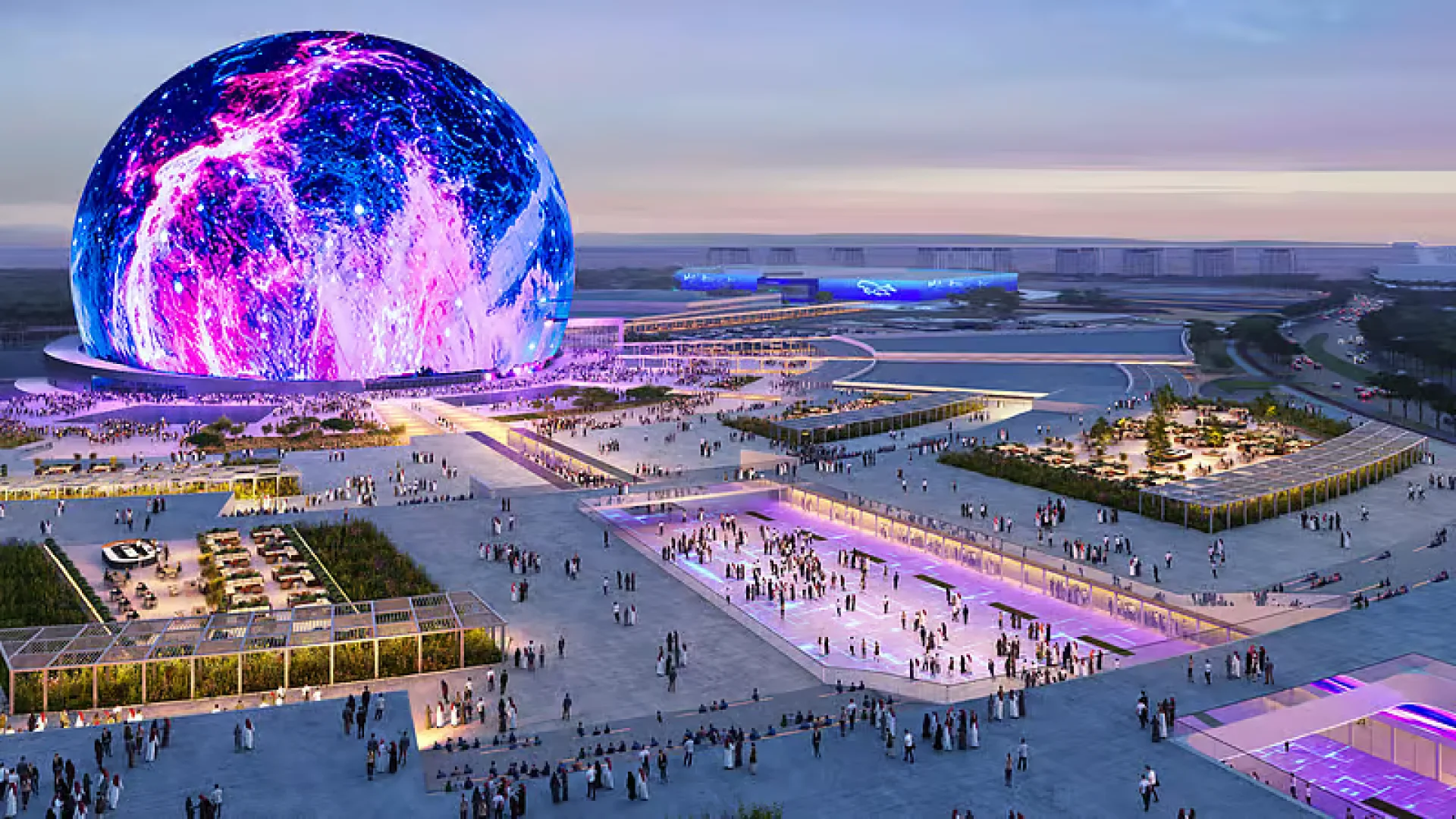

Picture a new moon over the Gulf—except it’s engineered, programmable, and pulsing with light. The Abu Dhabi Sphere is being discussed as a next-generation, immersive entertainment venue in the spirit of the Las Vegas Sphere: a landmark-scale media façade outside and a high-tech arena experience within. While public timelines remain limited, the strategic direction is unmistakable: Abu Dhabi is expanding its evening economy and global event pull. For the city’s property market, that typically means stronger hospitality performance, more serviced-living demand, and a premium on well-connected, experience-led neighborhoods.
The first thing you notice at night in Abu Dhabi is how quickly the city turns cinematic. The Corniche glides by like a ribbon of headlights. The sea is black glass. Then, somewhere between a roundabout and a palm-lined slip road, a driver says it—casually, like it’s already part of the skyline.
“They’re bringing a Sphere,” he tells me, one hand on the wheel, the other sketching a circle in the air. “Like Vegas. But… Abu Dhabi.”
He doesn’t need to explain the rest. A Sphere isn’t just a building anymore. It’s a signal. It’s a new kind of landmark—one that doesn’t merely sit in a city, but broadcasts it.
In global entertainment circles, “Sphere” has become shorthand for a very specific idea: a giant, next-generation venue that merges architecture, media technology, and live performance into one immersive machine. The best-known reference point is the Las Vegas Sphere, famous for its wraparound LED exterior and deeply immersive interior production capabilities.
Abu Dhabi’s Sphere—based on ongoing market chatter, partner ecosystem signals, and regional positioning—has been framed as a similar type of project: a landmark entertainment destination designed to host concerts, residencies, large-format shows, brand spectacles, and global events. Think of it as a venue that is also a screen, a stage, and a city-sized piece of content.
Outside, the promise is visual: a media façade visible from far away, capable of turning into art, advertising, and announcement in real time. Inside, the ambition is sensory: precise acoustics, dramatic sightlines, high-resolution visuals, and production infrastructure that makes “a night out” feel like stepping into a film.
The question everyone asks is the one nobody can answer with a single, official date—yet. As of now, publicly confirmed schedules have been limited, which is not unusual for mega-projects in the region: timelines are often communicated once the site, operator stack, and procurement pathways are locked.
Still, the broader pattern is readable. Abu Dhabi has been deliberately expanding its year-round visitor economy—culture, sport, leisure, and MICE all moving in sync. A Sphere would be the kind of anchor that gets timed to a wider wave of openings and programming cycles. Industry expectation places a project of this magnitude in the latter half of the 2020s, aligning with the emirate’s ongoing push to deepen its global events calendar.
In other words: the Sphere isn’t being discussed as a one-off headline. It’s being discussed as a long-term platform—something you build once, then program relentlessly.
Abu Dhabi doesn’t need more proof that it can build. What it is building now is something subtler: habits. Reasons to stay out later. Reasons to fly in for the weekend. Reasons for a conference delegate to add two extra nights “just because.”
A Sphere is particularly powerful because it creates repeatable, exportable imagery. It becomes the background of videos, the centerpiece of brand campaigns, the instant identifier in a skyline shot. And it converts that visibility into spend—tickets, hotels, dinners, taxis, retail baskets, after-parties, corporate buyouts.
It also changes the competitive framing. When a city owns a venue format that feels categorically new, it stops competing only on what it hosts—and starts competing on how it hosts it.
Here’s the part urban planners love and residents feel in their bones: landmarks don’t just add a point on a map. They redraw the map.
Once a major entertainment anchor opens, movement patterns shift. Pick-up zones become social hotspots. Restaurant reservations cluster around show times. Nearby hotels start selling “event weekends” instead of generic rooms. Streets that were quiet at 10 p.m. suddenly have a pulse.
Imagine opening week. The air is warm. The queue is half selfie-sticks, half evening wear. Someone behind you says, “Is it always this bright?” And the Sphere answers by changing its skin—deep ocean blue to molten amber in a breath. In that moment, Abu Dhabi isn’t just hosting an event. It’s creating a ritual.
Abu Dhabi has been assembling a powerful mix: major cultural institutions, headline sports, beach resorts, and family attractions. The missing piece in many cities is consistency after dark—something that keeps visitor spend concentrated and predictable.
A Sphere is designed for exactly that: high-frequency programming, premium experiences, and “must-see” productions that can run as seasons rather than one-night-only events. The spillover is measurable.
Entertainment landmarks create a distinctive kind of property momentum. Not overnight, not everywhere—but in the places that capture the new flow of people and money.
First comes hospitality. It always does. When a city adds a major reason to visit, hotels feel it in occupancy and rate power. Then comes serviced living—because shows, residencies, and event production teams need furnished, flexible stays. Only after that do you see the broader residential lift: more professionals choosing to base themselves locally, more lifestyle-driven demand, more appetite for neighborhoods that feel “alive” on a Thursday night.
Developers and investors watch for the same signals: transport upgrades, restaurant openings, brand leasing activity, and the density of complementary attractions. A Sphere performs best—and creates the strongest value halo—when it’s embedded in a walkable, mixed-use environment rather than isolated behind parking and highways.
For investors, the Abu Dhabi Sphere matters less as a single asset and more as a demand generator—a project that can increase footfall, extend length of stay, and strengthen Abu Dhabi’s global positioning in live entertainment and events. The most likely beneficiaries are hospitality, serviced apartments, prime residential in well-connected districts, and retail/F&B that captures event-driven peaks.
Investment lens: prioritize travel time over straight-line distance; analyze mobility capacity, parking/ride-hailing logistics, and pipeline visibility (hotel keys, retail leasing, planned infrastructure). If the Sphere lands as part of a broader destination district, the value halo can be material—supporting both yield stability (through diversified demand) and capital growth (through brand-driven neighborhood re-rating).