
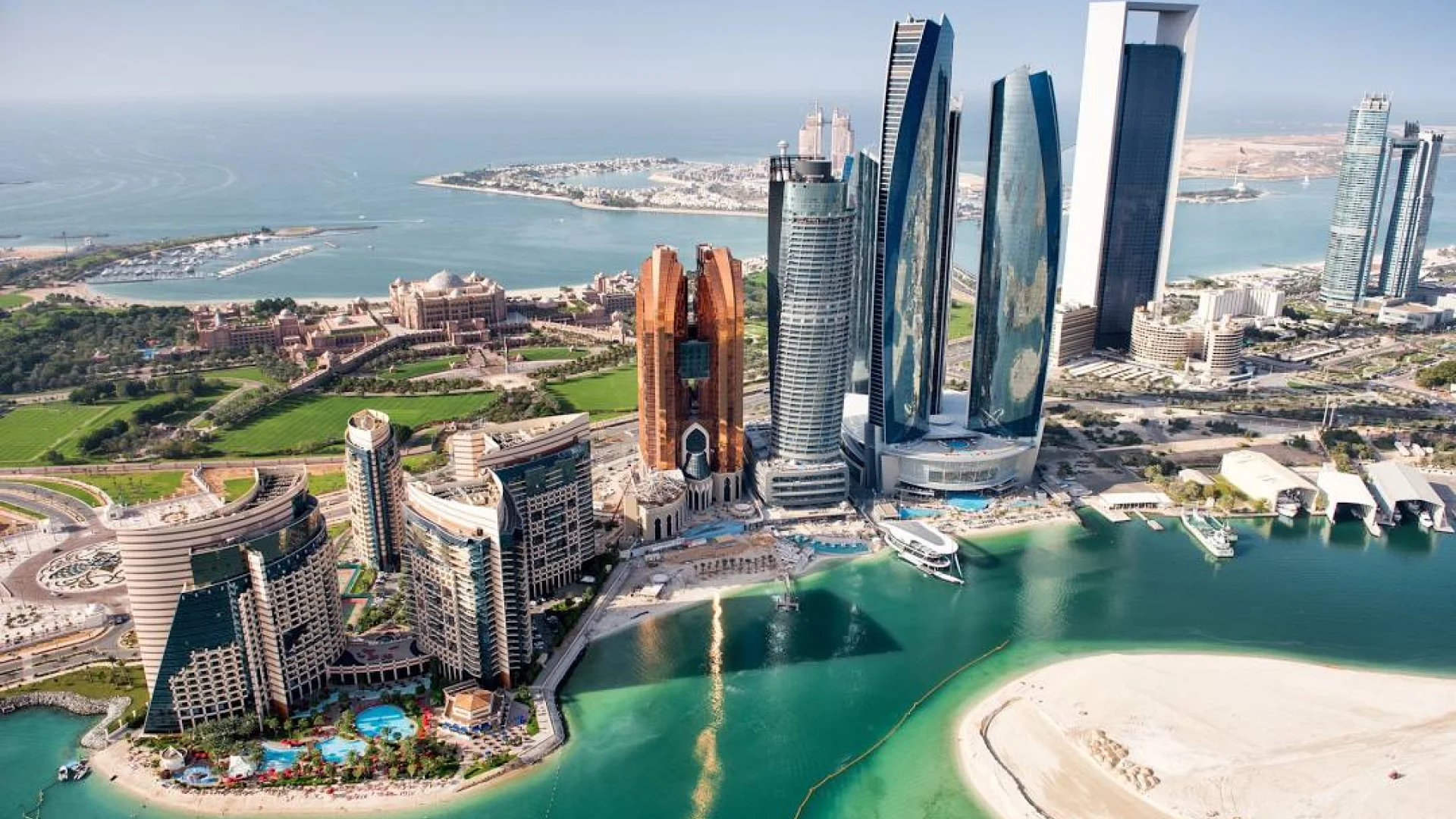

In 2029, Abu Dhabi will become the temporary nerve center of the global economy as it hosts the Annual Meetings of the World Bank Group and the International Monetary Fund. The decision places the UAE at the heart of debates that shape capital flows, debt solutions, climate finance and development priorities—while bringing a surge of delegations, CEOs, investors and media into the city. For Abu Dhabi, it’s a statement of stature and a real-world stress test of logistics, venues, hospitality and connectivity. For the region, it’s a powerful signal that financial influence is increasingly multi-polar, and that new hubs are helping set the agenda.
The first thing you notice is the cold.
Not outside—outside the Gulf heat shimmers like a mirage over the road—but inside the lobby, where the air-conditioning turns glass doors into a kind of threshold. People step in and exhale. Suit jackets settle on shoulders. A coffee cup lands on a saucer with a quiet click. Somewhere near a cluster of delegates, a single number floats through the conversation like a destination: “2029.”
That year, Abu Dhabi will host the Annual Meetings of the World Bank Group and the International Monetary Fund—one of the most influential gatherings in global finance and development. It’s the week when ministers and central bankers, multilateral lenders and private capital, economists and activists, journalists and CEOs all converge in the same corridors. Not to applaud. To negotiate. To persuade. To measure risk. To price the future.
On paper, they are the yearly meetings of the World Bank Group and the IMF. In practice, they are a moving city of decision-makers.
Think of it as a marketplace built from time slots: plenary sessions in cavernous halls, policy panels where acronyms fly like confetti, and—most importantly—hundreds of side meetings where the real work happens. A minister seeks support for reforms. A central bank governor compares notes on inflation and exchange rates. A development team pitches a project pipeline. Investors listen for signals: stability, transparency, momentum.
When the Annual Meetings arrive, a host city doesn’t just provide conference space. It becomes the backdrop for the world’s economic mood.
Choosing Abu Dhabi for 2029 is not a neutral calendar decision. It’s a recognition of how the map of influence is changing.
The UAE has spent years positioning itself as a bridge—between East and West, between established capital and emerging opportunity, between an energy-present and a tech-forward future. Abu Dhabi, in particular, has built a reputation for long-horizon strategy, deep pools of capital, and a steady push into new sectors.
Now picture the optics: the world’s top financial stewards stepping into Abu Dhabi’s venues, discussing debt sustainability, climate adaptation and growth models—while a city known for bold infrastructure and rapid execution hosts the conversation. It’s symbolism with real economic gravity.
Any city hosting the Annual Meetings feels it in its bones. The tempo changes.
Hotel lobbies become command centers. Every lounge chair is suddenly a negotiation table. Security checkpoints appear like temporary borders. Cars glide in synchronized lines. Translators move quickly, headsets in hand, as if language itself is on a tight schedule.
Abu Dhabi is no stranger to mega-events, but the Annual Meetings are their own species: less spectacle, more intensity. The success of the week depends on details that most visitors never see—room blocks coordinated months ahead, transport capacity at peak hours, stable high-speed connectivity, media facilities that can handle a constant churn of briefings, and the quiet competence of protocol.
In a gathering where everyone is late for something, friction becomes the enemy. The host city’s job is to remove it.
No one can write the 2029 agenda in full today. But the outlines are already visible, because the world is already wrestling with them.
Debt levels remain a pressing concern for many economies. Climate risks increasingly look like financial risks. Development funding is being re-architected, with a stronger push to mobilize private capital alongside public balance sheets. Digital systems—payments, identity, government services—are becoming core infrastructure, not add-ons. And the basic question underneath everything persists: how do countries grow in a way that is resilient, inclusive, and investable?
Inside a panel, those debates can sound clinical. Out in the corridor, they turn human.
“We need breathing room,” says a delegate from an emerging market, eyes fixed on a phone vibrating with messages from home.
“We need predictability,” replies an investor, scanning for the next meeting room, meaning rules that don’t change overnight.
Between those two sentences is the entire business of development finance.
The Annual Meetings last a week. Their aftereffects last longer.
There is the immediate benefit: a surge in demand for hotel rooms, transport, dining, event services. But the deeper impact is reputational. A host city gets written into the mental map of global decision-makers—people who spend their lives moving between airports and meeting rooms, and who remember, very simply, where things worked smoothly.
Hosting also compresses networking into a tight space. A brief handshake can become a follow-up call. A panel appearance can become an invitation to a roadshow. An informal conversation can become a memo that changes a project’s timeline. The Annual Meetings are partly policy, partly theatre, and partly an engine for deal flow.
For the UAE, hosting is an assertion of capability and relevance.
It says: we can convene at the highest level; we can provide the infrastructure; we can offer neutrality and efficiency; we can be a platform for difficult conversations. And it aligns with the country’s broader trajectory—diversifying the economy, strengthening global partnerships, and increasing its role in shaping how capital and development interact.
Abu Dhabi in 2029 will not just welcome guests. It will host the world’s economic attention—and, for a week, hold it.
For real estate and infrastructure investors, the World Bank–IMF Annual Meetings are not simply a prestigious conference. They are a demand shock, a visibility accelerator, and—if leveraged well—a catalyst for longer-term market liquidity.
1) Hospitality upside (and a global showroom effect). Annual Meetings typically bring tens of thousands of attendees across delegations, institutions, and media. That drives peak occupancy, higher ADR and RevPAR during the event window. More importantly, it showcases the destination’s operational maturity to the exact audience that influences future corporate travel and international event calendars. Owners of well-located full-service hotels, conference-capable assets, and high-quality serviced apartments tend to be the immediate beneficiaries.
2) Demand concentration around venues and transit corridors. These events are intensely time-sensitive. Delegations cluster where movement is easiest: near main venues, near premium hotels, and along airport-to-CBD corridors. For investors, this amplifies the value of micro-location analysis—walkability (or short shuttle times), security-friendly access points, and flexible meeting spaces can translate into pricing power.
3) Grade-A office and mixed-use: where deals actually happen. The public sessions are visible; the private meetings are decisive. High-end mixed-use districts—combining offices, hospitality, retail and branded residential—offer the “one-elevator” advantage that global delegations love. In practical terms, that can support leasing momentum for premium offices, elevate the desirability of adjacent retail, and strengthen the investment narrative for integrated urban projects.
4) Infrastructure premium and investability. Host-city preparations often sharpen infrastructure performance: transport planning, digital connectivity, crowd management, and public-realm upgrades. Even incremental improvements can reduce friction costs for tenants and visitors—raising a city’s competitiveness in site-selection decisions. Institutional investors increasingly price this kind of reliability into underwriting assumptions.
5) Capital conversations on home ground. Because the meetings revolve around financing—debt frameworks, climate funding, development pipelines—Abu Dhabi becomes a live setting for capital allocation discussions. That creates an unusually direct bridge between policy narratives and private investment interest. For the local market, it can shorten the distance between “curiosity” and “due diligence,” simply because decision-makers are physically present and can tour assets and districts between sessions.
Investor takeaway: The strongest positioning tends to be in assets aligned with MICE demand (conference hotels, serviced apartments, premium retail in business districts) and in core segments that benefit from elevated global visibility (prime residential, Grade-A office, logistics tied to high-value trade). With 2029 as a focal point, the window for strategic acquisitions, refurbishments and partnership formation is typically measured in years—not months.
In the end, hosting the Annual Meetings is like turning on a floodlight: for a moment, the whole world looks your way. In real estate, attention often precedes liquidity—and liquidity changes everything.