
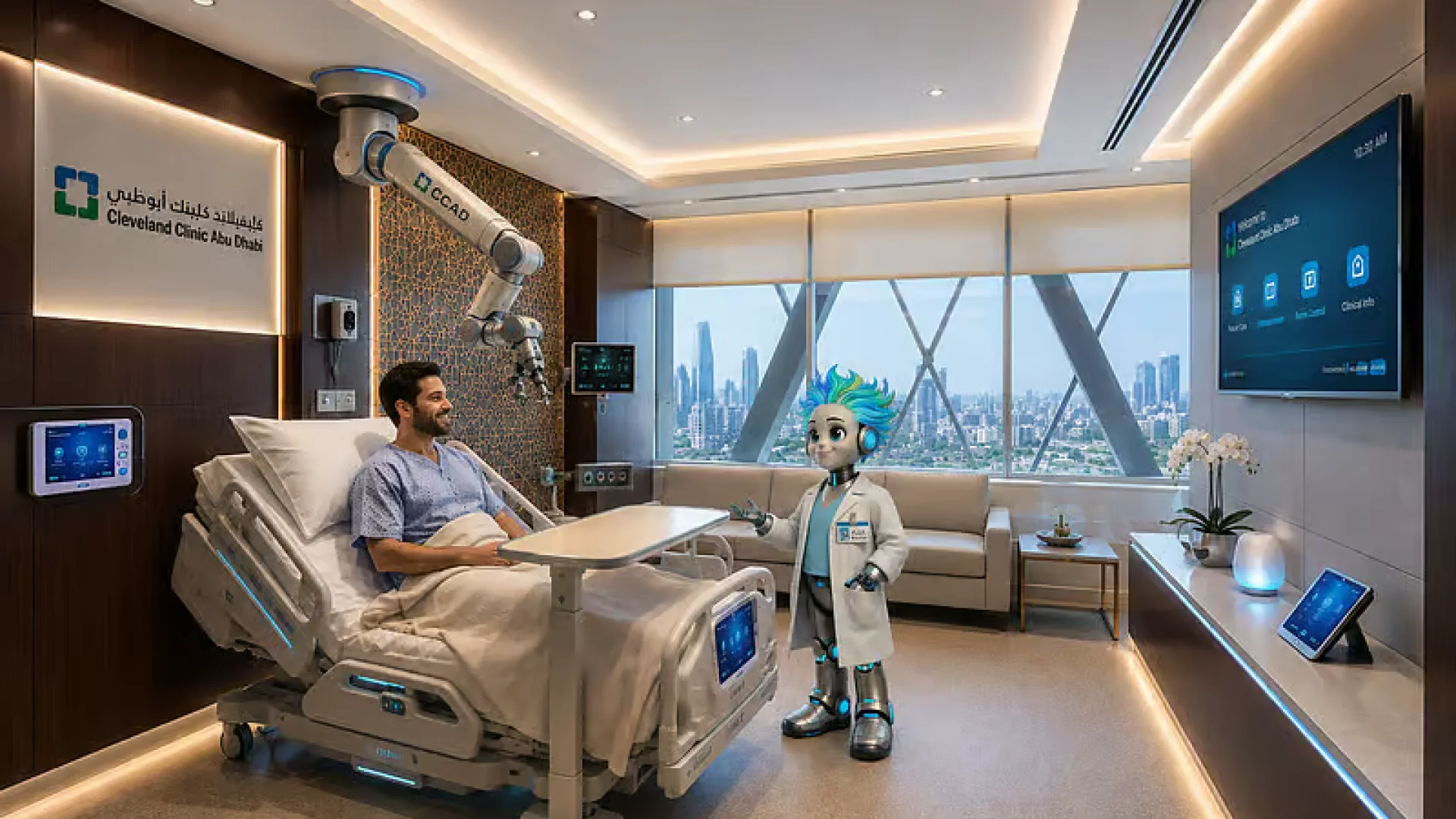

In Abu Dhabi, a new kind of colleague is joining the clinical team: “Aila,” described as the world’s first Clinical AI Scientist. Built to connect patient information with medical guidelines and research, the system helps clinicians check options quickly and consistently—turning hours of searching into minutes of structured reasoning. The ambition is assistance, not replacement: reducing cognitive load, improving documentation and standardisation, and giving staff more time for judgement and care. For a healthcare hub investing heavily in innovation, Aila is a statement about the next frontier of clinical operations.
The ward has its own soundtrack: soft alarms, rolling carts, the hush that falls when someone reads a lab result twice. Under fluorescent light, a doctor scrolls through a patient file—pages of history, medications, comorbidities, notes from three departments. The kind of case that doesn’t fit neatly into a template.
“We can’t afford to guess,” she says, not loudly, just firmly. A colleague leans in. Another opens a guideline page, then another, then another—tabs multiplying like worry.
And then, on a screen, a different rhythm appears: a structured summary, a set of options, the reasoning behind them, the references that support them. It feels less like a machine delivering an answer and more like a meticulous colleague laying out the table before a decision is made.
That colleague is called Aila. In Abu Dhabi, it’s being presented as the world’s first Clinical AI Scientist—a role designed to help doctors and clinical teams make faster, better-supported decisions.
Hospitals don’t run on ideas. They run on minutes. On shift handovers. On the fragile balance between urgency and caution. The reality is that clinicians are often forced to make high-stakes choices while juggling incomplete information, competing priorities, and a firehose of new research that no human can absorb in real time.
Aila steps into that pressure cooker with a simple promise: bring order to complexity. The system is built to connect patient data with clinical guidelines and medical research, producing suggestions that are meant to be checked, discussed and either used—or rejected—by the humans in the room.
“It’s the difference between hunting for the needle and having someone hand you the magnet,” one clinician quips in the corridor. He smiles, then adds more seriously: “You still decide. But you decide with the map open.”
Call it AI, call it a scientist, call it a breakthrough—what makes Aila notable is the way it reframes a daily clinical pain point: information overload. Medicine is not short on knowledge; it’s drowning in it. Guidelines update. Evidence evolves. Trials contradict each other. New therapies emerge. Meanwhile, every decision needs justification—clear enough for a team, a patient, a record.
Aila’s value proposition is to compress the “search-and-synthesise” phase. Instead of a clinician jumping between portals, PDFs, internal documents, and memory, the system aims to assemble the relevant pieces into a coherent chain: what the data suggests, what the guideline says, what evidence supports it, what could reasonably happen next.
Crucially, the story being told in Abu Dhabi is not replacement. It’s support. Aila doesn’t carry a medical licence; the people do. But it can carry the burden of scanning, comparing and structuring, so that clinicians can spend their energy on judgement.
There’s a difference between being fast and being hurried. In a hospital, hurried can be dangerous. The goal here is a different kind of speed: time regained.
Picture a complex patient: multiple conditions, medications that interact, symptoms that refuse to stay in one category. Traditional workflow can look like this: open guideline, cross-check dosing, check contraindications, scan recent evidence, ask a colleague, document the rationale, repeat. It’s not just time-consuming—it’s mentally expensive.
Now imagine the same moment with a structured output already on the screen: a compact summary of the case, key risks flagged, plausible next steps suggested, links to the underlying evidence. The room gets quieter. Not because the tension disappears, but because the decision becomes discussable—anchored.
“Show me why,” a junior doctor says, tilting the monitor toward her consultant. And that’s the scene that matters: not a machine commanding, but a team interrogating a recommendation, together.
Abu Dhabi has been building a reputation as a healthcare and innovation hub—investing in advanced hospitals, research capabilities, and digital infrastructure. In that context, a clinical AI role is both practical and symbolic: it signals an ambition to modernise the core of clinical operations, not just the administrative layer.
There’s another reason such tools can matter in the Gulf’s international clinical environment. Teams are often multinational. Protocols need to be consistent. Documentation needs to be clear across specialties and shifts. A system designed to surface guidelines consistently and support structured reasoning can help standardise quality—particularly when hospitals are scaling.
Aila’s “Clinical AI Scientist” label points to a wide remit: acting as a bridge between the patient in front of you and the ever-expanding universe of medical evidence.
Big technologies often arrive with loud promises. In a hospital, the most meaningful impact can be almost silent: a doctor who doesn’t have to spend half the shift searching; a consultant who can focus on judgement instead of paperwork; a team that can discuss options with more clarity; a patient who gets a fuller explanation because the clinician has time to sit down.
A nurse at the station puts it simply: “You can tell when doctors aren’t scrambling. They talk to patients more.”
It’s an unglamorous metric. But it’s the one patients feel.
For AI to truly help in clinical settings, it has to be more than clever. It has to fit. Who asks the questions? How are outputs reviewed? What gets documented? How is accountability preserved? The future of tools like Aila won’t be decided by demos—it will be decided by daily routines, training, governance and the discipline of checking.
In Abu Dhabi, Aila is being positioned as a step toward that future: faster decisions, yes—but also better-structured decisions, made in teams, with reasoning that can be understood, questioned and improved.
Clinical AI may sound like a hospital-only story, but it has direct implications for real estate and investment—especially in markets building healthcare clusters.
Abu Dhabi’s bet on tools like Aila sends a market signal: the next wave of healthcare competitiveness won’t be built only on equipment and talent—but also on the spaces, districts and infrastructure that let advanced care run smoothly, every day.