

On 31 August 2026, the new school year began for most pupils in Dubai. But how does the education system work in a city where families from all over the world live, 17 different curricula are offered and annual school fees can amount to well over €25,000 per year? A detailed overview of educational pathways, quality, costs and the most important differences compared with Germany.
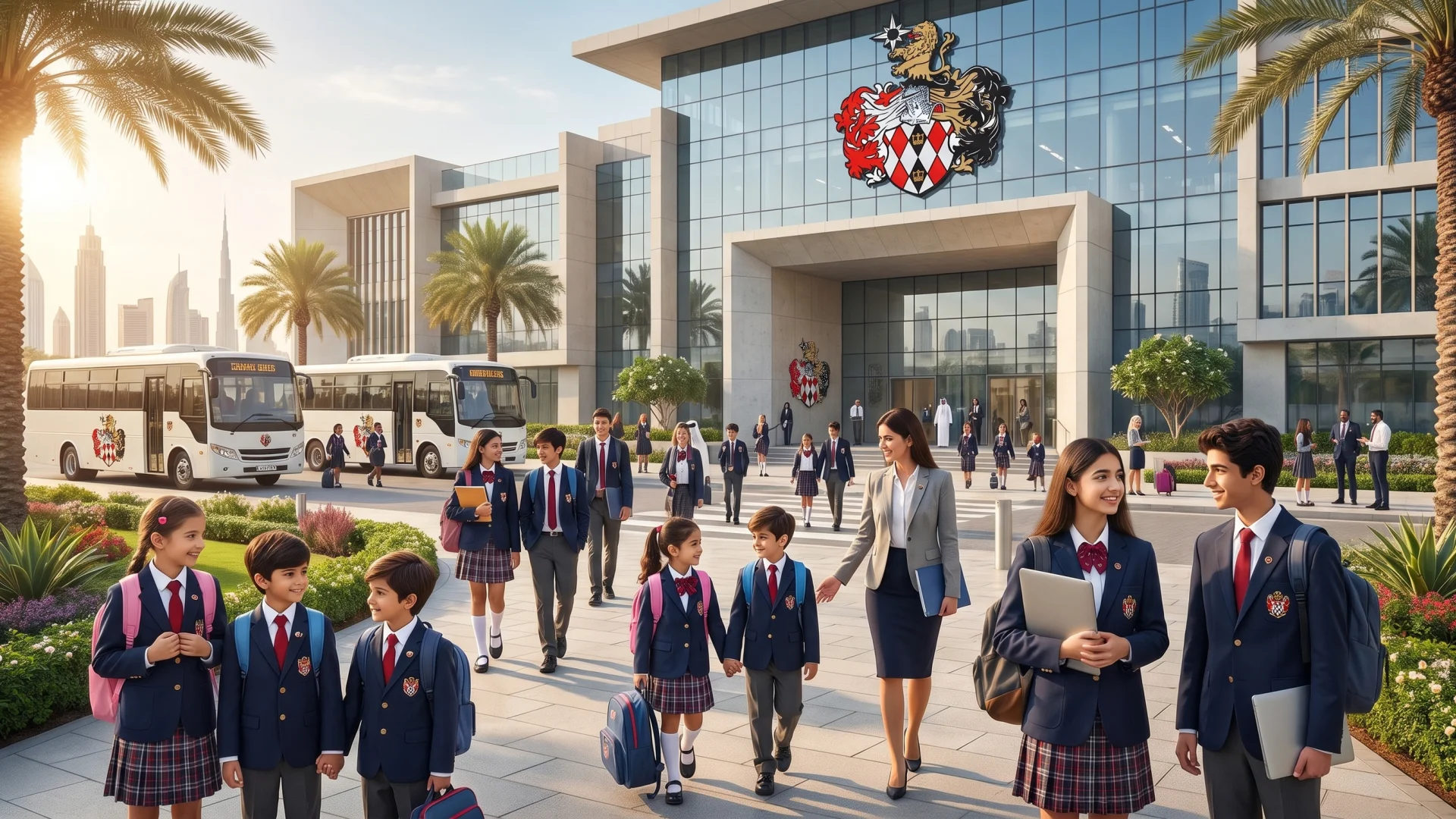
On Monday, 31 August 2026, a familiar sight returned to Dubai: yellow school buses on the roads, children in freshly ironed uniforms and parents awaiting the first day of school with at least as much excitement as their children. For a large proportion of schools, this marked the beginning of the 2026/27 academic year.
The start of school in Dubai is far more than an organisational date. It makes visible just how much the city has grown in recent years and how consistently it has evolved from an international business location into a permanent place for families to live. People moving to Dubai today are no longer coming merely for a temporary stage in their careers. Many families are planning for ten, fifteen or more years, making the question of their children’s education one of the most important location decisions of all.
Strictly speaking, however, there is no single “Dubai school system”. There is a federal framework established by the United Arab Emirates, public schools following the national curriculum and an exceptionally large private education landscape in which different international systems are offered in parallel. This diversity is precisely the location’s greatest strength, but it also makes the decision more demanding for parents than it is in Germany.
Public schools in the Emirates follow the Ministry of Education curriculum. The language of instruction is predominantly Arabic, although English plays an important role. Attendance at public schools is generally free of charge for Emirati citizens. Certain non-Emirati pupils may also be admitted under specified conditions; the official government portal currently states an annual school fee of €1,500 for them. For the vast majority of international families in Dubai, however, private schools are the norm.
Legally, compulsory education begins at primary level. For Emirati children, it applies until they complete their school education; for non-Emirati children, until the end of primary school. Parents or legal guardians must ensure enrolment and regular attendance. Kindergarten, KG1 and KG2 are therefore not subject to compulsory education in the same way, even though almost all internationally oriented families use these early stages of education.
This differs from Germany, where general compulsory full-time education applies in principle to all children and covers nine or ten school years, depending on the federal state.
These private schools are regulated in Dubai by the Knowledge and Human Development Authority, or KHDA. The authority approves schools and fees, publishes inspection reports, provides parents with concise fee fact sheets and monitors educational quality. The private sector is correspondingly large: the most recently published comprehensive KHDA landscape report for 2024/25 counted 227 private schools, 400,000 pupils and 17 different curricula. More than one-third of the children attended a school following the British curriculum.
The range is expanding again for the 2026/27 school year. Seven new private schools are creating a combined 17,000 additional places; four of the new schools follow the British curriculum and three the International Baccalaureate. There are also 17 new early childhood education centres offering more than 1,700 places. This is not merely education news, but also an indication that Dubai is expanding its social infrastructure in parallel with population growth.
In Germany, a child’s educational pathway is determined primarily by the federal state, place of residence and, later, the type of school chosen. In Dubai, by contrast, parents make a decision at the enrolment stage that can shape the child’s entire subsequent school career: Which curriculum should the child follow? The British, American, Indian and international IB curricula are particularly widespread. There are also French, German, Australian, Filipino and other national or combined systems.
This choice affects more than teaching style and language. It determines class designations, examinations, holiday schedules and the eventual school-leaving qualification. A British educational pathway typically leads through IGCSEs or GCSEs and A-Levels, an American pathway through the High School Diploma and possibly Advanced Placement courses, an Indian pathway through CBSE or CISCE and an IB pathway through the internationally recognised IB Diploma. Anyone who already knows in which country their child is likely to study should therefore plan this decision backwards from the intended route to university admission.
The educational journey can begin very early in Dubai. Private nurseries and Early Childhood Centres cater to babies and toddlers, with some facilities accepting children during their first year of life. This stage should not be confused with compulsory education in Germany. It primarily serves childcare, language acquisition, social development and learning through play. Options include the British Early Years Foundation Stage, Montessori, Reggio Emilia, French, Indian and bilingual concepts.
As in Germany, attending a nursery is not compulsory. Many families initially use a nanny, care within the family or a nursery on selected days of the week, increasing the amount of care later. Unlike Germany’s largely publicly co-funded childcare system, the costs in Dubai are generally borne almost entirely privately. Depending on the number of days, daily care hours, location and concept, several thousand euros per year may already be payable during this early stage.
For guidance, entry for new pupils in 2026/27 typically looks like this:
| Age on 31 December | International/MoE system | British system | Rough German equivalent |
|---|---|---|---|
| 3 years | Pre-KG | FS1 | Daycare/kindergarten |
| 4 years | KG1 | FS2 | Kindergarten |
| 5 years | KG2 | Year 1 | Final daycare or preschool year |
| 6 years | Grade 1 | Year 2 | First year of primary school |
The British terminology frequently causes misunderstandings among parents who have recently moved to Dubai. Under the classification used in the Emirates, British “Year 1” still corresponds to KG2, while “Grade 1” corresponds to British “Year 2”. The decisive factors are therefore not merely the name of the class, but the child’s age, the school year most recently completed successfully and the official equivalence between the curricula.
The International Baccalaureate uses the Primary Years Programme in the early stages, while the German International School Dubai offers a primary school modelled on the German system. American schools refer to Elementary School. British schools call the corresponding phase Primary School and typically continue it through Year 6.
International schools are so-called through-schools: they accompany children from kindergarten or Foundation Stage through to graduation on the same campus or within the same school organisation. This can be very convenient for families because there is no automatic move to a different type of school after the fourth grade. At the same time, parents should not assume that an educational pathway, once selected, must remain unchanged. Transfers are possible, but become more complicated as children get older, particularly when examination subjects and graduation requirements diverge.
Primary school is followed by Middle or Secondary School, depending on the curriculum. In the American system, Middle School encompasses Grades 6 to 8 and High School Grades 9 to 12. In the British system, Secondary School begins with Year 7; pupils prepare for their IGCSE examinations in Years 10 and 11, followed by Sixth Form and A-Levels in Years 12 and 13, or alternatively the IB Diploma.
There is therefore no uniform “Dubai Abitur”. Instead, the city offers pathways that provide access to education internationally. This is a major advantage for mobile families, but it requires planning. An IB Diploma or British A-Levels are recognised worldwide, yet universities set different minimum grades and subject combinations depending on the country, degree programme and institution. With American qualifications, additional AP courses, standardised tests or specific equivalency certificates may be important. Anyone considering studying in Germany at a later date should also check early on whether the chosen qualification meets the requirements for direct university admission.
For German-speaking families, the German International School Dubai is a particularly obvious option. It covers kindergarten, primary and secondary school through to the German International Abitur, teaches predominantly in German and follows the Thuringian curriculum. This can significantly simplify a later move back to Germany. However, it is also a private school and charges tuition fees accordingly.
International schools teach their respective core curricula, but must also integrate mandatory content from the Emirates. This includes Arabic, UAE Social Studies and Moral Education; Muslim pupils also receive Islamic Education. Arabic-speaking and non-Arabic-speaking children are generally taught at different levels. This preserves the international profile while also conveying the language, history, culture and values of the host country.
The language of instruction at most international schools is English. As a result, children often grow up bilingual or multilingual. The initial period can be demanding for a child who arrives in Dubai without any knowledge of English. Younger children in particular often acquire the language remarkably quickly, however; for older children, parents should specifically ask about English as an Additional Language programmes.
The composition of classes is a distinctive educational factor. Children learn alongside classmates from a wide variety of nations and experience cultural diversity not as a project day, but as part of everyday life. This can foster intercultural competence, adaptability and international networks. At the same time, a good school concept needs clear shared standards so that diversity is not merely featured in the brochure, but used meaningfully in education.
Many schools advertise modern science laboratories, robotics, coding, makerspaces, theatres, music studios, swimming pools and extensive sports facilities. This infrastructure can be impressive, but it is not automatically synonymous with good teaching. What remains decisive is whether qualified teachers use these opportunities meaningfully, measure learning progress, support children individually and create a stable, safe school community.
A blanket answer would be misleading because there are considerable differences between schools. However, the level of transparency is remarkable by international standards. The KHDA, through the Dubai Schools Inspection Bureau, assesses schools based on criteria including learning outcomes, learning progress, teaching quality, personal and social development, curriculum, inclusion, child safeguarding and school leadership. Overall ratings range from “Outstanding” and “Very Good” through “Good” and “Acceptable” to “Weak” and “Very Weak”.
International comparative studies provide strong indications. In the KHDA comparison for PISA 2022, Dubai’s private schools ranked ninth in mathematics with 497 points, 13th in reading with 498 points and 14th in science with 503 points. These are impressive results. They show that the private education sector as a whole can be internationally competitive, but they do not mean that every individual school achieves the same quality or that every child will automatically succeed in a particular system.
The Emirates pursue the principle of inclusive education for “Students of Determination”, and the KHDA assesses how schools accommodate different learning needs. In practice, however, experience, staffing levels and the therapies available vary considerably. Before signing a contract, families should therefore obtain written clarification of what support is offered, how it is organised and what additional costs may arise, for example for Learning Support Assistants.
Ideally, the search for a school should begin several months before the move. Particularly sought-after schools and entry-year groups may have waiting lists, even though the new school places are continuing to ease pressure on the market. The KHDA school database allows families to make an initial selection based on curriculum, location, fees and rating. It is then advisable to visit several schools in person, speak with the school leadership and observe lessons or break-time situations, rather than looking only at the prestigious entrance hall.
Five questions are particularly important when making a choice: Does the curriculum fit the long-term educational pathway? How good is the school at the specific age level? How stable are the school leadership and teaching staff? What are the actual total costs? And is the daily journey to school manageable for the child over the long term? An excellent school loses much of its value in everyday family life if a child spends 60 or 90 minutes on the bus each morning and afternoon.
Once an offer has been made, the place is secured by an admission payment, which is normally credited towards the first tuition fee. Parents and the school then conclude the digital Parent-School Contract, and the school registers the child in the KHDA system. Families should read the refund rules carefully: application, enrolment and re-enrolment fees are not refundable in every situation, and a school transfer can only be completed once outstanding amounts have been paid and the required leaving documents have been issued.
The honest answer is that almost every budget segment is represented. International education is a significant household expense for families. Current KHDA fee fact sheets for 2026/27 show examples ranging from an annual fee of around €1,200 in the very affordable segment to €36,000 for individual year groups at a new premium school. This is not a meaningful “average”, but the range between two entirely different educational offerings.
As a rough guide, budget-conscious schools frequently charge between approximately €1,200 and €5,000 per year, the broad mid-market segment between €5,000 and €12,000, and premium schools often between €13,000 and €25,000. A small number of top-end offerings significantly exceed €25,000. Fees increase with the child’s age because higher grades require specialist subject teachers, laboratories, examinations and smaller course groups.
The published tuition fee is also not always the full price. Additional costs include uniforms, books, a laptop or tablet, school bus transport, lunch, excursions, camps, sports and music programmes, examination fees and additional learning support. For reliable family budgeting, parents should therefore always consult the official School Fees Fact Sheet for the specific year group, rather than looking only at the headline fee on the website.
Dubai has frozen the fees of existing private schools for 2026/27; general increases are not permitted for this school year. This provides short-term planning certainty, but does not change the fact that education ties up a substantial sum over the entire school career.
This is one of the greatest differences compared with Germany. There, the majority of schools are state-funded and provide tuition free of charge; fees arise primarily at private and international schools and for childcare, meals, trips and materials. In Dubai, by contrast, international families finance their children’s schooling directly. When negotiating a salary, it is therefore crucial to establish whether the employer pays an Education Allowance, how much it provides per child and whether it covers tuition only or additional costs as well.
In both countries, the regular school phase usually begins at around the age of six. In Germany, children initially attend primary school, in most federal states from Grades 1 to 4 and in Berlin and Brandenburg through Grade 6. The educational pathway then branches into different types of school or programmes depending on the federal state and the child’s performance level. Dubai does not have this widespread early division into Hauptschule, Realschule and Gymnasium; differentiation takes place more within the chosen curriculum, through subjects, course levels and graduation programmes.
Through its public school system, dual vocational training and largely tuition-free public universities, Germany offers considerable structural stability. Dubai, in turn, offers an exceptional international selection, English-language educational pathways, frequently modern campus facilities and a high level of transparency regarding inspections and fees. One system is therefore not categorically “better” than the other. Germany is organised more strongly as a system of public services; for international families, Dubai operates predominantly as a regulated private education market.
There is no simple winner from an educational perspective either. A good German primary school can impress through experienced teachers, short journeys and social diversity. A good school in Dubai can stand out through smaller learning groups, international perspectives, extensive activities and consistent use of English. Conversely, both systems have differences in quality, teacher shortages, varying levels of leadership and schools that are a better or worse fit for an individual child.
Families who do not rule out returning to Germany should actively maintain German as a language of education. A child may speak perfect German in everyday life and still develop difficulties with spelling, academic language or literary texts if taught exclusively in English for years.
Dubai is now also expanding the stage following Grade 12 or Year 13 considerably. According to KHDA figures published in 2025, 42,050 students were enrolled with 41 private higher-education providers; 37 of these were international branch campuses. Students can therefore earn degrees from international universities without having to leave Dubai. The 2026/27 academic year will see the addition of a campus of the American University of Beirut and programmes from Peking University HSBC Business School, among others.
The selection ranges from business, engineering and computer science to media and design, psychology, law and hospitality. Nevertheless, families should examine carefully who awards the degree and in which countries, or for which regulated professions, it is recognised. “International” is a useful signal, but no substitute for checking the specific programme.
This development is significant for pupils. Dubai increasingly offers a continuous educational pathway from an Early Childhood Centre through an international school to a bachelor’s or master’s degree. Those who wish to do so can complete their entire education in one city; those who want to attend university in Europe, North America, Asia or Australia can, at the same time, find curricula designed specifically to prepare them for that step.
For a city, education is not a decorative additional service, but core infrastructure, much like safety, healthcare, transport and digital networks. An international manager or highly qualified specialist does not decide whether to relocate based solely on salary and taxes. If their children cannot obtain a reliable school place or an internationally recognised qualification, an attractive job offer can quickly be declined.
The appropriate term here is: highly qualified, well-educated and education-oriented families. A location with convincing schools attracts specialists and executives, scientists, entrepreneurs, engineers, medical professionals and other knowledge workers. This talent pool, in turn, is a strong argument for international businesses, research divisions, technology companies and regional corporate headquarters to establish themselves in Dubai or expand their presence there.
This chain generates real-estate demand on several levels. More businesses require office and commercial space. Housing, local amenities, leisure facilities and transport links are needed not only by people in executive positions, but by employees across all income groups within the growing organisations and their service providers. Good schools therefore do not automatically increase the value of every property, but they broaden a city’s long-term user base and strengthen its ability to retain families permanently.
When looking for a home, families pay attention to journeys to school, bus routes and proximity to several alternative schools. New campuses can accelerate the development of emerging residential areas; established school clusters often stabilise demand for family-friendly apartments and villas. For a sound real-estate analysis, however, merely pointing to “a school nearby” is not enough. The decisive factors are quality, curriculum, fee level, availability of places and actual accessibility.
Dubai’s school system is not simple, but it is exceptionally diverse. A child can begin learning through play at a nursery, move into Foundation Stage at the age of three or four, attend a British, American, German, Indian, French or international school and then study in Dubai or almost anywhere in the world. This freedom of choice is a privilege.
The most important conclusion is therefore this: A good school experience is not determined by the most prestigious building, the highest fee or the best-known name. What matters is the combination of proven quality, a suitable curriculum, stable teaching staff, meaningful support, manageable costs and an everyday routine that also works outside school.
The start of school on 31 August therefore represents more than new timetables and uniforms. It shows that Dubai is not only creating jobs, growing businesses and developing real estate; it is also building a complete urban living environment. Whether this environment is right for a particular child remains an individual decision. The fact that families can now choose between numerous educational pathways offering international progression is, however, one of the strongest arguments for Dubai as a permanent place to live.