
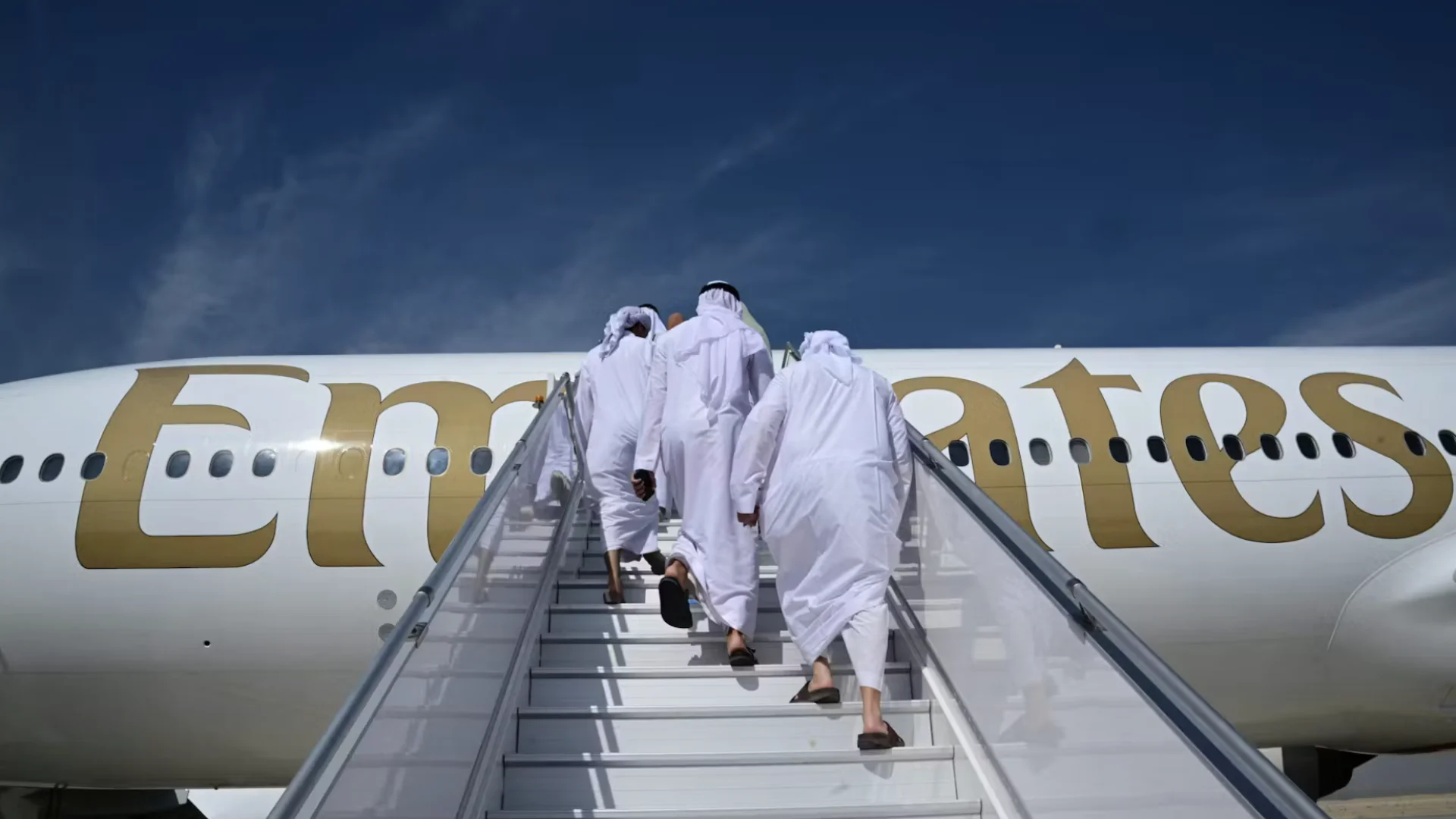

At Berlin Brandenburg Airport, the dream is written between the gate announcements: a direct Emirates link that would plug Berlin into Dubai’s global hub. Supporters see faster access to Asia, Africa and Australia, more business travel and a stronger international profile for the capital region. But from Hesse—home to Frankfurt’s powerhouse hub—comes fierce resistance, warning of distorted competition and a drain of lucrative long-haul traffic. What looks like a single route is, in reality, a tug-of-war over traffic rights, market power and the future map of Germany’s intercontinental connections.
The morning at BER has its own rhythm. Wheels on stone. A thin line at security. The hiss of the espresso machine behind the counter. People speak in half-sentences—“Gate changed,” “Where’s row 12?”—and the airport replies with beeps and blinking screens.
Look up at the departures board and you’ll see the familiar geography of European city breaks. Then you notice what isn’t there. No long-haul promise in bold letters. No “Dubai” that turns heads and shortens conversations.
“That would be a game changer,” a passenger says quietly, scrolling through a flight search on his phone. “One connection less. And suddenly the world opens.”
Emirates is more than a carrier—it’s shorthand for global reach. Dubai is one of those airports that doesn’t just receive flights; it redistributes the world. Land there and you can keep moving: Mumbai, Bangkok, Nairobi, Sydney. For Berlin, a direct BER–Dubai service would function like a new artery—less about tourism alone, more about connectivity, business velocity, and the city’s self-image as a capital that belongs on the intercontinental network.
Inside the airport ecosystem, that kind of route has a magnetic effect. It attracts transfer logic, premium passengers, cargo capacity in the belly of wide-body aircraft, and—perhaps most importantly—attention. In aviation, attention is a currency.
Just as the idea gains heat around Berlin, a colder air mass moves in from Hesse. Frankfurt Airport—Germany’s dominant hub—sits there like a fixed star in the national system. And fixed stars don’t love sudden new constellations.
The pushback is forceful: additional rights for a Gulf carrier are portrayed as a threat to existing structures, to competition on long-haul routes, and to the economic gravity Frankfurt has built over decades. The fear is not only symbolic. Hubs live on concentration. Pull even a small share of long-haul demand toward another airport and the system starts to shift: fewer feeder flows, fewer transfer passengers, altered airline economics.
In short: what Berlin calls “catching up,” Frankfurt may experience as “leakage.”
From the outside, it feels simple: an airport courts an airline, an airline launches a route, travelers cheer. But long-haul flying is stitched together by something far less romantic—bilateral air service agreements, negotiated capacities, and traffic rights that often require political approval or careful reallocation.
That’s where the debate sharpens. Supporters argue Berlin deserves direct links befitting a capital region with growing tech, science, culture, and conference activity. Critics argue the national interest lies in protecting the hub that already connects Germany to the world at scale—and in preventing what they see as unfair competitive advantages for certain carriers.
BER is still a young airport with a long shadow. Its opening came after years of delay, headlines, and public frustration. Every step forward now carries a subtle undertone of redemption. A long-haul route—especially one with the international glow of Emirates—would be a milestone people can immediately understand. It’s not a technical KPI. It’s a destination you can point to on a map.
And Berlin, as a brand, thrives on immediacy. The city’s economy is increasingly international in its clients, talent, and investors. Yet its air links often funnel through Frankfurt, Munich, Amsterdam or Doha. A direct Dubai connection would shorten not only travel times but also the psychological distance between Berlin and fast-growing regions.
Across Europe, Gulf carriers have long been a lightning rod. Critics talk about state backing and tilted playing fields. Supporters talk about consumer choice, quality, and the reality of global demand. In Germany, the argument tends to flare up whenever additional frequencies or new airports enter the equation.
That’s why the discussion around BER and Emirates quickly becomes bigger than Berlin. It turns into a proxy battle over what kind of aviation market Germany wants: one concentrated around a single mega-hub, or one that allows more long-haul routes to emerge in other metropolitan regions.
Whether Emirates actually lands at BER depends on a chain of decisions that reach beyond airport marketing. Negotiations over rights and capacities matter. Political willingness matters. Lobby pressure matters. And the airline’s own network logic matters: aircraft availability, profitability, slot coordination, and demand forecasts.
On the passenger level, the idea remains beautifully simple: direct is better than indirect. On the system level, it’s a struggle over who gets to host the long-haul future.
Back at BER, the screen flickers. Another short-haul flight begins boarding. A family argues gently about snacks. A business traveler taps out an email with one thumb.
Dubai still isn’t listed. But the conversation is. And in airports, conversations are often the first sign that the map is about to change.
For real estate investors, a potential Emirates long-haul link at BER is not just an aviation headline—it’s a signal about international accessibility, which can translate into occupier demand, pricing power, and development momentum over time. Direct intercontinental connectivity tends to matter most for sectors that monetize speed, reliability and global reach.
Office & corporate locations: If Berlin gains a stable, high-quality connection to a global hub like Dubai, it strengthens the city’s proposition for EMEA/APAC-facing firms—especially in professional services, tech, research collaborations and scale-ups that travel frequently. That can support demand for Grade A offices and flexible space, including in submarkets with strong airport links (the southeast corridor, Adlershof, and nodes with fast rail access).
Hospitality (hotels, serviced apartments): Long-haul passengers over-index on overnight stays—arrivals late, departures early, crew rotations, and multi-day business trips. A new long-haul route can lift occupancy and average daily rates, with the most direct impact in airport-adjacent micro-locations and well-connected city districts. Serviced apartments and long-stay concepts may benefit if international project teams increase.
Logistics & light industrial: Wide-body passenger flights often add meaningful belly-cargo capacity. Better access to Dubai’s cargo ecosystem can support industries that rely on high-value, time-sensitive shipments. Investors should watch for knock-on effects in last-mile logistics, cold chain capacity, and light industrial demand—balanced against land constraints, permitting timelines and transport infrastructure.
Residential implications: The housing impact is more indirect, but stronger global connectivity can amplify international hiring and longer stays, boosting demand for high-quality rentals and furnished units. At the same time, airport proximity introduces noise and traffic considerations; winners tend to be neighborhoods that combine accessibility with livability rather than those in immediate flight-path exposure.
Risk framing: The political resistance from Hesse highlights execution risk. Investors should model the route as upside rather than baseline—until rights, frequencies and long-term commitment are secured. Even without the route, Berlin’s fundamentals (population, science, public sector, culture, tech) remain the core demand drivers; with it, certain segments—hospitality, flexible offices, mixed-use near airport-linked nodes—could see a measurable tailwind.