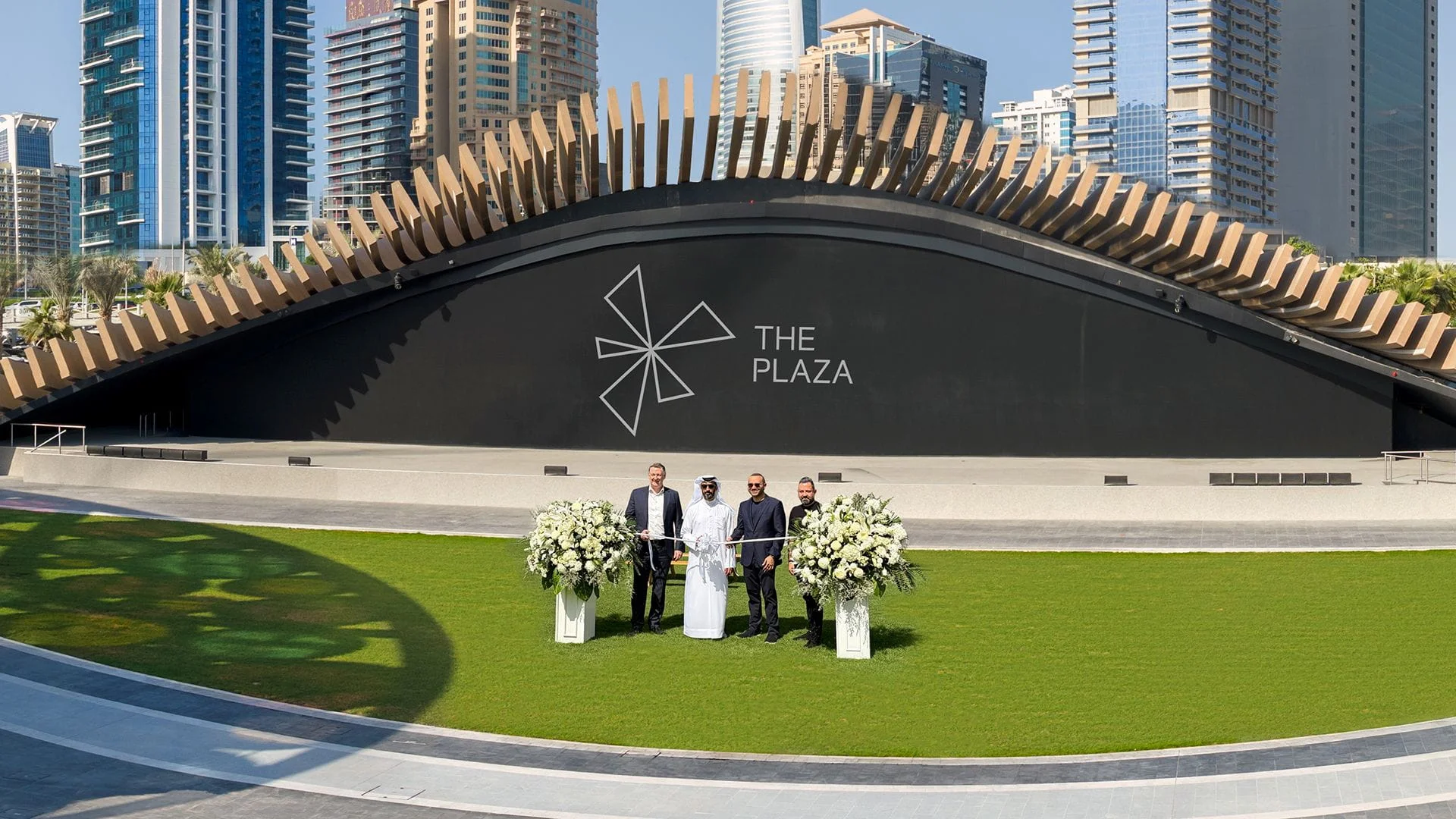
In Uptown Dubai, DMCC has unveiled The Plaza—an open, public-facing centerpiece designed to turn a fast-growing district into a place people actually linger. The new space brings together hospitality, seating and walkable connections at the base of the towers, with a clear intention: daily life, not just business hours. Positioned as the next phase in Uptown Dubai’s evolution, The Plaza is set to host activations and events that help the neighbourhood build rhythm and identity. It’s a small shift in footprint, but a big shift in feeling—ground-level energy that makes a district memorable.
You notice it before you see it. The sound of a coffee spoon tapping porcelain. A quick burst of laughter. Footsteps that slow down—on purpose. Between the vertical drama of Uptown Dubai’s towers, something new has appeared at ground level: a pause. DMCC’s newly opened The Plaza doesn’t announce itself with a billboard-sized statement. It does something more disarming. It invites you to stay.
There’s a particular kind of emptiness that can haunt brand-new districts—beautiful, expensive, and strangely silent. The Plaza feels like an antidote. People drift into it the way they drift into a good street café: not because they have to be there, but because it makes sense to be there. “Two minutes,” someone says into their phone, and you can almost hear their schedule softening.
DMCC—widely known in Dubai for building one of the region’s most dynamic free zones and business communities—has framed the opening of The Plaza as the next step in Uptown Dubai’s growth. The message is straightforward: a district isn’t complete when the towers rise; it’s complete when the ground starts to live.
The Plaza is designed as a public realm anchor—an open, accessible centre where residents, professionals and visitors can cross paths naturally. It’s not just a walkway between destinations. It’s the destination in between: the place you meet before dinner, where you decompress after a meeting, where the day can be extended by a simple, unplanned “Let’s sit here.”
Look closely and the logic becomes visible. Seating isn’t treated like leftover furniture; it’s arranged like an invitation. Edges are softened. Movement is intuitive. And hospitality—cafés, dining, the easy promise of something cold or something warm—sits at the core of the experience. In modern mixed-use districts, food and drink aren’t accessories. They’re the pulse. They generate repetition, and repetition creates belonging.
That’s the bet DMCC is making with The Plaza: that a strong everyday offer will turn Uptown Dubai from a place people pass through into a place people return to. A district needs its rituals. Morning coffee. A casual lunch. A post-work meet-up. These tiny habits are what give urban spaces their stickiness—and their value.
Openings like this can look ceremonial from the outside, but the real impact is operational. DMCC has positioned The Plaza as a platform for activations and events—programming that keeps the space animated beyond peak office hours. This matters in Dubai, where the difference between a “successful development” and a “loved neighbourhood” often comes down to how well the public realm is curated.
At the base of tall buildings, the ground level is where reputation is made. If it feels welcoming, people talk. If it feels empty, they move on. The Plaza is an intentional move toward that welcoming feeling: a human-scale counterbalance to the skyline-scale ambition.
Everyone will read the space differently—some as a meeting point, others as an after-hours lounge, others simply as a pleasant shortcut with better light. But DMCC’s purpose comes through clearly: build a public heart that can carry daily life. In practical terms, The Plaza delivers:
As the afternoon light drops and the towers throw longer shadows, The Plaza feels like a scene that will keep changing. A plaza is never finished on opening day. It’s finished when people claim it—when the same faces reappear, when meet-ups become routine, when a district finally gains that intangible thing: mood.
For property markets, a high-quality public realm is more than aesthetics—it’s performance infrastructure. A well-activated plaza can lift a district’s perception, increase dwell time, and support the trading strength of ground-floor retail and F&B. In mixed-use environments like Uptown Dubai, that ground-level vitality can improve office leasing appeal, reinforce residential pricing power, and reduce the risk of single-peak occupancy patterns (busy only during work hours, quiet the rest of the time). For investors, DMCC’s visible progress and emphasis on programming are also maturity signals: they suggest a move from delivery to lived experience—often a key ingredient for more resilient, long-term demand.