
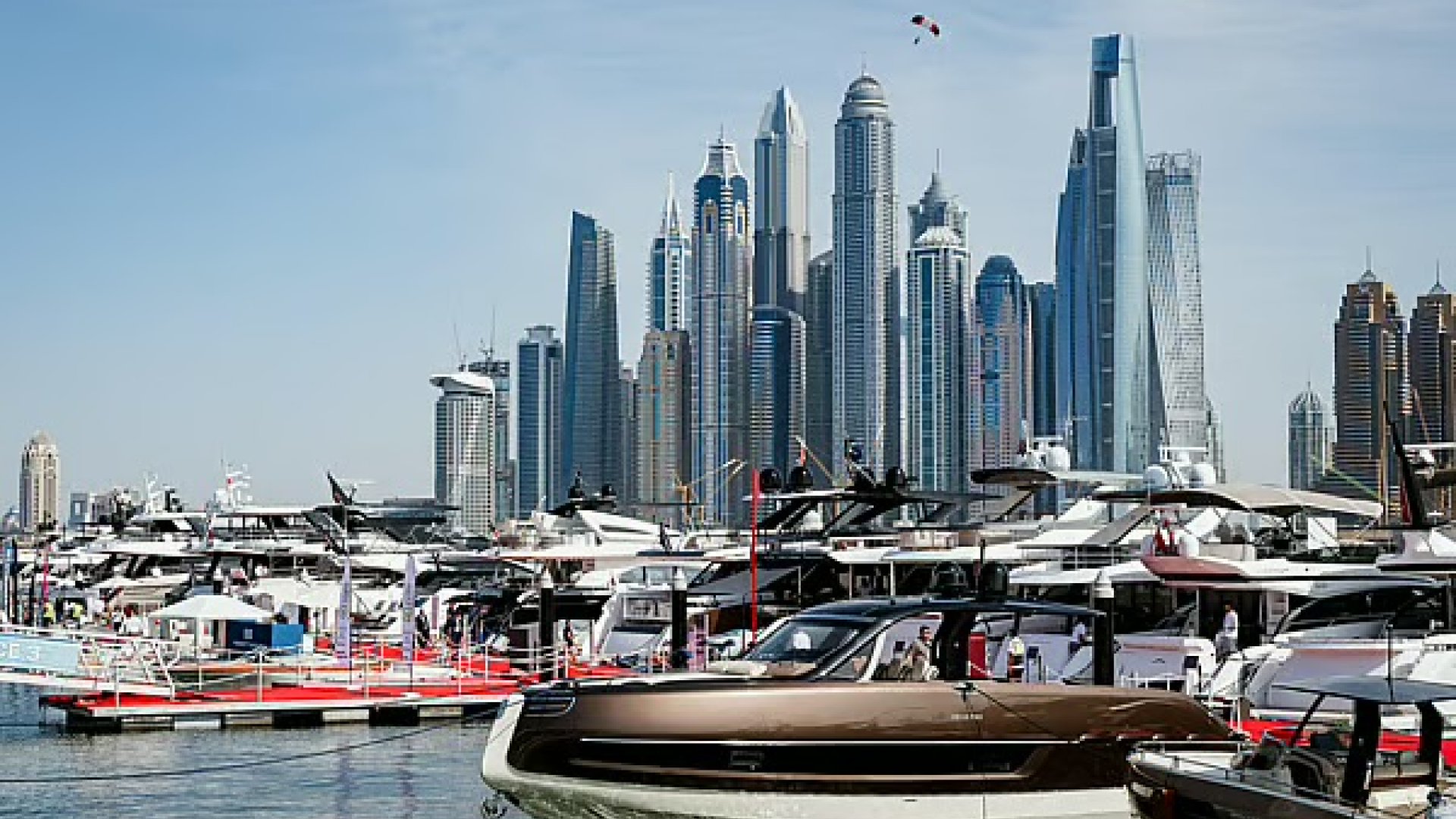

You ease into the berth as the city turns gold—then hear the words every skipper loves: your moorage is free if you dine ashore. Dubai’s new “Dock & Dine” programme connects participating restaurants with approximately 20 marinas, offering complimentary short-term berthing for guests who come in by boat. Conditions vary by location, but the logic is consistent: arrive by water, step straight into dinner, and skip the usual mooring fee. It’s a small perk with big intent—energising marina footfall, boosting waterfront F&B, and reinforcing Dubai’s identity as a city built not just beside the sea, but on it.
The engine drops to a hush, the kind that makes you notice everything else.
Water tapping the hull. A distant bassline from a terrace. Cutlery clicking like tiny wind chimes. Dubai, at dusk, doesn’t simply light up—it performs. Towers shimmer, the promenade gathers a gentle crowd, and your bow slides between finger pontoons as if the marina is guiding you in on invisible rails.
“Easy… easy… hold.” A dockhand’s voice floats across the gap. A line is tossed. A cleat catches. And right on cue, the thought arrives—What’s the damage for an hour or two?
Then comes the surprise: if you’re dining here, your moorage is free.
Dubai’s new initiative, branded “Dock & Dine,” is as crisp as a well-folded napkin. Arrive by boat at a participating marina. Go to a partner restaurant. In return, receive complimentary moorage for a defined time window—details depending on the venue and marina, but the proposition staying neatly intact. It turns an evening out into a seamless waterfront ritual: glide in, step off, sit down.
According to the reported plan, the programme spans around 20 marinas across Dubai, each tied into a set of restaurants along their promenades. The goal isn’t subtle. Marinas want movement and visibility. Restaurants want tables filled, especially with guests who arrive in groups and order like the night is a celebration. Dubai wants its waterfront to feel alive—less like a backdrop, more like a living room.
There’s a particular luxury in arriving by water that has nothing to do with the price of your boat. It’s the way the city meets you at human speed. No circling for parking. No valet queue. No tense glance at the meter. You step off the deck and—almost ridiculously—you’re already there.
The promenade smells of salt and citrus and grill smoke. A hostess stands framed by warm light. You can hear the room before you see it: laughter rolling out in waves, a brief burst of applause from a birthday table, the soft thud of a cocktail being set down.
Behind you, your yacht rocks gently, tethered like a patient animal. In most cities, that patience costs money by the minute. Here, it’s bundled into the meal.
Marinas are more than infrastructure; they’re psychology. Fees are friction. Even modest charges can turn a spontaneous plan into a spreadsheet moment—Is it worth it just for dinner? By removing the mooring fee for dining guests (within set conditions), Dubai makes spontaneity cheaper, and therefore more likely.
And once spontaneity enters the room, it tends to stay a while. A table orders dessert instead of splitting one. A second round appears. Someone suggests a slow walk along the water after dinner—“Let’s just stretch our legs.” The evening expands. That expansion is exactly what waterfront districts are designed for: time spent, not merely money spent.
Dubai has been steadily teaching residents and visitors to read the city in two dimensions: roads and water. Canals, marina basins, and sheltered berths aren’t just pretty—they’re pathways, arrival points, and stages for the city’s most photogenic moments.
With roughly 20 marinas involved, Dock & Dine signals scale. This isn’t a single flagship perk for a single elite corner; it’s an attempt to normalise the idea that a boat is a practical way to arrive for dinner. Today one marina, tomorrow another—each with its own vibe: family-friendly terraces, late-night lounges, crisp white-tablecloth dining where the waterline feels like part of the décor.
Every boater has the same set of questions, asked in the same tone—half hopeful, half suspicious. How long can I stay? Do I need to book? Is there a minimum spend? What if it’s busy?
Dock & Dine doesn’t erase the need for rules, but it reframes them as service. The specifics vary by marina and restaurant—time limits, validation methods, berth availability, and potential minimum spend thresholds. The common thread is that your dining plan becomes your docking permission.
There’s an unspoken truth about boats at a marina restaurant: they make the place feel real. Not themed. Not staged. Actual. A yacht tied up outside is like a moving prop that proves the waterfront isn’t decorative—it’s functional.
For restaurants, that matters. A lively dock is the best kind of signage. It says: something is happening here. People are arriving, not merely passing by. And the guests who arrive by boat often arrive with momentum—friends in high spirits, visitors who want a “Dubai night,” families turning a meal into a memory.
For the city, it’s the sort of lifestyle loop Dubai loves to build: movement generates energy, energy attracts people, people justify more investment in the experience.
On paper, free moorage sounds like a giveaway. In practice, it’s a trade: the marina discounts a cost to unlock spending elsewhere on the waterfront. It’s also a bet on behaviour. If boaters start choosing restaurants based on ease of docking—and if diners start choosing marinas because they feel alive—then the whole district benefits.
You feel that logic in the little moments. The dockhand who gestures toward the promenade like it’s your living room. The quick nod from a captain at the next berth, as if you’re part of the same informal club. The way the terrace seems closer when you’ve arrived by water—because you have. You’ve earned your seat by steering into it.
Later, when you step back onto the deck, the city looks different. Not bigger. Closer. And your boat is still there, waiting, without a meter ticking in your head.
For investors, Dock & Dine is more than a marina promotion—it’s a measurable push to activate waterfront real estate. Programmes that increase dwell time and repeat visitation can strengthen the fundamentals of mixed-use marina districts: retail turnover, restaurant revenues, and ultimately rental performance and asset values.
1) Stronger ground-floor economics in marina districts. Waterfront developments rely heavily on F&B and experiential retail to animate promenades. By lowering the “cost of arrival” for boaters, Dock & Dine can raise high-spend visitation during peak dining hours. That supports tenant sales, reduces vacancy risk, and improves lease negotiations—especially where turnover rent or revenue-sharing exists.
2) Premium reinforcement for residential near marinas. Lifestyle amenities become more valuable when they’re actively used. A marina that feels busy—boats coming and going, terraces full—adds intangible but powerful desirability to nearby apartments and serviced residences. Over time, this can underpin pricing premiums for waterfront views, walkability to dining, and a “resort-at-home” narrative.
3) Competitive differentiation for developers and operators. In a market with many waterfront addresses, operational programming matters. Dock & Dine functions as a place-branding tool: it turns “we have a marina” into “you can arrive by boat for dinner, effortlessly.” That’s an advantage for mixed-use projects seeking higher-quality tenants and stronger visitor flows.
4) Marina assets: diversification beyond berthing fees. The model hints at a broader revenue strategy for marina operators: treat berths as a gateway into a wider ecosystem—restaurants, events, memberships, concierge services. For investors evaluating marina-linked income, cross-tenant partnerships can smooth seasonality and reduce reliance on a single fee line.
5) What to watch (risk and scalability). The investment upside depends on execution: berth capacity at peak times, clear time limits, verification mechanisms, and customer experience. If managed well—ideally with digital validation and reservation logic—the programme can scale across locations without frustrating long-term berth holders or walk-in diners.
Investor takeaway: Dock & Dine is a micro-policy that can move macro metrics—footfall, spend, and brand power—within Dubai’s marina clusters. For investors screening waterfront assets, favour districts where marina operations, F&B curation, and public-realm programming work together to keep the promenade busy long after sunset.