
You feel it before you read it: fuller trains, busier lobbies, more “available today?” messages flying between agents and tenants. Dubai has now crossed the 4 million resident mark, and its real estate market has chalked up more than Dh900 billion in property deals in a record-setting year. The numbers point to momentum across the spectrum—off-plan launches, resale transactions, and headline luxury—powered by sustained population inflows and the city’s global pull. For buyers, renters, developers and investors, it’s a clear signal that Dubai isn’t just trading fast; it’s expanding structurally, with real implications for pricing, rents and strategy.
The first clue isn’t a statistic. It’s the elevator.
In a Downtown tower, the doors keep sliding open like they’re breathing—ding, step in, shoulder to shoulder, a polite half-smile, a glance at the floor buttons. Someone carries a laptop bag. Someone else has a stroller. A delivery rider checks his phone, thumb moving fast. The building is awake, and it’s not even nine.
Dubai has crossed 4 million residents, and suddenly the city’s everyday scenes—packed metro platforms, crowded café queues, overbooked viewing schedules—feel like evidence. At the same time, the property market has delivered a number that lands with a thud: more than Dh900 billion in real estate deals in a record year. Not a warm headline. A hot engine.
“Four million” sounds clean on paper. In real life, it’s messy and vivid. It’s traffic that thickens earlier in the afternoon. It’s a receptionist who has learned to pronounce names from five continents. It’s a school tour where parents ask the same question in different accents: “Do you have places for September?”
Dubai has always been a city that grows in leaps—new districts, new bridges, new skylines appearing as if someone pressed a fast-forward button. But crossing a population milestone changes the tone. It suggests scale. Staying power. A deeper pool of talent and tenants, customers and capital. The kind of mass that turns a boomtown into a full-fledged metropolis.
Try to imagine Dh900 billion. It slips out of your hands. So picture it instead as doors opening: one after another, across thousands of transactions. A studio bought as a first foothold. A family upgrading to a two-bedroom near a school. A penthouse sold with a view so wide it feels like weather.
This record deal value is a signal that activity isn’t limited to one glamorous corner of the market. Yes, Dubai’s luxury segment is loud—its villa sales and trophy apartments make great copy. But the real force is breadth: off-plan buyers lining up for new launches, end-users moving within the city, investors comparing yields and service charges with the seriousness of accountants.
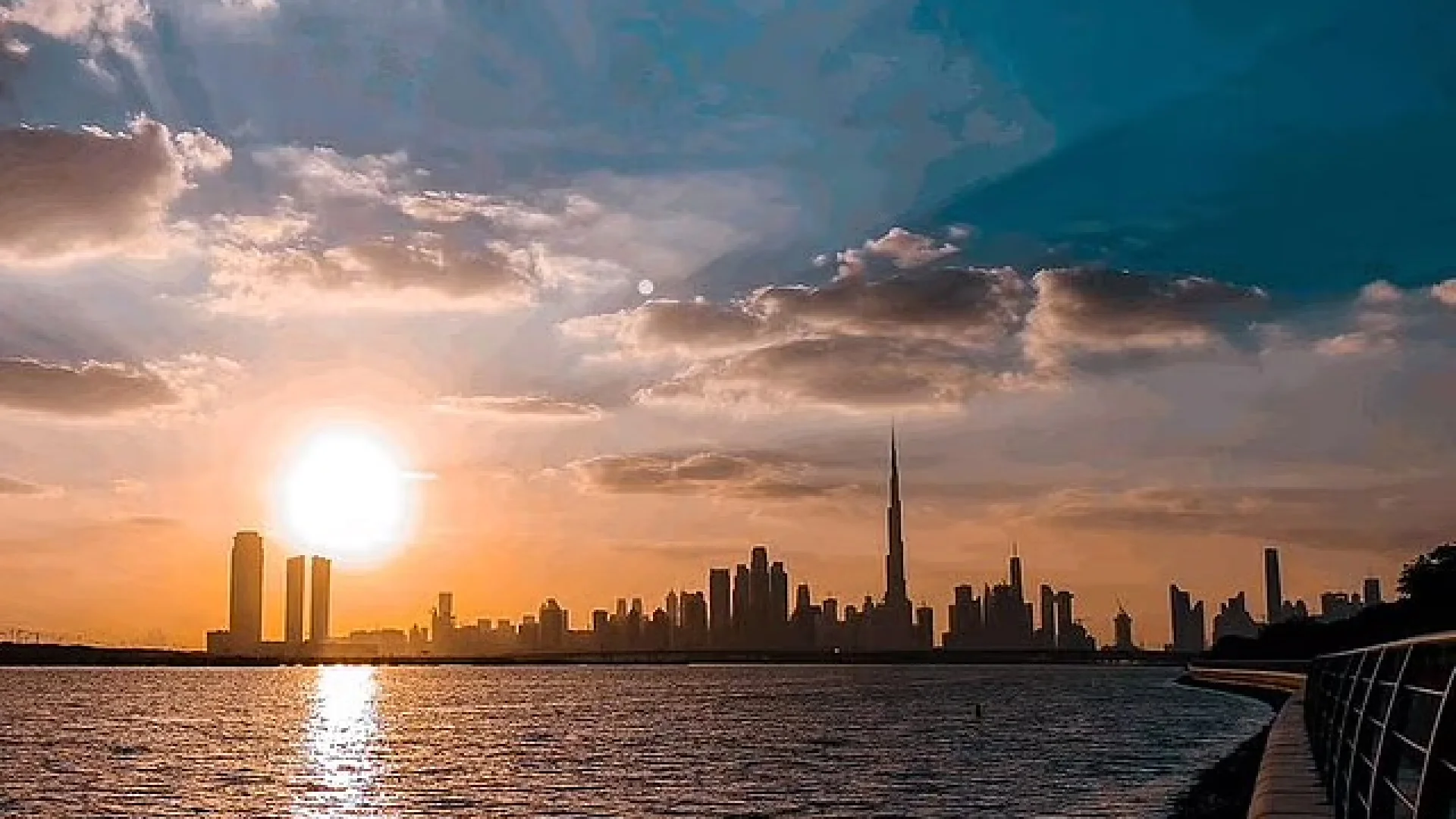
Walk along the water in Business Bay at dusk and you’ll understand why the numbers add up. The skyline is a row of lit-up promises. Joggers pass with earbuds in. A couple leans on the railing, scrolling through listings like they’re choosing a restaurant. Behind them, a crane holds still in the last light, as if pausing to listen.
“We’re seeing it every day,” an agent tells me, tapping his screen. “New inquiries. New faces. People want to be close to work, close to the metro, close to life.” He pauses, then adds, almost like a confession: “And they want to move quickly.”
That speed—of decision-making, of transaction flow—has become part of Dubai’s property identity. But the deeper story this year is not just velocity. It’s volume, and the population context behind it.
When a city gains residents, the first market to feel it is rentals. New arrivals rarely buy on day one. They rent, they learn neighborhoods, they test commute times, they ask colleagues where the good supermarkets are. Then, sometimes, they buy.
That sequence matters. It means population growth can tighten occupancy, put upward pressure on rents in sought-after areas, and—crucially—create a clearer investment narrative for income-focused buyers. The Dh900+ billion in deals tells us money is already moving. The 4 million resident threshold tells us the tenant base is expanding too.
The record year is built from many different “yes” moments: a hand hovering over a reservation form in a developer showroom; a buyer on a video call saying, “Show me the balcony again”; an investor asking the blunt question—“Net yield after service charges?”
Across Dubai, transactions span:
What ties these together is confidence—partly in the city’s direction, partly in its ability to absorb growth. Four million residents implies demand isn’t a one-season phenomenon. It’s a pipeline of households, each needing space, choosing locations, making trade-offs.
In a bright, staged apartment—white sofa, a bowl of green apples that no one will eat—two potential tenants stand by the window. One points to the road below. “How loud is it at night?” The agent answers without blinking: “Close the balcony door and it’s fine.”
Then the real question: “What’s the best you can do on the rent?”
This is Dubai in miniature: negotiation, urgency, options. But it’s also a reminder that the market is not a monolith. Every district has its own rhythm. Every building has its own reputation. And in a record year, differentiation matters more than ever.
Crossing 4 million residents doesn’t just mean more people—it means more layers. More competition for well-located units. More demand for transport links and community retail. More pressure on developers to deliver quality, not just quantity.
For end-users, that can mean tougher choices: pay more for proximity, or commute longer for space. For investors, it can mean a clearer runway for occupancy—but also a need to be sharper about supply risk, service charges, and the true durability of a location.
After dark, Dubai looks like it’s plugged into a socket. Towers sparkle. The sea is a black sheet with scattered lights. In a café, someone scrolls through property photos—kitchen, lobby, pool, the same familiar sequence—then stops on a balcony shot.
“This one,” he says quietly, like he’s choosing a future.
Four million residents. Dh900 billion in deals. The numbers are huge, yes—but the city is built from these small moments: a choice, a signature, a key placed in a palm.
For investors, the combination of population expansion (4+ million residents) and record transaction value (Dh900+ billion) is a dual signal: demand fundamentals are broadening while market liquidity remains strong. Population growth typically supports rental absorption—especially in transit-connected and employment-adjacent districts—while high deal volume suggests a deep buyer pool and more reliable price discovery.
Key implications to consider now:
Overall, the milestone reinforces Dubai’s shift from rapid-growth story to scale story: a larger resident base underpinning occupancy, and a high-turnover market offering entry and exit options—provided investors stay disciplined on asset selection and cashflow assumptions.