
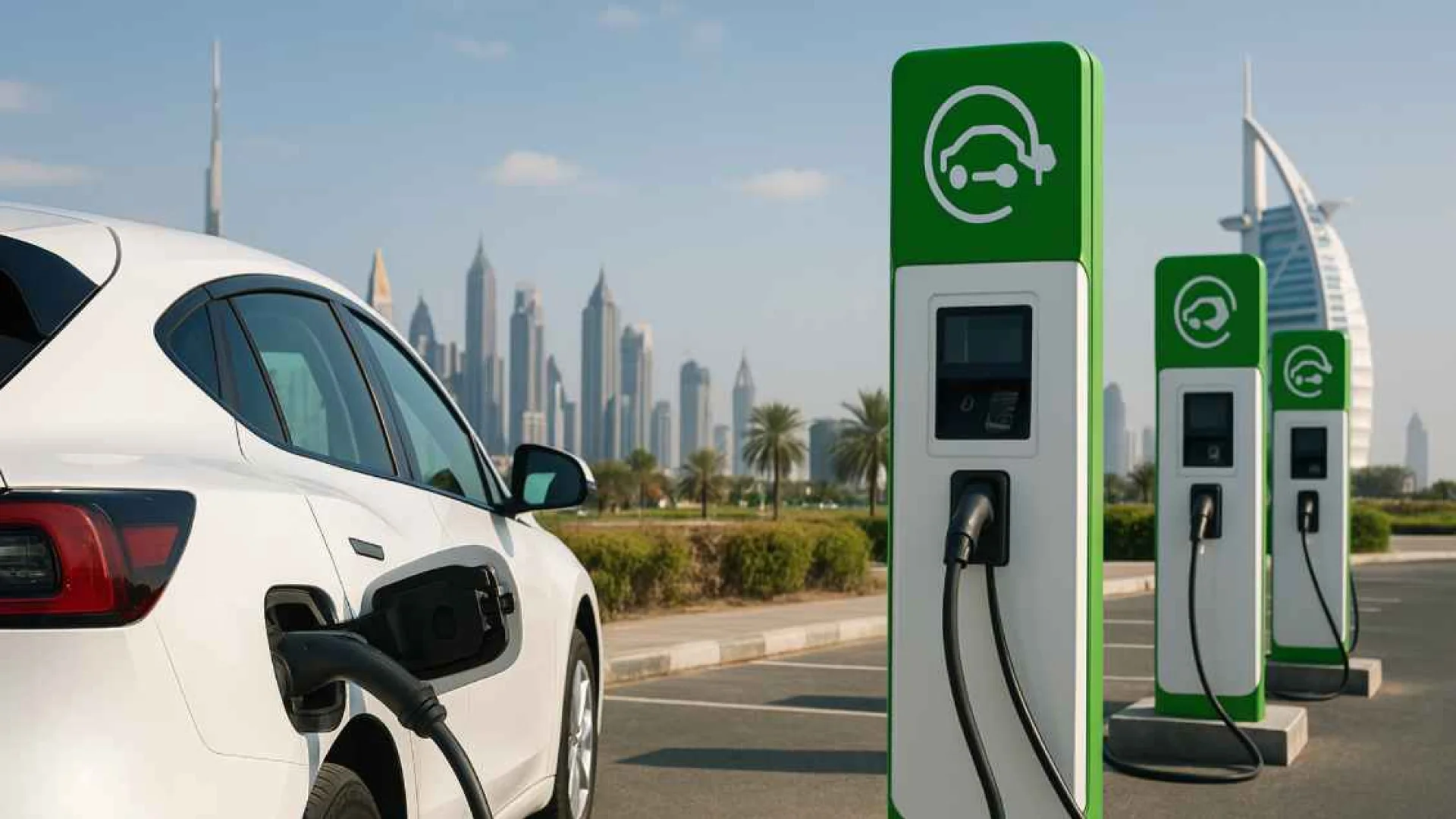

A beach day in Dubai is about to come with an extra kind of convenience: plug in, walk off, and let the car quietly refill while you live your life. The city is set to install roughly 600 new EV charging stations in parks, along beaches and across leisure and recreation areas—bringing charging closer to where residents and visitors actually spend their time. The move is designed to ease everyday charging pressure, cut detours, and make electric driving feel normal in the city’s most-loved public spaces. It also reinforces Dubai’s wider push toward cleaner, future-ready mobility infrastructure.
The sand is still warm when the sun starts to drop behind the skyline. You can hear it before you see it: the soft roll of wheels on the promenade, the slap of flip-flops, the hush of waves. A family drags a cooler across the boardwalk. A runner stops to stretch. And near a row of palms—almost blending into the street furniture—a charging post gives off a small, confident glow.
Click. A cable locks in.
“Nice,” someone says, as if they’ve just found an empty bench with a view.
That’s the point. Dubai’s next EV charging expansion isn’t trying to feel like an industrial service area. It’s moving into the places people love: parks, beaches, and recreational zones. According to the plan, the city will add around 600 new EV charging stations across these public spaces—turning charging into something you do almost accidentally, while you’re busy living.
For many drivers, the hardest part of going electric isn’t the car—it’s the choreography. Where do you charge? When? Do you need to drive out of your way, sit in a parking structure, watch the minutes tick by, scroll through apps hoping a slot frees up?
Dubai’s answer is simple: stop asking people to revolve around charging. Bring charging to the rhythm of the city instead.
Parks and beaches are perfect for that. They’re not quick in-and-out errands; they’re places where time naturally stretches. A walk around the lake. A kids’ playdate. A coffee after a swim. A sunset cycle. Those are the little windows where an EV can quietly gain range without demanding your attention.
Public leisure spaces are where a city reveals its daily habits. In Dubai, they’re packed—especially in the early mornings and late afternoons when the temperature finally softens. A beach promenade isn’t just a tourist postcard; it’s a routine. A park isn’t just greenery; it’s a social hub, a fitness track, a weekend meeting point.
Placing chargers there is a design choice as much as a mobility choice. It says: this is infrastructure, yes—but it’s also part of quality of life.
And it quietly addresses a real urban issue: not everyone can install a home charger. In a city of high-rise living, rented apartments, shared parking and frequent moves, home charging can be complicated. Public charging in the places people already visit becomes a bridge—sometimes the bridge—to EV adoption.
A man walking his bike slows down and points at the post.
“Is that new?” he asks.
A nearby attendant nods, eyes still on the flow of people. “More are coming. In the parks too.”
The man smiles, not because it’s flashy, but because it’s practical. It’s the kind of update that makes tomorrow easier.
“Six hundred” sounds like a headline number—big, neat, easy to repeat. But its real impact is felt in the gaps it fills. Charging infrastructure works like streetlights: the difference between a few and enough is everything. Enough means you stop planning your life around it.
More chargers spread across leisure zones can:
The effect is psychological as much as practical. A charger you spot near the beach becomes a little mental safety net. You start thinking of charging as something that happens in the background—like your phone topping up while you sleep.
Dubai is famous for dramatic infrastructure gestures—towering projects, bold openings, skyline-changing announcements. This one is quieter, but it’s the kind of quiet that transforms habits. Because the future of EVs isn’t only about faster chargers and bigger batteries. It’s about normalization.
Normalization happens when you don’t have to hunt for a plug. When the plug is simply there, next to the path you already take.
Imagine the small scenes this enables: an evening picnic where the car gains a meaningful boost; a weekend beach session that doubles as a recharge; a family park visit where you leave with the kids tired and the battery fuller. None of it feels like an “EV task.” It just feels like Dubai catching up with the way people actually live.
Later, the beach lights flicker on. The water turns dark and glossy. A woman returns to her car, brushes sand from her ankle, and checks the screen. She unplugs with one hand—quick, casual—like removing headphones.
No waiting room. No special trip. No sacrifice.
That’s what these 600 chargers are really selling: not electricity, but time. Time returned to you, while the car quietly takes care of itself.
For real estate investors, Dubai’s decision to place EV chargers in high-footfall leisure locations is a signal about where value will concentrate next. Charging infrastructure is becoming a new layer of urban convenience—similar to metro access, walkability, or proximity to retail—especially in a high-rise, renter-heavy city where home charging isn’t guaranteed.
1) Location premiums near “charging-ready” lifestyle hubs
When parks, beaches, and promenades become dependable charging nodes, nearby residential and hospitality assets gain an extra selling point: tenants and guests can recharge the car while enjoying the neighborhood. Expect stronger positioning for properties within a short drive or walk of these leisure chargers—particularly in lifestyle communities where evenings and weekends revolve around outdoor amenities.
2) Apartment towers benefit disproportionately
In buildings without widespread private chargers, public infrastructure nearby can meaningfully raise perceived livability. That can translate into:
3) Mixed-use and retail upside: dwell time becomes monetizable
Charging encourages longer stays—particularly when paired with cafes, gyms, waterfront F&B, and family attractions. For investors in mixed-use, retail strips, and community centers, EV charging density nearby can support footfall and spending, strengthening tenant sales performance and rental resilience.
4) Development & exit strategy: “EV-ready” moves from feature to expectation
As public charging becomes more visible, buyer expectations rise. New developments will increasingly be compared on EV readiness—both on-site charging provisions and the surrounding charging ecosystem. Projects that combine (a) a few reliable in-building chargers with (b) proximity to public chargers in leisure zones are likely to command better liquidity at exit, particularly with international buyers focused on sustainability and modern infrastructure.
Investor takeaway: incorporate an “EV convenience radius” into site selection and due diligence. In Dubai’s next mobility chapter, chargers near parks and beaches won’t just power cars—they’ll quietly power demand for the neighborhoods around them.