
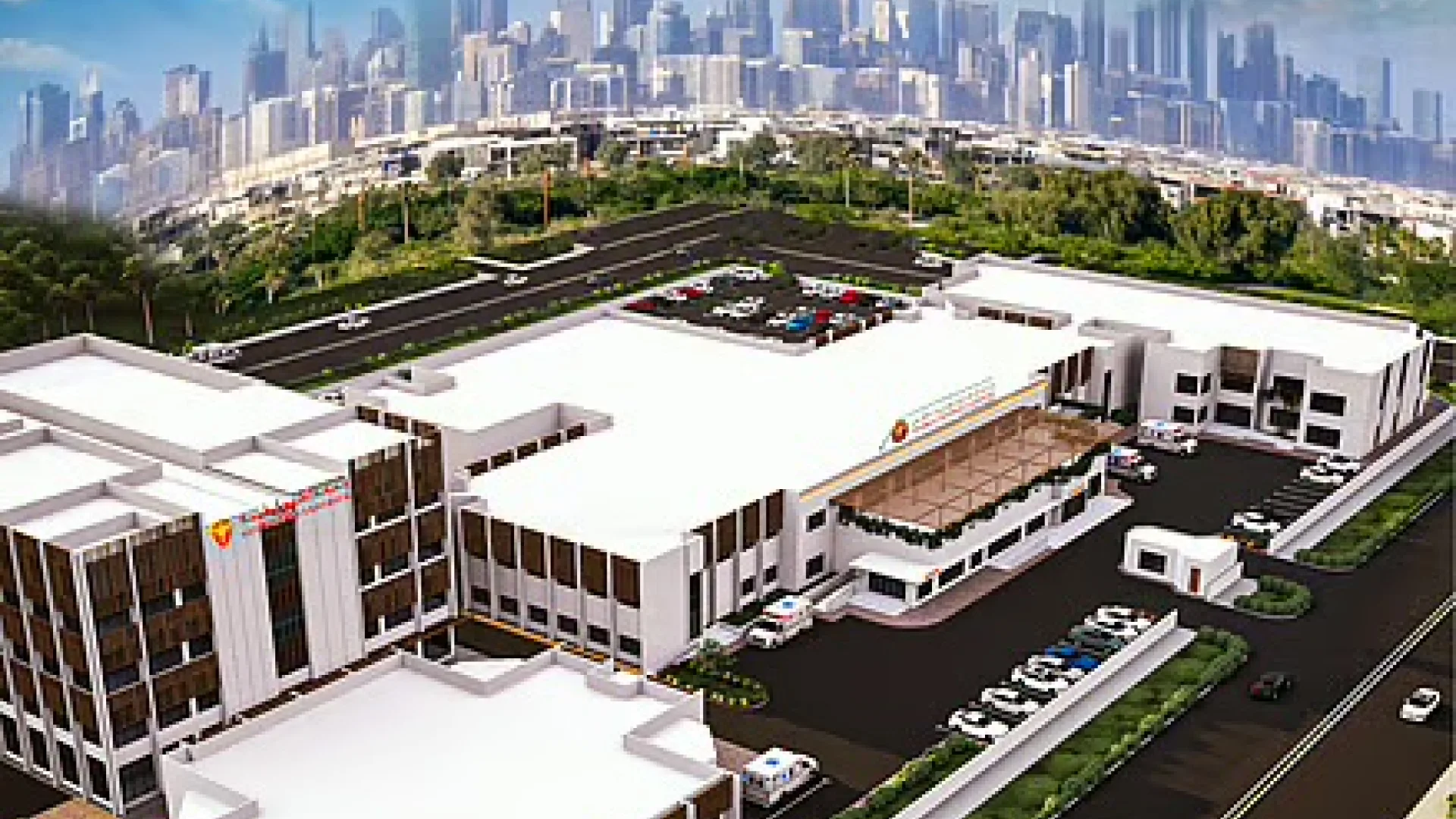

The air feels cooler the moment the doors slide open—part hospital calm, part campus energy—as Dubai unveils its new Academic Medical City. Built to bring clinical care, research and medical education under one roof, the project aims to shorten the distance between discovery and bedside treatment. It’s a strategic move in a fast-growing city that needs both capacity and highly skilled talent, and it strengthens Dubai’s wider push to become a regional hub for advanced healthcare. Beyond medicine, the campus signals a new kind of urban gravity—one that reshapes neighborhoods, demand patterns and investment logic.
The first thing you notice isn’t the building. It’s the rhythm.
A soft beep behind glass. The hush of rubber wheels on a spotless corridor. A quick exchange—“This way.” “Got it.”—and the faint click of a door sealing shut like a promise. Dubai’s newly opened Academic Medical City doesn’t announce itself with fireworks. It does something more unsettlingly modern: it feels ready. Like a place that has been waiting for people to arrive.
You step inside and time changes shape. In most cities, medicine is scattered—lecture halls in one district, labs in another, hospitals somewhere else entirely. Here, the idea is to compress the distance between those worlds until they touch. A question raised in a classroom can be tested in a lab and discussed again at a patient’s bedside without anyone needing to cross town. That’s the point of an academic medical city: not just treatment, but a living loop of learning.
Dubai grows with a certain impatience—roads appear where sand used to be, skylines redraw themselves, industries are planted and scaled. Healthcare, though, isn’t a sector you can simply “add.” It’s a trust business. It depends on systems that hold under pressure, on teams that can be trained and retained, on pathways that make sense at three in the morning.
This is why the opening of a new Academic Medical City matters. The model is designed to combine specialized clinical services with research capability and structured medical education. In plain terms: it’s meant to make care better now, and even better later.
A staff member passes with a badge that catches the light. Another pauses in front of a door, reading the sign twice. A student, maybe—coat slightly too long, sleeves pushed up. He exhales as if the building has weight. “First day?” someone asks. He nods. “You’ll be fine.” Two sentences, and suddenly the place doesn’t feel like a machine. It feels like a story beginning.
“Academic” can sound distant—like theory, like journals, like titles on office doors. But in an integrated medical campus, it becomes practical. It means protocols aren’t just followed; they’re questioned and improved. It means complex cases are discussed with a depth that comes from having researchers nearby and educators who insist on clarity.
The promise is speed with memory: faster diagnostics and treatment pathways, but also a system that learns. When education and care share the same hallways, knowledge stops being an export and becomes an on-site resource.
Openings can be ceremonial—ribbons, speeches, photo lines. But the real inauguration of a medical campus happens later, in the ordinary hours. It happens when the first worried family sits down. When the first multidisciplinary meeting runs long because the question is hard. When the first trainee realizes that medicine isn’t a chapter—it’s a conversation.
In one empty lecture room, chairs wait in rows like an audience before the lights go down. You can almost hear the future voice at the front: a case, an image, a decision. Later, those same students will walk a corridor and meet the consequence of that decision in a human face. That’s what this campus is built to do—close the loop between learning and living.
The opening also fits into a broader pattern: Dubai positioning healthcare as a pillar of its next growth cycle. In a city competing globally for companies and skilled professionals, quality of life is not an accessory—it’s infrastructure. And healthcare is the part of infrastructure people feel most personally.
A robust medical ecosystem supports residents, but it also supports business relocation, family settlement decisions and the rising expectation that a global city should provide global-standard care. An Academic Medical City adds another layer: it signals that Dubai wants to develop expertise locally, not just import it.
Outside, the heat presses back in. Inside, the air stays cool and controlled. The contrast is almost symbolic. Dubai is building a kind of shelter here—not from weather, but from uncertainty. And the city is doing it the Dubai way: at scale, with intent, and with an eye on what comes next.
For real estate investors, major healthcare projects are more than community amenities—they are durable demand engines. An academic medical campus generates daily, non-seasonal footfall: shift workers, students, faculty, patients, visiting families, suppliers and a ring of supporting services. That regularity tends to translate into resilience for nearby real estate values and leasing.
1) Residential demand (rentals and end-user): Hospitals and teaching institutions recruit continuously, creating a steady pool of tenants—doctors, nurses, technicians, administrators and visiting faculty. The most sought-after products are typically well-connected apartments and family-friendly units within a predictable commute. Over time, this can reduce vacancy volatility versus purely lifestyle-driven locations.
2) Serviced apartments and short-stay living: Specialized care often attracts out-of-area patients, plus relatives who stay for consultations and treatment cycles. This supports the business case for serviced living, aparthotels and flexible-stay concepts—particularly those that can capture mid-week demand and “shoulder season” occupancy.
3) Healthcare-adjacent commercial: Academic medical cities tend to seed clusters: diagnostics, rehab, day-surgery, pharmacies, training centers, insurance administration, and health-tech. For developers and landlords, that can mean demand for:
4) Place-making and price premiums: High-quality healthcare improves the perceived “livability index” of a district. In Dubai’s globally mobile market, where relocation decisions are compared city-to-city, proximity to trusted care can be a deciding factor for families and employers. That supports pricing power in nearby residential communities and helps emerging micro-locations mature faster.
5) Timing, risk and due diligence: Investors should think in phases. Early-stage periods can favor land and development plays; later stages often favor stabilized income assets once the campus reaches operational maturity. Key diligence points include actual staffing and patient throughput expectations, transit access, parking strategy, and the regulatory environment for medical, hospitality and short-stay products.
Bottom line: Dubai’s new Academic Medical City is an urban anchor with long-duration impact. For property markets, anchors like this don’t just raise convenience—they change the map, creating corridors of predictable demand and new mixed-use opportunities around healthcare-driven everyday life.