
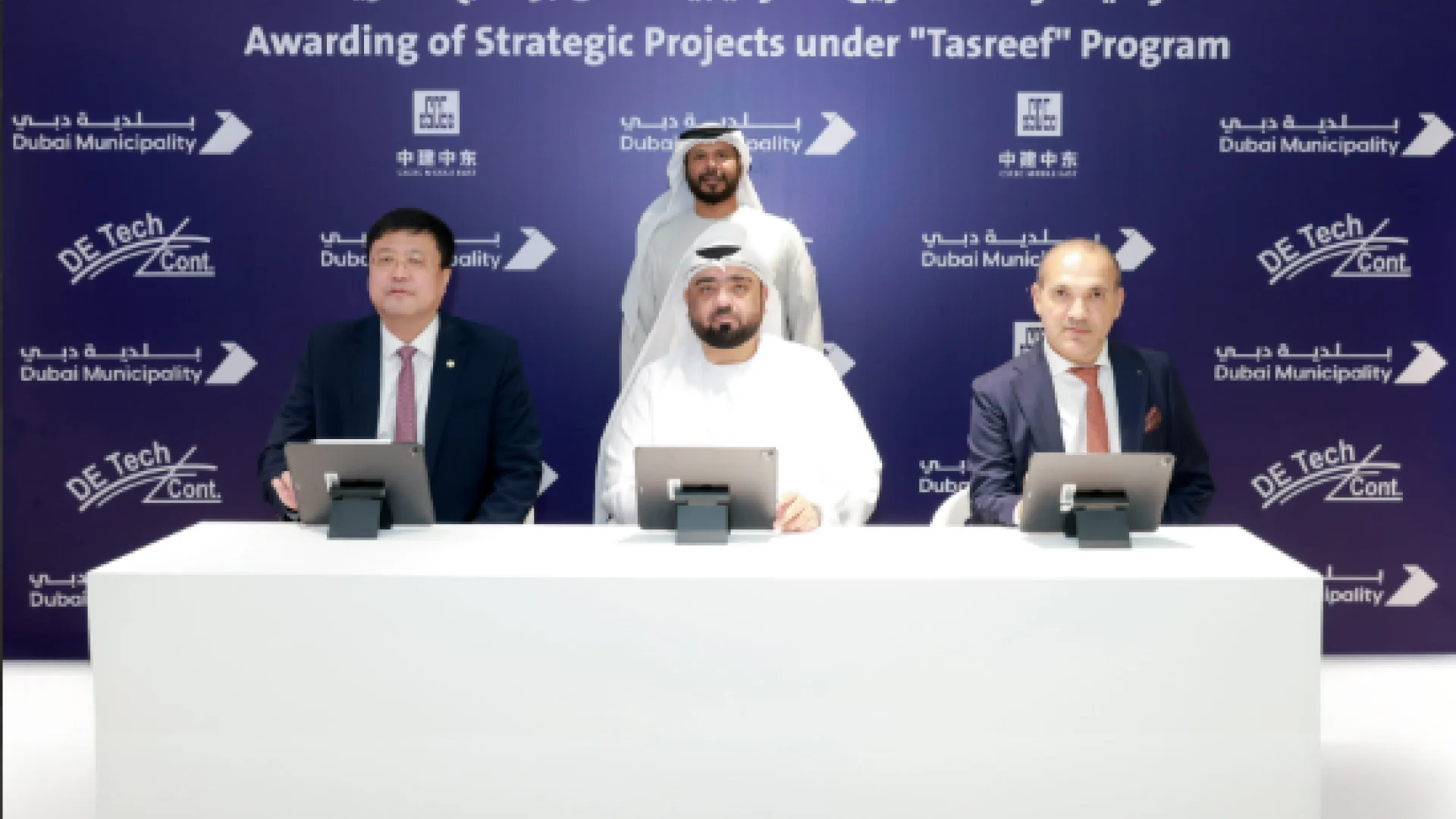

After a downpour, Dubai’s real drama happens underground—where minutes decide whether streets clear or choke. The city is now accelerating its AED 30 billion Tasreef programme, rolling forward new drainage network expansions designed to boost stormwater capacity and improve the speed and reliability of runoff management. The move sharpens Dubai’s climate-resilience agenda and reinforces its promise of continuity for residents, businesses, and investors. In a fast-growing global hub, the pipes and channels you never see are becoming as strategic as the skyline.
The rain has stopped, but the city still sounds wet.
Tyres hiss over glossy asphalt. A shallow lake clings to the edge of a service road, holding the reflected lights of a billboard like a stubborn souvenir. Somewhere behind a concrete barrier, a pump hums with the steady patience of machinery that knows it will be blamed if it falls silent. “It was up to the kerb,” a delivery driver tells me, drawing a line in the air with his hand. “Then it just… moved.”
That last part—it moved—is the whole story. In Dubai, when a rare, heavy storm hits, the difference between inconvenience and paralysis is measured in flow: how quickly water finds its way off the surface, into a network, and out of harm’s way. And that’s why Dubai is now pushing harder on its AED 30 billion Tasreef programme, advancing new phases of drainage network expansion to strengthen the city’s ability to absorb extreme rainfall.
Dubai is famous for what rises. The world knows the silhouettes: towers like exclamation points, highways braided through new districts, glass and steel catching the afternoon sun. Tasreef, by contrast, is a megaproject that doesn’t pose for photos. It’s the city thinking downward—digging, linking, widening, re-routing—so that stormwater has a clear path when the sky decides to test the streets.
In practical terms, the Tasreef programme is designed to upgrade and expand Dubai’s stormwater and drainage infrastructure on a citywide scale. The latest push accelerates that work, adding new expansion steps intended to increase capacity and improve performance where it matters most: during intense rainfall events, when runoff can pool quickly and disrupt mobility, access, and daily life.
Drainage sounds like a footnote until you’ve watched a city hesitate. One blocked underpass, one waterlogged junction, and the ripple spreads: delayed deliveries, stranded commuters, emergency routes squeezed, building entrances compromised. In modern cities, stormwater management isn’t maintenance—it’s continuity.
Infrastructure people speak in numbers—diameters, gradients, volumes. Everyone else speaks in moments: “I made it home.” “The school bus got through.” “The shop opened on time.” Tasreef translates engineering into those moments by building redundancy and speed into the drainage system.
Dubai’s accelerated expansion is aimed at improving the network’s overall ability to collect and convey stormwater efficiently. That typically means more routes for water to travel, fewer bottlenecks, and stronger system-wide resilience—so a single stressed point doesn’t turn into a cascade of problems across a district.
Think of it as giving a city more exits in an emergency—except the emergency is water, and the exits are underground.
In desert climates, water is usually discussed with reverence and restraint: supply, desalination, storage. Rainwater used to be a curiosity—welcome, photogenic, short-lived. But climate patterns are shifting, and “rare” events can arrive with unfamiliar force. That turns drainage into strategy.
An AED 30 billion commitment is not incremental work. It signals that Dubai is treating stormwater risk as a core urban planning challenge, not an occasional clean-up operation. Accelerating Tasreef is a way of pulling the future into the present: build the capacity before the next test, not after the headlines.
And the value of that is not abstract. It shows up in response time. In the ability to keep arterial routes open. In fewer disruptions to business operations. In reduced exposure for ground-level retail, basements, parking structures, and critical electrical systems.
I stand near a junction where traffic is moving again, cautiously at first, then with the familiar impatience of a city that doesn’t like to wait. Two men in work boots glance at a storm drain and exchange a quick verdict.
“Better than last time,” one says.
“Still too slow,” the other replies.
That is the real metric: friction. When the drainage system struggles, friction increases everywhere—commutes stretch, logistics costs rise, emergency services lose minutes, and confidence takes a hit. When the system performs, the city regains its rhythm quickly. Tasreef is, in essence, a programme designed to protect that rhythm.
Dubai’s broader identity is built on reliability: aviation schedules, port throughput, hospitality standards, 24-hour convenience. Drainage resilience fits into that same promise. It’s not glamorous, but it’s foundational—especially for a global hub that continues to expand in population, development, and ambition.
Drainage does not live alone. Every new line underground has implications above ground: roads, utilities, construction phasing, district connectivity. Accelerating a programme like Tasreef means coordination—between agencies, contractors, and the long list of urban systems that share space beneath the surface.
Residents may notice it as targeted works: a lane closed for a week, a fenced-off patch of pavement, the sudden appearance of equipment at odd hours. The payoff is meant to be quiet: fewer dramatic photos, fewer stranded vehicles, fewer flooded entrances, fewer frantic detours.
There’s also a subtler effect. When a city invests visibly in resilience, it changes the story people tell themselves. The next time dark clouds gather, anxiety doesn’t spike quite as high. Trust—hard-won and easily lost—has an infrastructure component.
For real estate investors, stormwater infrastructure is not a civic detail—it’s a line item in risk. Dubai’s decision to accelerate Tasreef matters because it directly influences asset resilience, operational continuity, and the pricing of physical climate risk across neighborhoods.
1) Lower physical risk for buildings
Heavy rain events tend to damage the most expensive-to-fix parts of a property: basement parking, MEP rooms, lift systems, electrical switchgear, and access ramps. A stronger, faster drainage network reduces the probability and severity of such incidents, which can translate into fewer unplanned capital expenditures, less downtime, and more stable net operating income—particularly for retail, hospitality, mixed-use, and high-density residential assets.
2) Micro-location differentiation
As Tasreef expands, connectivity to upgraded drainage corridors may become a meaningful micro-location factor. Districts with improved stormwater conveyance can gain relative attractiveness, especially where plot elevations, road profiles, and underground parking exposure previously increased flood sensitivity. For acquisitions and development, investors should incorporate questions such as: What is the site’s flood pathway? Where does surface water go? What phases of network expansion serve this area?
3) Insurance, financing, and ESG due diligence
Lenders and insurers are increasingly attentive to physical climate risks. A large-scale, government-backed resilience programme can support stronger underwriting narratives: risk mitigation is being funded and implemented at the city level, not left to individual buildings alone. This can influence insurance terms, financing conversations, and ESG reporting—especially for institutional capital with long holding periods.
4) Development execution and long-term value
In the short term, accelerated infrastructure works can add logistical complexity around construction sites and access. Over the medium to long term, improved city resilience can reduce weather-related disruption to construction schedules and enhance the long-run desirability of completed projects, supporting exit values and tenant demand.
5) Market narrative and occupier confidence
Resilience is becoming part of how cities compete. For Dubai, Tasreef reinforces a broader message: growth is being matched with infrastructure that protects day-to-day operability. That confidence matters to occupiers deciding on leases, to tourists booking hotels, and to investors comparing global markets.
Investor takeaway: Accelerating Tasreef is effectively a citywide risk-reduction strategy. Over time, that can compress the “resilience discount” applied to certain assets, support value stability, and make infrastructure-aligned districts more compelling for both income and growth strategies.