
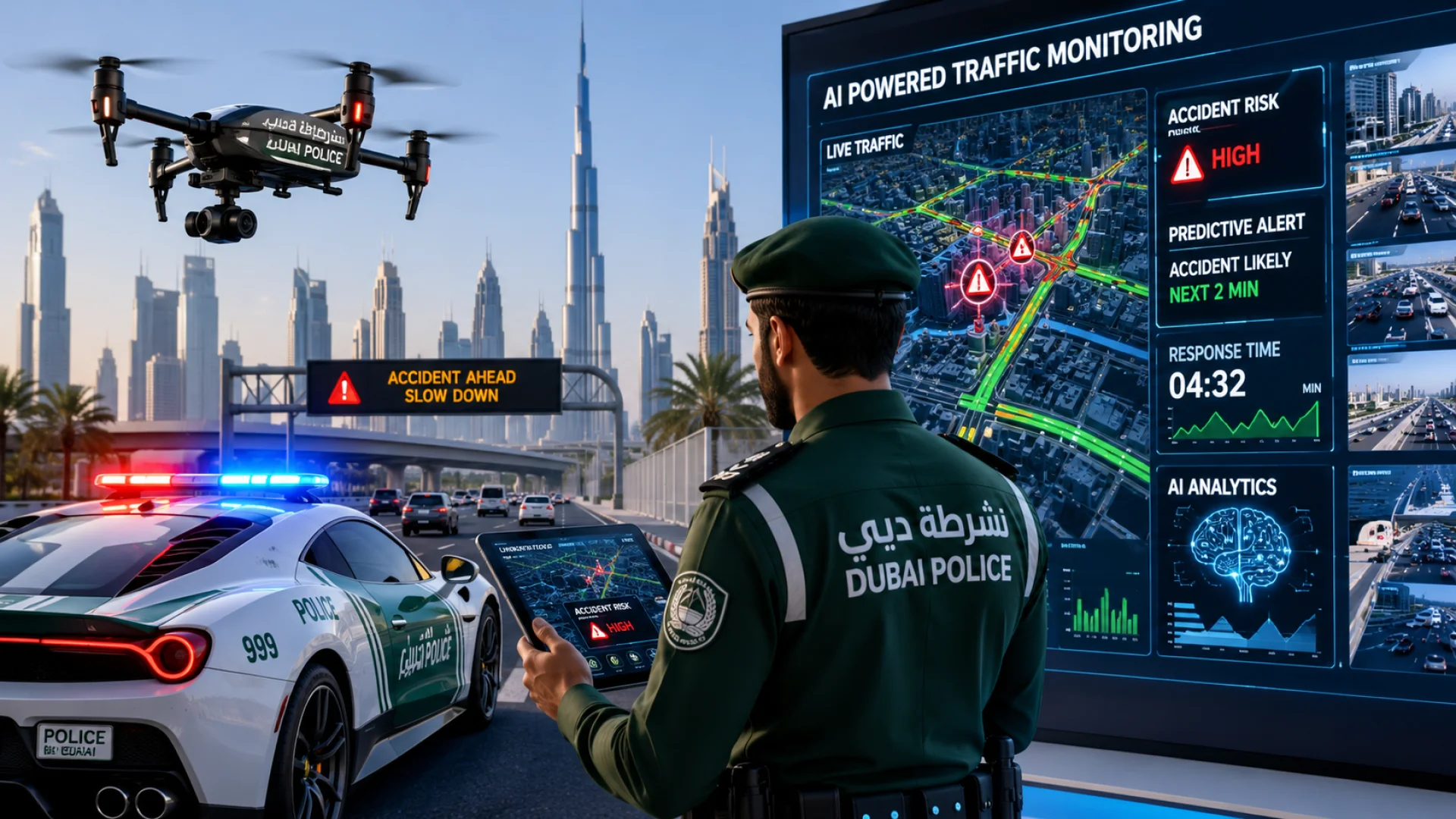

Dubai is giving its roads something like intuition: AI-driven traffic systems that monitor movement, detect risky patterns, and flag potential accidents before they happen. By combining live feeds, sensors, and historical traffic behavior, Dubai Police can identify hotspots, anticipate congestion-linked danger, and respond faster with targeted interventions. The aim is simple but ambitious—shift from cleaning up crashes to stopping them from unfolding in the first place. In a city built on speed, the new priority is safer momentum.
The heat is still on the asphalt even after sunset. Headlights stitch bright threads through the lanes, and the towers along Sheikh Zayed Road glow like polished metal. You feel Dubai moving—fast, confident, impatient. Then, at a busy intersection, everything tightens for a second: a last-moment merge, a brake light flare, a horn that sounds less like anger and more like panic.
“Here,” a taxi driver says quietly, nodding toward the left-turn lanes. “People always try to squeeze in.” He doesn’t need to explain what happens next. Anyone who has driven in a hurry knows the script: one car darts, another hesitates, a third commits too late. The city’s rhythm stutters. Sometimes it recovers. Sometimes it doesn’t.
Dubai Police, in a push that fits the emirate’s wider smart-city ambition, are leaning into AI-powered traffic systems designed to predict accidents—spotting the warning signs before metal meets metal. The promise isn’t magic. It’s pattern recognition. And in a city where patterns repeat thousands of times a day, that can change everything.
Traffic is usually treated like weather: you look out, you adapt, you complain. But traffic is also data—dense, continuous, and surprisingly expressive. Cameras, sensors, live traffic feeds, and historical incident records create a stream of signals: sudden braking waves, aggressive lane changes, bottlenecks that form at the same on-ramp, speeds that spike at the wrong time of day.
AI systems thrive on exactly this. They don’t “see” a crash; they see the pre-crash. A cluster of near-misses. A repeated conflict point. A subtle shift in flow that, based on what has happened before, often ends with sirens.
Think of it like a citywide sixth sense—built not from intuition, but from millions of tiny observations stitched together in real time.
Traditional road policing is reactive by design. A collision happens, the call comes in, officers and ambulances arrive, traffic is diverted, reports are written. Dubai’s new direction is to push the timeline backward: detect risk early, intervene quickly, reduce the likelihood of impact.
That intervention can take different forms depending on what the system flags. Sometimes it’s about guiding patrols toward an emerging hotspot. Sometimes it’s about coordinating traffic management so congestion doesn’t trigger risky behavior. Sometimes it’s simply about visibility—knowing where the city’s stress points are right now, not last month.
The goal is not just fewer crashes. It’s fewer moments where a driver has to make a desperate decision.
At the intersection the taxi driver mentioned, the tension is almost cinematic. SUVs idle with the calm authority of weight. A delivery van creeps forward as if it’s uncertain it belongs in the frame. Two cars in the through-lane accelerate hard as the light turns green—because in Dubai, hesitation can be its own hazard.
“Watch,” the driver murmurs. A sedan glides toward the turning lane from one lane over, late, quick, decisive. A small correction from the car behind. Brake lights bloom, then disappear. No crash. Just a near miss that dissolves into traffic like it never happened.
But near misses are not invisible anymore. In data terms, they leave fingerprints: abrupt deceleration, erratic trajectory, unusual compression of space between vehicles. Multiply that by weeks, months, years—and a risky junction becomes obvious, even if it looks perfectly ordinary to the naked eye.
The AI-driven approach described around Dubai Police traffic operations centers on identifying danger early, understanding where and why it concentrates, and improving both safety and flow. In practical terms, the systems are built to support decision-making at speed—because the road doesn’t wait for meetings.
There’s a quiet logic to all of it: if you can see risk forming, you can treat it like a problem to manage—not a surprise to endure.
Road safety is usually discussed in statistics, but it’s lived in emotions. The clenched jaw in stop-and-go traffic. The split-second fear when someone cuts across your hood. The relief when you arrive without drama. Multiply that by a city, and the stakes become enormous.
In Dubai, where daily mobility links residential districts to business hubs, ports, airports, malls, schools, and construction sites, traffic isn’t a side issue. It’s the bloodstream. Anything that reduces shock—sudden jams, unpredictable collisions, cascading slowdowns—doesn’t just improve safety. It makes the city feel more breathable.
And that’s the deeper story: AI isn’t being added for spectacle. It’s being added to reduce friction in the most literal sense.
Smart-city branding is easy. Smart-city operations are hard. They require systems that don’t merely collect data but turn it into action—fast, repeatable, measurable. Traffic is one of the clearest places to do that because the feedback loop is immediate. If you adjust something—signal timing, patrol presence, incident response routing—the road tells you within minutes whether it worked.
That’s why AI traffic monitoring matters. It’s not only about catching offenders or documenting crashes. It’s about running the city like a real-time service.
Once a city starts predicting accidents, expectations shift. Residents and visitors begin to assume that danger should be anticipated, not accepted. Businesses start valuing travel-time reliability as much as proximity. Urban planners start designing around live performance, not static maps.
Dubai’s bet is that safer roads and smoother flow are not competing goals. They’re the same goal, viewed from two angles. Fewer sudden stops. Fewer desperate merges. Fewer sirens slicing through the night.
For real estate investors, AI-led traffic safety initiatives are not just a public-policy headline—they reshape the fundamentals of location value. In Dubai, where market dynamics can turn on accessibility, lifestyle convenience, and perceived safety, improvements in road performance translate into measurable shifts in demand, pricing power, and risk.
Investor takeaway: In a smart-city framework, mobility is not only infrastructure—it’s an operational layer that can improve quarter by quarter. Investors should complement traditional location analysis (proximity to hubs, transit plans) with performance indicators: congestion patterns by time of day, crash incidence density, bottleneck sensitivity, and whether key corridors are being actively managed and upgraded. In Dubai, minutes saved—and risk reduced—can compound into long-term value.