
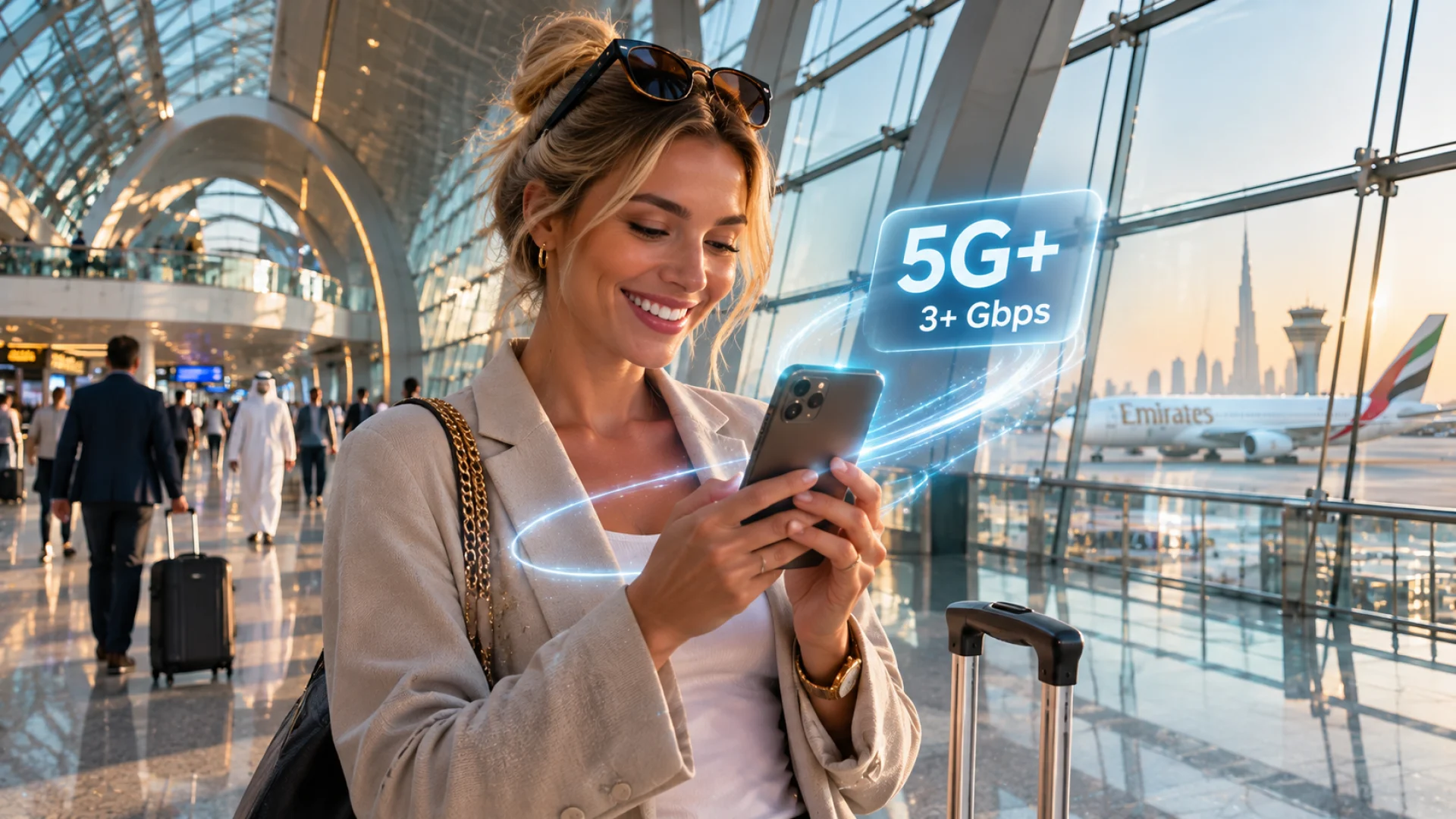

At Dubai International Airport, the pause before boarding is about to become far more connected. DXB is rolling out 5G and reporting download speeds of more than 3 Gbps, bringing faster streaming, video calls, cloud access and large file transfers to one of the world’s busiest aviation hubs. The upgrade strengthens Dubai’s image as a place where transport, technology and international business move at the same pace.
A suitcase clicks across the polished floor. A departure board changes. Somewhere near the gate, a phone wakes up and a large file begins to download. This time, there is no long pause and no spinning wheel demanding attention. At Dubai International Airport, the digital side of the journey is being given a new engine.
DXB is rolling out 5G+, with download speeds exceeding 3 Gbps. The figure is striking, especially in a place where thousands of passengers are working, streaming, messaging and navigating at the same time. Airports are built around movement. Now their connectivity is expected to move just as quickly.
Dubai International Airport is not simply a building between a road and a runway. It is a temporary city. People sleep in lounges, hold meetings at charging points, search for restaurants, follow connections and make decisions under time pressure. Every passenger carries a small digital command centre in a pocket or cabin bag.
That makes network quality part of the travel experience. A business traveller may need to send a presentation before boarding. A family may want to share photographs with relatives at home. A passenger with a short connection may depend on an app for directions, gate information or a digital boarding pass.
5G is designed to support exactly this kind of high-demand environment. Compared with earlier mobile generations, it can deliver higher data rates and lower latency. At DXB, the reported speeds of more than 3 Gbps point to a network built for demanding digital habits rather than occasional browsing.
The change may not arrive with a dramatic announcement. It will appear in small moments. A film loads before the coffee cools. A video call connects without the familiar frozen face. A cloud folder opens while a passenger walks toward the gate. A large document reaches a colleague before the boarding queue starts moving.
“Will the connection hold?” is a question travellers often ask without saying it aloud. Faster, more capable mobile service can remove one more source of friction from the airport experience. The result is not only convenience. It is confidence: the feeling that a digital task can be completed before the aircraft doors close.
Dubai’s global appeal has always been linked to speed. Roads, towers, hotels, logistics systems and financial districts are presented as parts of an ecosystem that works quickly and across borders. A faster airport network fits neatly into that narrative.
DXB is also a powerful first impression. Millions of international passengers encounter Dubai through its terminals before they see its skyline. They notice how easy it is to find a gate, connect to a service, work between flights or contact someone outside the airport. A reliable 5G+ experience therefore becomes part of the city’s brand.
The implications reach beyond entertainment. Better connectivity can support richer real-time information, more responsive navigation, digital assistance and future applications that depend on fast data exchange. The airport becomes not merely a place with internet access, but a platform for increasingly intelligent services.
A peak speed of more than 3 Gbps is impressive, but a headline figure is not the same as the experience of every passenger. Devices must support 5G+. Mobile subscriptions must provide access. Signal conditions, terminal design, crowd density and network traffic all matter.
That is not a weakness of the rollout; it is the reality of every communications network. Infrastructure proves its value through repetition. The benefit appears when thousands of ordinary tasks work a little more smoothly: when a message sends, a map refreshes, a file arrives or a call stays connected.
In a busy airport, those seconds accumulate. Less digital friction means fewer interruptions in a journey already filled with queues, announcements and changing schedules. The technology works quietly in the background, which is often the best possible outcome.
For international companies, an airport is part of the working environment. Executives, consultants, investors and mobile teams use terminals as transition offices. Stronger connectivity supports productivity during those in-between hours when a traveller is neither at home nor at a corporate desk.
It also reinforces the role of DXB as a global gateway. Connectivity does not replace efficient operations, attractive destinations or convenient transfers. But it adds another layer to the promise of frictionless international movement. A passenger can arrive, connect, work and depart without feeling digitally cut off.
Connectivity has become a real estate factor. Around major airports, high-capacity digital infrastructure can support demand for hotels, serviced residences, offices, logistics facilities and mixed-use districts. Businesses looking for international access increasingly assess not only roads and flight connections, but also the quality of the digital environment.
For Dubai, the 5G+ rollout at DXB strengthens the story of an airport-led urban ecosystem. Areas linked to the airport and major business corridors may benefit from stronger appeal among companies, international professionals and short-stay visitors. It is not a standalone reason to buy property, but it is an important signal of continued investment in the competitiveness of the location.
The terminal will remain full of familiar sounds: wheels on stone, boarding calls, footsteps toward immigration. Yet beneath them runs a faster current. Dubai’s airport is becoming not only a gateway through the air, but a high-speed gateway into the city itself.