
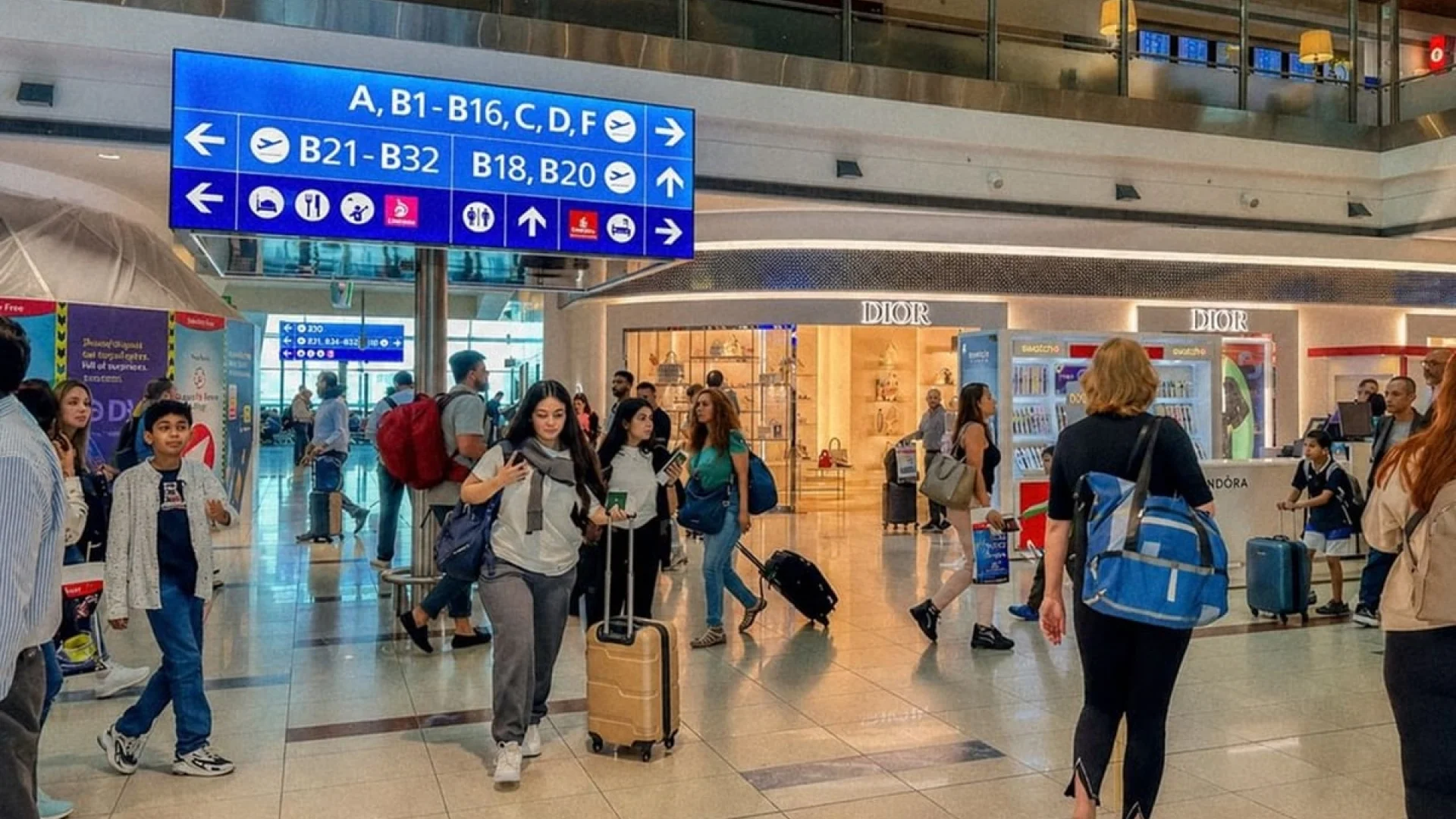

A suitcase drops onto the belt, disappears behind a rubber curtain—and, almost instantly, it’s cleared to move on. Dubai Airports has reduced the screening time for checked baggage to roughly seven seconds per bag by upgrading security and automation systems and tightening the choreography of the baggage journey. The aim is simple but massive in impact: fewer queues and stoppages in the back-of-house, smoother connections, and a more reliable passenger experience at one of the world’s most intensively used hubs. In a place where minutes decide whether you make your flight—and whether your luggage makes it with you—seconds have become a strategic advantage.
The terminal air has that familiar chill—part air-conditioning, part adrenaline. Wheels whisper over polished stone. A boarding call blooms and fades in the distance. At the check-in counter, a traveler nudges a hard-shell suitcase forward as if coaxing it into behaving.
“Please, not again,” she murmurs—half joke, half prayer—then watches the bag slide onto the belt. It tips, catches, and vanishes through the black rubber flaps. The bag is gone, swallowed by the airport’s unseen underside.
Most passengers never think about what happens next. They only feel the outcome later—at the carousel, scanning faces and flight numbers, waiting for that one familiar case to appear. Or not.
Dubai Airports is betting that the best way to change that feeling is to change the invisible mechanics. Its latest claim is a crisp, almost cinematic number: checked-baggage screening has been cut to about seven seconds per bag.
Seven seconds is the time it takes to glance at your gate, to tighten a strap, to send a quick “Landed” message. It’s barely time at all—yet in the subterranean world of conveyors and scanners, it’s the difference between flow and clog.
This isn’t a story about a single miracle machine. It’s a story about a system learning to move like one organism. Faster screening comes from sharper detection, better imaging, more automation, and fewer handoffs that force bags to pause, queue, or be rerouted. It’s about tightening the choreography so the bag doesn’t just travel—it glides.
Nearby, a frequent flyer overhears the number and laughs once. “Seven seconds? That’s not baggage handling. That’s pit-lane speed.” His companion raises an eyebrow. “As long as my suitcase doesn’t take off without me.”
Speed and security sound like rivals. In airports, “faster” can trigger an instinctive suspicion: what’s being skipped? But modern screening works differently. The objective isn’t to do less—it’s to see more clearly and decide more consistently. Better technology reduces ambiguity. Less ambiguity means fewer bags get stuck in the “maybe” lane, fewer manual escalations, fewer stop-start moments that ripple through the entire system.
In a hub like Dubai, ripple effects are everything. A delayed bag isn’t just a bag. It’s a missed connection, an extra service ticket, an expedited delivery run, a frustrated traveler, a small dent in the airport’s promise of seamlessness. Multiply that by the daily churn of long-haul arrivals and tightly timed departures, and baggage becomes one of the most important quiet operations in the building.
Above ground, the airport is glass, light, retail, and the soft choreography of travelers weaving around each other. Below ground is another city entirely—industrial, relentless, timed to the second. Conveyors are roads. Sorters are intersections. Sensors are traffic lights. Scanners are checkpoints.
Cut the screening time, and the entire city changes its pace. Buffers shrink. Backlogs loosen. The system needs fewer “holding areas” where bags wait for capacity to return. That matters most during the surges: the early-morning departure waves, the late-night long-haul arrivals, the tight transfer windows when an airport either performs—or apologizes.
Dubai’s advantage has always been its ability to connect continents with minimal friction. But friction often hides in places passengers never see. Baggage screening is one of them. If you can make that invisible segment faster and more predictable, you improve the part passengers do see: the ease of the journey.
No one will step off a plane and say, “My bag was screened in seven seconds today.” People will say other things—simple sentences that sound like feelings but are really performance metrics in disguise:
That’s the product airports sell: confidence. The luxury of not having to worry about the basics. In the background, a thousand micro-decisions—routing, scanning, sorting—have to land correctly for those sentences to be true.
Dubai doesn’t merely operate an airport; it operates a brand of movement. The city has built a global reputation on being a place where ambition becomes infrastructure, where scale meets speed. So it makes sense that the next frontier isn’t just another terminal feature you can photograph—it’s operational excellence you can feel.
Checked luggage is oddly emotional. It’s the suit for a wedding, the medication you can’t replace, the small gifts wrapped in tissue paper. We hand those items to a belt and accept a kind of faith-based transaction: trust us, it will arrive when you do.
Shaving screening down to seven seconds is therefore not only about throughput. It’s a signal to travelers and airlines alike: the machine room is being upgraded. The hidden city beneath the floor is learning to run cleaner and faster.
Dubai Airports says it has upgraded its checked-baggage security and automation systems to reduce screening time to around seven seconds per bag—designed to cut bottlenecks and smooth the end-to-end passenger journey at a major global hub.
In Dubai, airport performance is not just an aviation metric—it’s a location advantage. When a hub feels reliable, the city becomes easier to sell: for corporate expansions, for conferences, for premium tourism, for talent recruitment. And those forces show up in real estate demand.
Key property and investment implications:
Investor takeaway: In a hub city, operational seconds can translate into economic momentum. Dubai’s push to accelerate baggage screening is a small technical change with a large narrative: the gateway is being tuned. And when gateways get smoother, the markets around them—especially hospitality, serviced living, and well-connected commercial nodes—tend to feel it.