
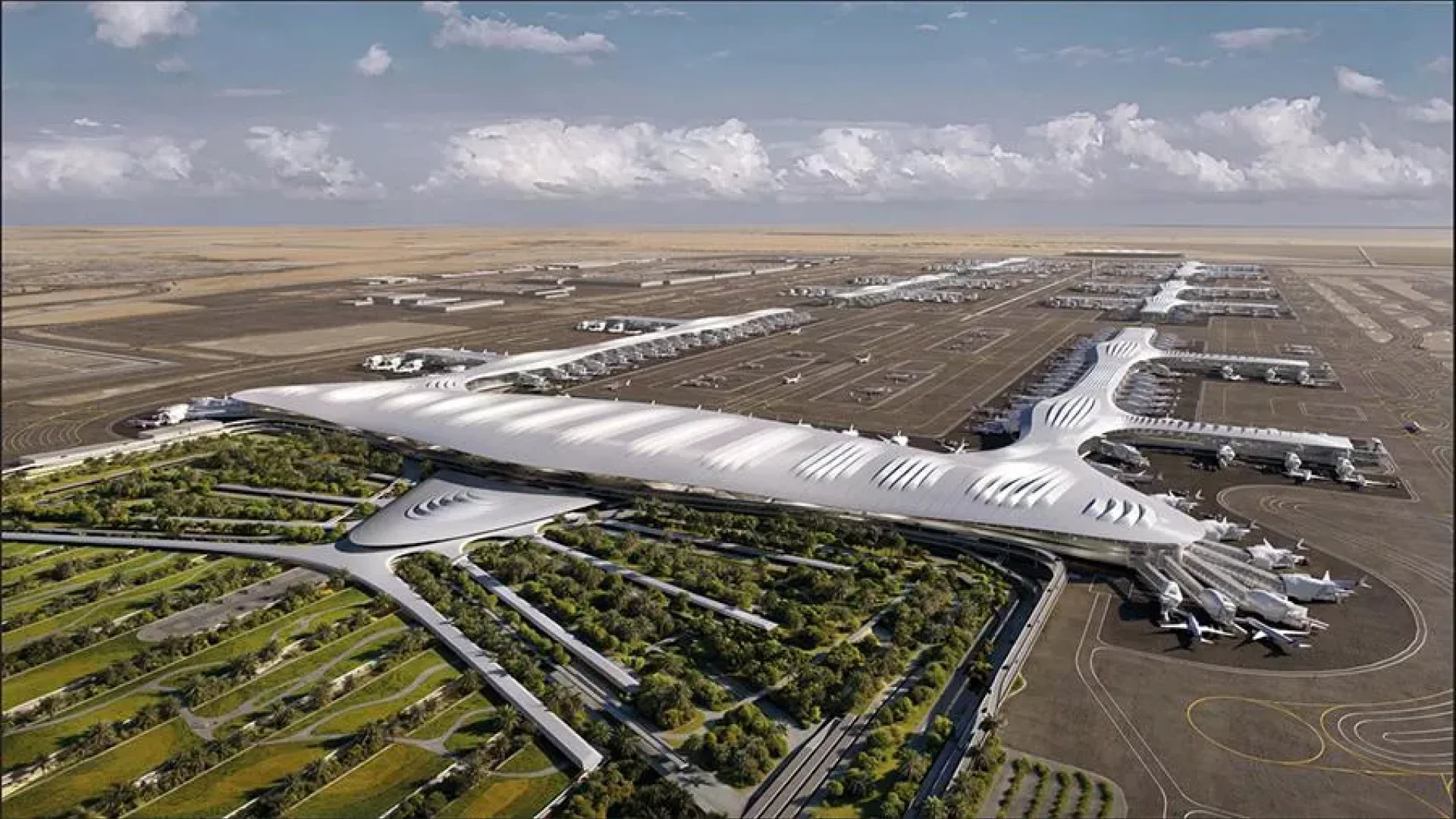

In the desert south of Dubai, the future hums beneath the runway. Al Maktoum International Airport (DWC) is getting a 50 km, fully underground, driverless people mover with nine stations at launch—expanding to 14 as the mega-hub grows. Awarded to Mitsubishi Heavy Industries and Larsen & Toubro, the system will run under the apron and terminals, linking concourses and gates like a hidden subway. Construction is due to complete in December 2031, perfectly timed for DWC’s first-phase opening in 2032, while new rail links—Etihad Rail’s high-speed service and the 55 km Airport Express Link—stitch the airport into the city and beyond. The goal: the world’s biggest airport handling up to 260 million passengers and 12 million tonnes of freight a year.
Dawn paints the empty tarmac copper. A survey laser blinks in the heat shimmer. “Nine stations now,” an engineer says, tapping a laminated map with sandy fingers. “Fourteen when the dream is complete.” Below our boots, not yet poured, a silent city is taking shape: tunnels curling beneath the apron, platforms tucked under future concourses, rails lined up like neat stitches under a giant wing.
This is the spine of the new Al Maktoum International Airport. Fifty kilometers of autonomous people mover, fully underground, gliding beneath runways and terminal floors, ferrying travelers from check-in to gate like a whisper. The contract is signed. Dubai Aviation City Corporation awarded it to Mitsubishi Heavy Industries (with its Dubai subsidiary) and India’s Larsen & Toubro. Big names. Bigger ambition.
“This project exemplifies the scale and complexity of integrated APM Rail Systems that L&T is uniquely positioned to deliver,” says Ramkumar Sundararajan, executive vice president and head of transportation infrastructure at L&T. He doesn’t raise his voice. He doesn’t need to. The numbers do the talking: nine stations in the initial rollout, a 50 km line tucked entirely inside the airport boundary, and a design focused—obsessively—on safety and quality. “MHI’s proven APM Systems and L&T’s extensive integrated systems experience,” he adds, “enable us to execute such projects with a strong focus on safety and quality.”
What does it feel like to ride a people mover? If you’ve taken the shuttle between Terminals 1 and 3 at Dubai International, you know: no driver, quick acceleration, a soft chime, doors that open exactly where the floor markings predict. A people mover is like a metro, but tighter, shorter, sealed inside one place—an airport, a theme park, a campus. DWC’s version will outgrow them all. For scale, the DFW Skylink in Dallas is about 8 km. AirTrain JFK in New York is similar, with an extra stretch beyond the airport lines. Dubai’s line clears those by a desert mile.
Above ground, cranes tilt. Below, the route snakes under the apron of the entire airfield and the terminals. The promise: step off a long-haul flight into a light-washed hall, tap your bag along the platform edge, doors glide, and you’re whooshed to a distant concourse in minutes. No buses. No bottlenecks. No guessing games.
Phase 1 of the airport opens in 2032: the West Terminal, Concourse 1, and the people mover in its first configuration. Capacity jumps to 130 million passengers a year. In the endgame, DWC aims for 260 million passengers and 12 million tonnes of freight—numbers so large they read like science fiction. Four concourses will be operational, each with three people-mover stops. The elevators hum, the escalators whirr, and below it all, the APM draws lines between moments that used to require long walks and bus rides.
Outside the fence, the city is knitting new connections. The Airport Express Link will run 55 km across Dubai, connecting DXB and DWC with stops in popular districts—airport to airport, city to city. And in 2030, Etihad Rail’s high-speed service adds another thread. “Etihad Rail will now come very close to DWC phase 2,” Dubai Airports CEO Paul Griffiths said earlier this year. “You’ll be able to step off Etihad Rail effortlessly into the new airport.” The word he uses—effortlessly—fits the mood. The airport of the future doesn’t shout. It smooths.
On site, a foreman rubs dust off his tablet and pinches a 3D model into view. Tunnels bloom like arteries. “Here, under the apron,” he says, drawing a square with his thumb. “And here, below the terminal.” You can almost hear it: the quiet chime, the controlled rush of air as a train slides past. The beauty of the thing is that it disappears. No viaducts. No overhead wires. Just shadow and speed.
We linger where Concourse 1 will rise. The horizon fades into steel. A flight path arcs overhead, still empty. The megaproject logic becomes clear: high capacity above; high velocity below. Passengers transfer faster. Gates turn quicker. Aircraft spend less time waiting for people to arrive. Multiply that by hundreds of daily movements, and you’ve moved the needle on the world’s largest airport.
Dubai knows the choreography of arrivals. It also knows the theater. The new APM is not just infrastructure; it’s timing. A promise that the distance from curb to cabin will shrink to a few pleasing, predictable minutes. “Safety. Quality,” the L&T executive had repeated. In a place built on precision, those aren’t buzzwords. They’re operating instructions.
By late afternoon, the wind kicks up. The survey laser flicks off. Somewhere below future foundations, the idea of movement keeps humming, an invisible line waiting for its first train. The city around it moves too—toward a map where distance means less, and time matters most.
Follow the rails to find the growth. The APM anchors a new center of gravity in Dubai South, turning airport-side land from future promise into near-term opportunity. With a 2031–2032 handover window for core systems and Phase 1, the investment clock is ticking now.
What to watch next: station-area plans, final alignments, developer MOUs within Dubai South, hospitality brand announcements tied to the West Terminal, and the sequencing of the Airport Express Link stations. Liquidity typically arrives before ribbon-cutting; pricing often jumps after the first operational proofs. In other words: the runway for returns may appear before the first plane lands.