At Dubai’s southern edge, Al Maktoum International is being planned as an airport for the next generation of global travel. Its long-term capacity is expected to reach up to 260 million passengers a year, making dependable ground transport essential. Planned metro and rail connections could link the airport with Dubai South, major employment centres and the wider UAE network, reshaping travel and property demand across the south of the emirate.
The desert light is soft over Dubai South, but the horizon feels enormous. Roads stretch between construction sites. Cranes stand against the pale sky. Beyond them, Al Maktoum International is taking shape—not merely as another airport, but as a new anchor for Dubai’s next chapter.
“How will people get there?” a visitor asks, looking across the open site. The answer is increasingly clear: by rail.
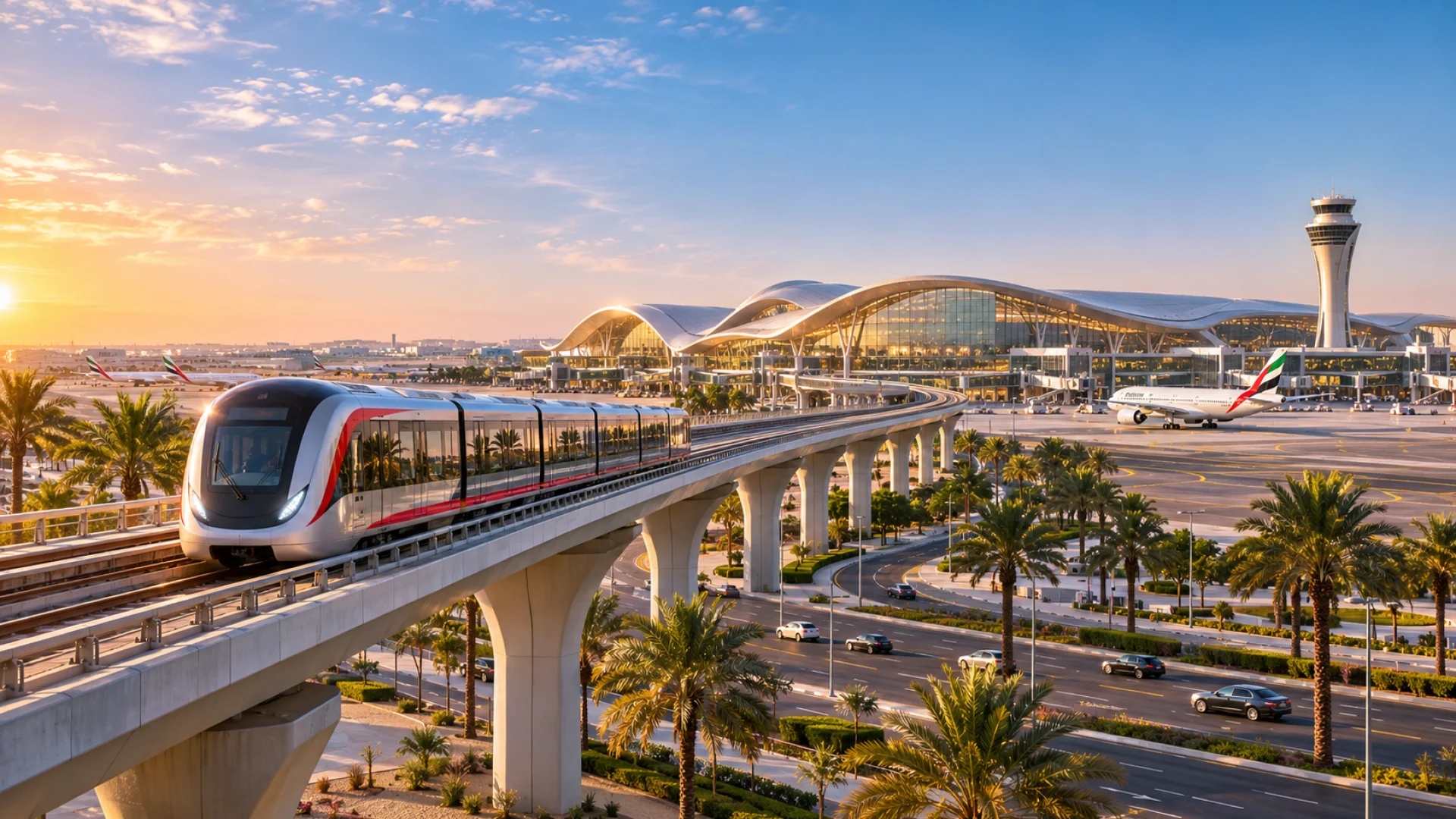
Dubai is planning metro and rail links to the future airport, bringing Al Maktoum International into the city’s wider public transport system. Exact routes and delivery phases will be confirmed progressively, but the ambition is unmistakable. The airport is not meant to remain an isolated terminal reached only by car or taxi. It is being designed as part of a connected urban and regional network.
Al Maktoum International is planned for a different order of magnitude. Dubai has announced a major expansion in Dubai South, with long-term capacity of up to 260 million passengers annually. Dubai International will continue to play a vital role, but the southern airport is intended to carry future growth and provide space for a new generation of aviation infrastructure.
The vision includes several terminals, multiple runways and extensive logistics facilities. Automation, efficient passenger flows and integrated transport are central to the concept. A passenger should be able to move from aircraft to train with as little friction as possible. That simple experience requires a sophisticated system of metro lines, regional rail, buses, roads, baggage handling and last-mile connections.
Dubai Metro has become part of the city’s daily rhythm. It carries residents to work, visitors to attractions and commuters between homes, offices and shopping districts. Extending that network towards Al Maktoum International would give the airport a direct role in everyday urban mobility.
The impact would be especially significant for Dubai South. The district is being developed around aviation, logistics, business and housing. At present, many destinations remain spread across large distances. A reliable rail connection could turn those distances into manageable journeys.
Picture the future arrival. A train leaves the city and moves south. New residential districts slide past the window. Warehouses give way to offices and hotels. Then the terminal appears. No anxious search for parking. No guessing how long traffic will take. Just a clear, timed journey to the airport.
Dubai’s rail expansion is taking place in stages. The planned Blue Line will connect important districts including Mirdif, International City, Dubai Silicon Oasis, Dubai Creek Harbour and Dubai Festival City. Its main role is to strengthen links across the eastern and central parts of the city. A future connection to Al Maktoum International forms part of the wider long-term vision for public transport, while individual routes and construction phases continue to be developed.
Etihad Rail adds another layer. The UAE’s national railway is designed to connect the emirates for freight and, in the future, passenger services. A link involving Al Maktoum International could connect the airport not only with Dubai but with other emirates and major economic centres.
The breakthrough will not come from one line alone. It will come from making the lines work together.
For international travellers, the ground journey could become part of the Dubai experience. Instead of an unpredictable taxi ride, visitors may step directly onto a train from the city. Digital tickets, coordinated transfers and efficient baggage services could make the route feel almost effortless.
The airport workforce will benefit too. A hub of this scale will require employees across terminals, security, hospitality, maintenance, catering, logistics and retail. Better public transport enlarges the accessible labour market. Workers living in different parts of Dubai could reach the airport more reliably and with less dependence on private cars.
“The distance is still there,” a future employee might say. “But it no longer feels far away.”
For years, the southern edge of Dubai was viewed as remote. The airport changes that perception. Dubai South, the Jebel Ali logistics area, Expo City and surrounding residential communities are gaining strategic weight. The map of the emirate is being redrawn around new employment and transport corridors.
Infrastructure does more than follow development. It helps create it. A station can turn an overlooked parcel into a recognised address. A regional rail stop can transform an industrial district into a connected business hub. Roads provide access, but rail often provides a stronger sense of permanence and direction.
The planned connections are already relevant to Dubai’s property story. Around Dubai South, developers are bringing forward apartments, serviced residences, offices, hotels and logistics facilities. Better rail access could support demand by making the district more practical for residents, employees and companies.
Locations near future transport corridors may attract particular attention. But distance alone is not enough. Investors should distinguish between a confirmed station and a marketing promise. The real test will be the final route, construction schedule, walkability, interchange quality and the surrounding mix of schools, shops, offices and services.
Key factors include:
The airport could also generate demand for hotels, short-stay accommodation, corporate housing and flexible offices. Yet the opportunity is a long-term one. Announcements must be followed by design, approvals, funding, construction and operations. The strongest projects will be those planned around actual mobility—not simply placed near a line on a map.
Al Maktoum International is therefore about more than aircraft. It is a test of how Dubai wants to grow. Will the southern city remain a collection of distant sites connected mainly by highways? Or will a rail network bring homes, jobs and global travel into one coherent urban system?
For now, the landscape still looks open and unfinished. Dust moves across the road. Tower cranes mark future neighbourhoods. But the next connection is already being imagined. When the first train eventually reaches the terminal, it will carry more than passengers. It will announce that Dubai’s centre of gravity has shifted south.