
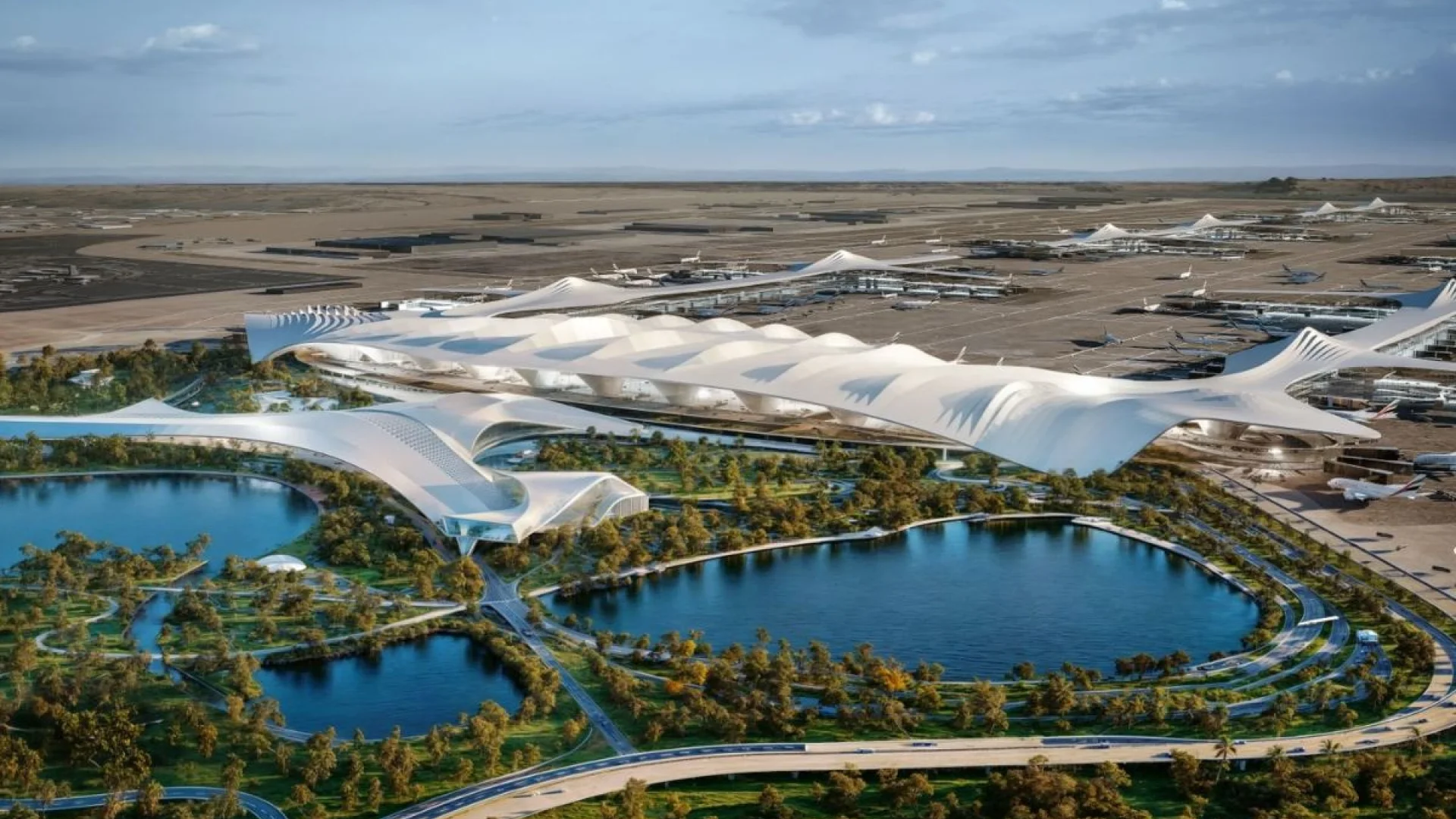
Imagine clearing security without stopping. That is the promise of Dubai’s next‑generation Al Maktoum International: continuous, walk‑through screening, biometric identity from curb to gate, and CT scanners that let liquids and laptops stay in your bag. Built with an investment of roughly AED 128 billion, the southern mega‑hub is set to take over from DXB in the coming years, with up to 400 aircraft gates, five parallel runways, an ultimate capacity near 260 million annual passengers, and an initial phase targeting 150 million. For travelers, it means time back and stress down; for investors, it redraws the map around Dubai South and Expo City.
The escalator hums and you spill into light. No stanchions. No human knot of frustration. Ahead, a family drifts forward as if pulled by a tide. “Was that… security?” the dad whispers, half joking. A soft chime answers. A tiny green icon glows above the walkway. A staffer smiles and waves them on. That was it. No trays. No elbows. No sprint to repack.
This is the scene Dubai wants to make ordinary at Al Maktoum International. Security fades into the background. Safety stays, the queuing goes. Biometrics recognize you in motion. CT scanners read bags in three dimensions so liquids and laptops stay put. Risk engines do their work quietly, as you keep your stride and your pulse.
To get there, the city is building at a scale that still raises eyebrows: roughly AED 128 billion for a new hub in the south that will ultimately take over from DXB. Think five parallel runways. Up to 400 gates. An ultimate capacity near 260 million passengers a year, with phase one already aimed at 150 million. The audacity is familiar Dubai—what’s different is the texture of the promise: not just bigger, but smoother.
Picture the old pinch points dissolved into a mesh that moves with you. Instead of stopping at a single chokepoint, you are screened continuously as you walk. Here is how that changes your day:
It’s less a gadget parade than a new choreography. You feel it in the silence. In conversations that don’t need to pause for a barked instruction. In the way your coffee stays hot because you didn’t stand in a rope maze until the foam went flat. If you’ve glided through Dubai’s smart gates at DXB, you know the direction of travel. Al Maktoum just turns the dial to always‑on, barely‑there.
Scale matters. Terminals the size of small districts. Light that behaves like a stage manager, nudging you forward with gentle cues. Movement spines that make speed and calm coexist. And as operations migrate in stages from DXB, the city’s center of gravity tips south—closer to Expo City, to the logistics powerhouse at Dubai South, and to new neighborhoods that grew up in the wake of the World Expo.
Stand by the masterplan model and you hear the logic. “If you remove queues, you give space back,” a planner says, tapping a sweeping concourse with a pencil. “Every minute not spent in a line is capacity.” Capacity for airlines to breathe, to flatten peaks into gentler waves, to cut minimum connection times with confidence. Capacity for people to reclaim minutes that used to vanish into nowhere.
Security, of course, stays security. The point is not leniency, it is precision. When the system isn’t busy slowing everyone, it can see the few who matter more clearly. Interventions are targeted—and mostly invisible to everyone else. The rare becomes visible; the routine disappears.
On the ground, that flips dozens of small experiences. Boarding becomes an invitation, not a scrum. Restaurants feel like places to be, not holding pens. Duty‑free is once again a browse, not a sprint with a basket. Children press noses to glass to watch a wide‑body wink in the sun, instead of fidgeting past a rubber belt.
Outside, infrastructure leans in. Roads widen, interchanges tidy up, and transit lines are planned to lace the south more tightly into the network. Dubai’s Route 2020 Metro already reaches Expo City; extensions toward Al Maktoum are in the blueprint. The idea is simple: if flow is the product inside, access is the promise outside.
In the end, the airport reads as a statement about patience—about a city that refuses to waste yours. Technology takes the quiet role. Hospitality takes the loud one. And somewhere between curb and cabin, a sentence you’ll carry home as a boast: “We didn’t queue for anything.”
For a hub built on the art of connection, this is more than convenience—it’s a strategy.
Airports rearrange maps. Al Maktoum redraws them. The mega‑hub pulls gravity toward Dubai South, Expo City, and the logistics belts that have been quietly compounding for years. For investors, that translates into very specific plays—and timelines.
Checklist for disciplined capital:
The rule of thumb is blunt but useful: where time shrinks, value stretches. Queue‑free security is not just a line on a brochure—it’s a moat for a district, and a compounding story for anyone invested along the new south corridor.