
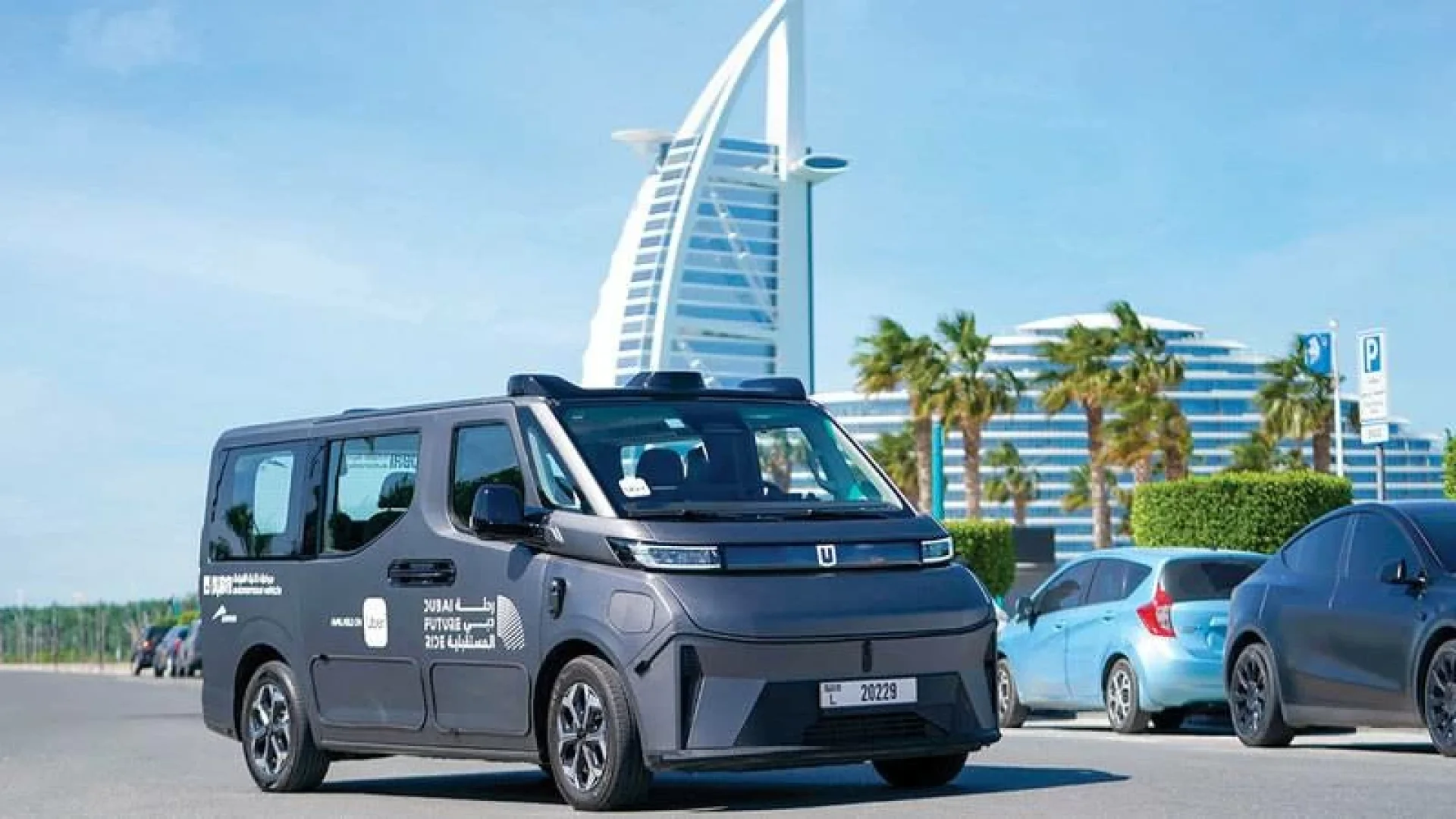

Dubai is already putting 160 autonomous vehicles through their paces on its roads, with a target of 4,000 by 2030. The ambition forms part of a wider vision for intelligent urban mobility, bringing driverless taxis, automated shuttles and logistics vehicles into everyday life. For Dubai, the project is about more than futuristic technology: it is a bid to make transport safer, more efficient and central to the city’s global identity.
The road is broad, polished and bright beneath the morning sun. A vehicle approaches without the familiar choreography of driving: no visible hand turning the wheel, no driver leaning forward at a junction. Cameras and sensors scan the traffic instead. In Dubai, the future does not arrive quietly in a laboratory. It moves through the city, lane by lane.
The emirate already has 160 autonomous vehicles on its roads, according to the report. The figure is still small compared with Dubai’s total fleet, but its meaning is larger than its size. Dubai is not waiting for driverless technology to become ordinary elsewhere. It wants to test, display and scale it at home.
The target is striking: 4,000 autonomous vehicles by 2030. That would transform a collection of pilot projects into a visible urban network, with potential applications ranging from taxis and public shuttles to deliveries and other forms of city logistics.
Dubai is well suited to this kind of experiment. It has invested heavily in digital infrastructure, expanded rapidly and developed a transport system that already combines roads, metro, tram, buses and on-demand services. The city sees mobility as an interconnected platform rather than a collection of separate journeys.
Stand beside a major road and the challenge becomes clear. Cars flow past towers and construction sites. Taxis pull in and out. Buses stop, motorcycles change lanes and pedestrians wait for gaps in the traffic. Every movement creates a calculation. Every intersection is a test of distance, timing and judgement.
An autonomous vehicle must read all of it almost instantly. It needs to recognize a braking car, anticipate a sudden lane change and distinguish between a pedestrian who is crossing and one who is merely waiting. The technology is not simply about turning a steering wheel. It is about interpreting the city.
The 160 vehicles represent a transition. They show that autonomous systems can operate in real streets rather than only in controlled demonstrations. Reaching 4,000 would be a different achievement. It would move autonomous mobility from a headline-making trial into a familiar part of daily life.
A resident might summon a driverless taxi and barely notice that it is unusual. A delivery vehicle could move through the city overnight. A shuttle could connect a residential district with a metro station, office complex or shopping destination. At first, a safety operator may remain on board. Later, one control room could monitor several vehicles from a distance.
“Is it really driving by itself?” a passenger might ask while fastening a seat belt. The answer would no longer describe a demonstration. It would describe a service. Public acceptance will be decided in those ordinary moments: on the way to work, in heavy traffic, with luggage in the boot or a child in the back seat.
Dubai’s 2030 horizon is tied to a broader development agenda. Autonomous mobility is expected to support goals such as improving road safety, reducing congestion, lowering operating costs and using transport infrastructure more efficiently.
Driverless systems could be especially useful where services operate around the clock or where staffing is difficult. A shuttle does not become tired. A delivery vehicle can follow a precise schedule. Public transport could respond more flexibly to demand. But the transition also raises practical questions: Who is responsible after a collision? How should vehicles share data? What happens to driving jobs? And how can passengers feel secure when the person in control is software?
Dubai’s answer is likely to be built through repetition. Technology becomes trusted not through one spectacular demonstration, but through thousands of uneventful journeys. A vehicle stops safely. It recognizes a cyclist. It waits for a pedestrian. It arrives on time. The ordinary becomes the proof.
Autonomous mobility is not only a vehicle project. It requires accurate digital maps, reliable communication networks, intelligent traffic signals and control centres. Roads must serve automated vehicles, human drivers, cyclists and pedestrians at the same time. Stations, parking facilities, charging points and maintenance hubs must evolve with them.
The most important innovation may therefore be invisible. It could be the sensor beneath the road, the traffic signal adjusting its timing or the operator watching a fleet from a control room. The futuristic vehicle is only the visible tip of a much larger urban system.
If the technology scales, the role of the car could change. A vehicle may become less a private possession and more an available service. Residents in a new district may not need a car parked outside their building for every trip. An autonomous shuttle could serve several households, connect them to the metro and return later for another passenger.
This possibility is particularly relevant to new developments. Mobility can be designed into a district from the beginning, rather than added after roads and buildings are complete. Streets, drop-off zones, pedestrian routes and public transport can be planned as one system.
Autonomous mobility could become a quiet but powerful factor in real estate values. Today, proximity to a metro station, a major road or a business district strongly influences a property’s appeal. Tomorrow, investors may also ask how reliably a driverless shuttle can connect a development to those destinations.
Residential communities outside traditional transport hubs could become more accessible. Office parks could improve their last-mile connections without adding enormous parking areas. Hotels, malls and mixed-use projects could operate dedicated autonomous shuttles as part of the tenant and visitor experience. Mobility would become part of the property proposition, not simply an external public service.
Parking may be reshaped as well. If vehicles can move independently, they do not always need to remain directly outside a building. Some parking could be concentrated in less prominent locations, freeing valuable land for landscaping, retail, restaurants or additional development. At the same time, buildings may be judged by their digital readiness: charging points, sensor systems, safe pick-up zones and access to mobility platforms could become important quality markers.
For investors, the key question will be whether the 4,000-vehicle ambition becomes a dependable operating network. The number is more than a technical milestone. It could indicate that autonomous transport has become part of Dubai’s daily economy. Property analysis may therefore need to look beyond road access and parking supply toward digital accessibility.
The vehicle continues down the avenue. Glass towers slide across its windows, while the desert glows beyond them. A human may still be watching from the front seat. But the direction is unmistakable: Dubai wants its city not only to grow faster, but to drive itself into the future.