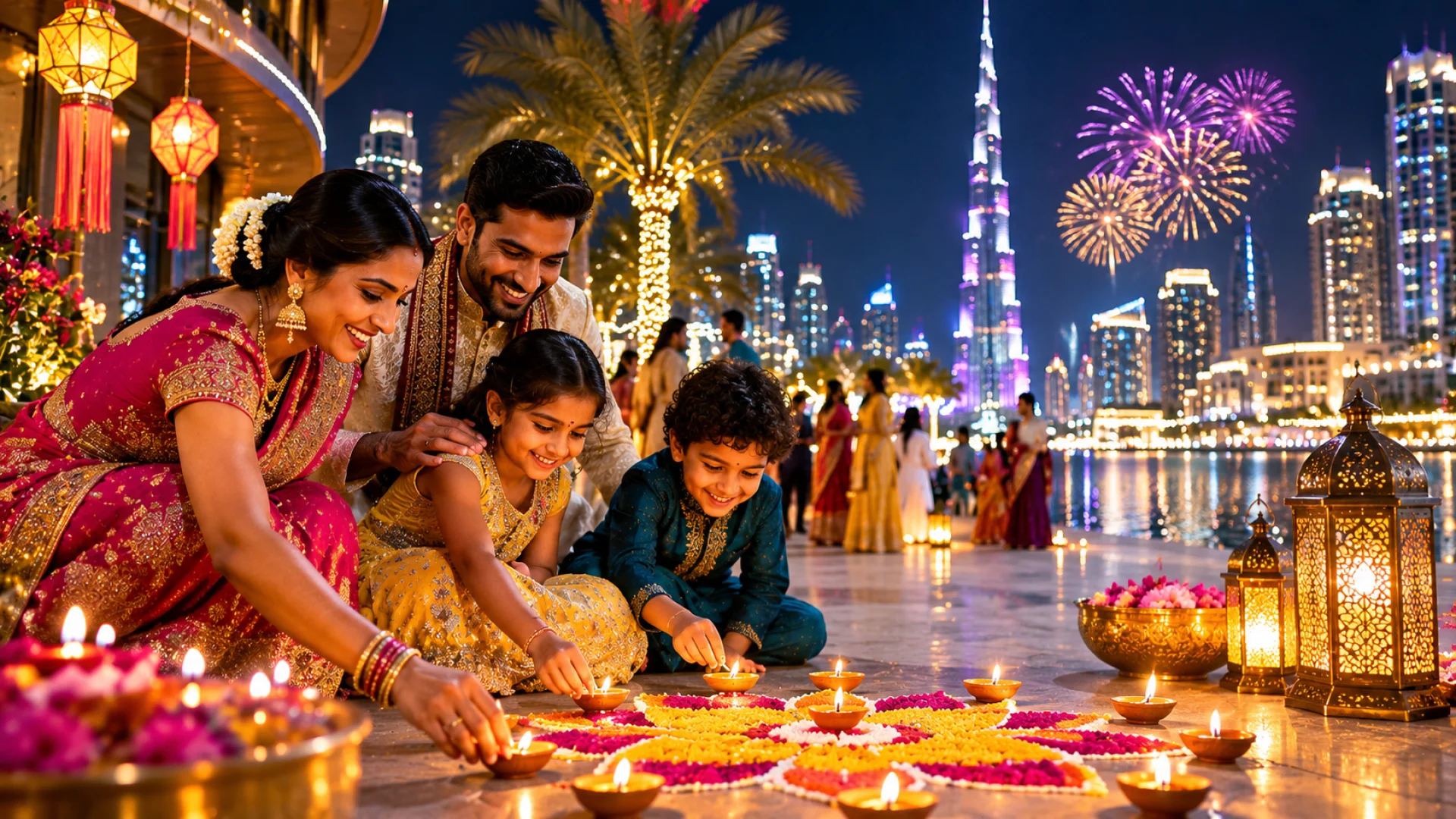
A small flame flickers beneath Dubai’s towering skyline as the city welcomes Diwali, the Festival of Lights. Across the emirate, Indian families and communities mark the occasion with prayers, rangoli designs, sweets, gifts, music and festive gatherings. The celebration carries an ancient message—the triumph of light over darkness, good over evil and knowledge over ignorance—while taking on a distinctly modern Dubai setting.
The first thing you notice is the glow. A row of tiny oil lamps lines the entrance to a restaurant. Their flames tremble in the warm evening air, bright enough to catch the attention of passing children. Inside, a family is dressed in new clothes. A tray of sweets appears. Someone says, “Happy Diwali.” Someone else answers with a smile.
This is Diwali in Dubai: deeply rooted in South Asian tradition, yet perfectly at home among glass towers, luxury malls and wide boulevards. Known as the Festival of Lights, Diwali is celebrated by millions of Hindus and is also observed by Jain, Sikh and some Buddhist communities. Depending on regional customs, the festival unfolds over several days, with the main celebrations often centred on a night of lamps, prayers and family gatherings.
The word Diwali comes from the Sanskrit term “Deepavali”, meaning a row or series of lights. Its stories and customs vary across India and the wider region. For many Hindus, the festival honours Lakshmi, the goddess of wealth and prosperity. Homes are cleaned, entrances are decorated and lamps are placed to welcome good fortune. In other traditions, Diwali recalls Lord Rama’s return to Ayodhya after defeating the demon king Ravana.
There is no single story that defines the festival for everyone. Yet the central idea is widely shared: light defeats darkness. Wisdom defeats ignorance. Hope is stronger than fear. That is why Diwali feels both personal and universal. It is a religious observance, a family holiday and a moment to begin again.
Preparation starts well before the lamps are lit. Families clean their homes, buy new clothes and prepare elaborate meals. At doorways, rangoli patterns appear in coloured powder, flower petals or rice. Kitchens fill with the scent of cardamom, saffron and roasted spices. Boxes of laddu, barfi and gulab jamun are exchanged with neighbours, colleagues and friends.
In Dubai, the festival spreads through many parts of daily life. Indian communities arrange prayers, cultural programmes and family events. Malls and hotels dress their entrances with flowers, lanterns and bright Diwali motifs. Restaurants offer special menus, while shops display saris, jewellery, gifts and traditional sweets. In some venues, visitors can watch dance performances, listen to live music or join craft activities designed to introduce younger generations to the festival.
The city’s architecture adds its own drama. Warm gold and orange decorations glow against cool glass facades. A rangoli pattern sits beneath a soaring atrium. A child in a sparkling outfit poses for a photograph while a grandmother adjusts the edge of her sari. Outside, Dubai’s traffic moves past in a ribbon of headlights, echoing the thousands of small lamps being lit across homes and public spaces.
Diwali is not confined to one district or one official stage. It travels through the city: from large shopping centres and hotels to restaurants, community halls and private homes. In residential areas, neighbours exchange sweets and greetings. In workplaces, colleagues share snacks and gifts. For many families, the most meaningful moment remains Lakshmi Puja, when prayers are offered for peace, prosperity and a bright year ahead.
Dubai’s Diwali atmosphere reflects the emirate’s remarkable cultural mix. More than 200 nationalities live and work here, and South Asian communities are an important part of the city’s social and economic life. During the festival, that diversity becomes especially visible. A traditional prayer may take place only a few streets from a luxury shopping experience. A family recipe may be enjoyed by guests who have never celebrated Diwali before.
Visitors do not need to understand every ritual to appreciate the feeling. Walk through a decorated mall. Stop at an Indian restaurant. Watch a dance performance. Accept a sweet if one is offered. Above all, observe respectfully, especially during prayers and private ceremonies.
Late at night, one image remains: a single lamp glowing before the immense Dubai skyline. It is small, but it changes the mood of the entire space. That is Diwali’s enduring power. The light is modest. The message is not.
Diwali also highlights the importance of community in Dubai’s residential landscape. For many Indian families and international residents, homes near schools, supermarkets, restaurants, places of worship and cultural venues offer more than convenience. They provide connection. Properties with shared gardens, multipurpose rooms, family-friendly amenities and accessible transport links can be especially appealing during festive seasons and throughout the year. As Dubai continues to attract global residents, neighbourhood identity and cultural diversity remain increasingly relevant factors in real estate decisions.