
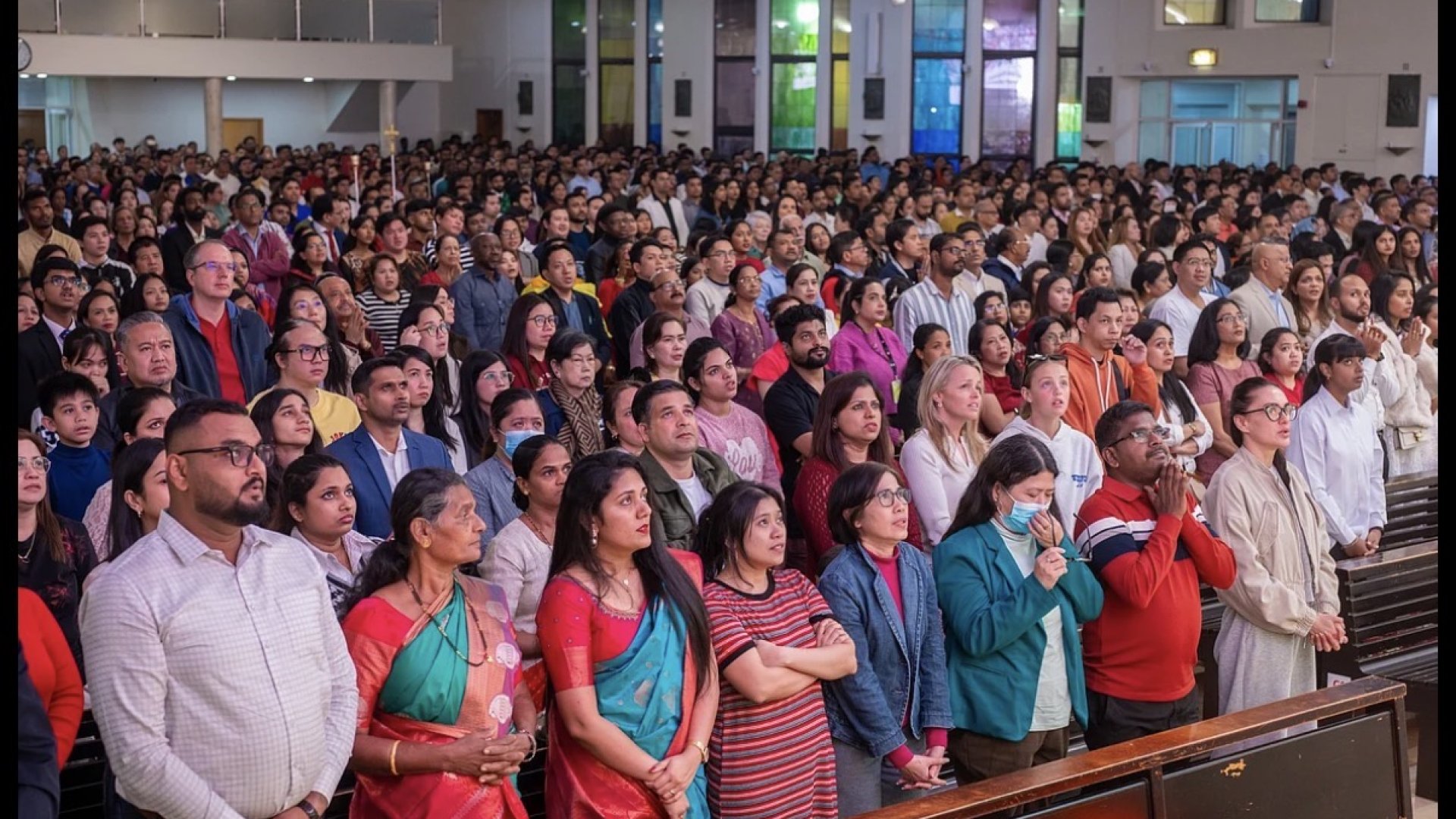
On December 24, 2025, Dubai’s churches became islands of candlelight in a city better known for neon and glass. Worshippers arrived early, filling pews for Christmas Eve Mass—families with restless children, solo expats missing home, friends from different continents sharing the same songs. The evening unfolded in photographs and hushed moments: security lines outside, carols inside, and a tide of people moving gently through decorated entrances. It was Dubai at its most intimate—faith, community, and belonging, compressed into one warm night.
The first thing you notice is the queue—not the impatient kind, but the quiet, self-organising kind. A line of best clothes and last-minute hair fixes. A father checks his watch, then checks his daughter’s bow. “You’re perfect,” he tells her, and she believes him.
Outside, Dubai keeps doing what Dubai does: traffic hums, towers blink, the air holds that soft winter warmth the city saves for December. But at the church entrance, the atmosphere changes. Bags are checked. Greetings are whispered. People step through the doors as if they’re crossing into a different temperature, a different rhythm.
Inside, light gathers—small flames, phone screens dimmed to minimum, reflections bouncing off polished floors. The room fills fast. A volunteer leans in to a couple hovering at the back. “Two seats here,” she says, pointing like she’s revealing treasure. They slide in, grateful, shoulders brushing strangers who suddenly feel less strange.
Christmas Eve Mass in Dubai has its own choreography. Arrive early. Smile at the person who will share your row. Make room—always make room. The city’s Christian community is vast and varied, shaped by people who came for work, safety, ambition, or love, and stayed long enough to build a life that needs traditions.
You can hear that variety before you even sit down. English floats across the aisle. Tagalog snaps gently in the air like a ribbon. Malayalam, French, Arabic—short bursts of language that land like familiar songs in unfamiliar mouths. Someone behind you says, “First Christmas here?” and the answer is a breathy laugh: “Yes. It’s… different.”
Different, but not diminished. If anything, distance makes the ritual brighter. The carols carry extra weight when your mother is a time zone away. The “peace” feels more precious when you’ve spent the year moving fast.
The Mass begins with a sound that seems to rise from the floorboards. A chord. Then another. The choir’s first notes are tentative for half a second, and then they lock in—strong, clean, filling every pocket of air. You see shoulders drop. You see faces soften.
A little boy in a crisp shirt swings his legs, bored for exactly two minutes, then stops when the singing grows louder. He looks up as if the ceiling has changed. His mother nudges him gently. “Sing,” she mouths. He doesn’t know all the words, but he tries anyway. That’s the point.
Near the front, candles tremble with every movement in the pews. A woman shields her flame with her palm as if it’s alive. An older man watches, eyes shining, and whispers—more to himself than anyone else—“This is home.”
In Dubai, Christmas Eve Mass isn’t just an hour in a church. It’s a meeting place. A check-in. A small survival kit for the soul. Many attendees are far from family; some are in the middle of building careers that don’t pause for holidays. The church becomes a place where the year’s homesickness can sit down for a while.
Outside, after earlier services, people gather for photos under lights and garlands. You see the careful choreography of memory-making: kids instructed to stand still, friends leaning in to fit everyone in frame, a couple taking a selfie that will travel instantly to parents and siblings overseas. “Send it to my mum,” someone says, and the phone becomes a bridge.
“Is this seat taken?”
“No, please—sit.”
“Thank you. Merry Christmas.”
“Merry Christmas.”
It’s simple, almost nothing, yet it repeats again and again like a soft refrain. People tuck bags under their feet. Someone offers a tissue without being asked. A young woman adjusts an elderly man’s scarf with the tenderness of someone who’s done it before. A teenager rolls his eyes at the length of the reading and then, when the choir returns, forgets to be sarcastic.
When the prayers begin, the church becomes a sea of bowed heads. Silence arrives—not empty silence, but crowded silence, full of private names and private wishes. The city outside feels far away for a few minutes, like a movie you’ve paused mid-scene.
Then comes the moment that always catches newcomers off guard: the exchange of peace. People turn to each other, hands meeting briefly. Not dramatic, not performative—just human.
“Peace be with you.”
“And with you.”
There is something powerful about hearing those words in a place known for speed and ambition. It’s Dubai, yes—but it’s also a room where strangers treat each other like neighbours, at least for the length of a hymn.
When the Mass ends, the crowd moves slowly, reluctant to break the spell. Outside, the night presses in again: car doors, engines, the glow of the city’s endless signage. But people linger. They don’t rush. They stand in small circles and talk, letting the warmth of the service follow them into the dark.
A man says to his friend, “Same time next year?”
It sounds like a joke, but it lands like a promise.
Dubai’s Christmas Eve is not about snow or silence. It’s about finding stillness in a city that never stops. It’s about a community that keeps arriving—new jobs, new visas, new apartments—and yet, somehow, keeps making room for an old story told in candlelight.
For real estate investors, packed Christmas Eve Masses are a small but telling signal: they point to the size, stability, and social rootedness of Dubai’s international resident base. Cities with strong, diverse communities tend to sustain housing demand through different economic cycles, because people aren’t only “passing through”—they’re building routines, friendships, and family life that anchor them to specific neighbourhoods.
1) Community permanence supports rental stability
High turnout at major cultural and religious moments often correlates with longer-term residency patterns. Longer stays typically translate into:
2) Location value is increasingly “liveability-led”
Beyond commute time, tenants weigh schools, clinics, parks, and community access. Proximity to established community hubs—whether places of worship, cultural centres, or international schools—can improve letting velocity and reduce vacancy risk. Investors underwriting rental income should factor in these soft-demand drivers alongside transport and job nodes.
3) Peak-season visitation boosts certain strategies
Holiday periods add a layer of short-stay demand in select areas. Where regulations and building policies allow, professionally managed short-term rentals can benefit from December peaks. The key differentiator is operational quality: concierge-like services, clear house rules, and strong maintenance standards protect reviews, occupancy, and pricing power.
4) City brand and talent attraction feed housing absorption
Global images of an orderly, welcoming holiday season reinforce Dubai’s reputation as a safe, functional, cosmopolitan place to live. That perception helps attract and retain skilled talent—supporting absorption in mid- to premium residential segments and strengthening long-term capital values in well-connected communities.
Investor takeaway: follow the people, not just the projects. Neighbourhoods with durable communities, strong services, and proven year-round occupancy tend to deliver steadier yields than areas dependent on a single demand source.