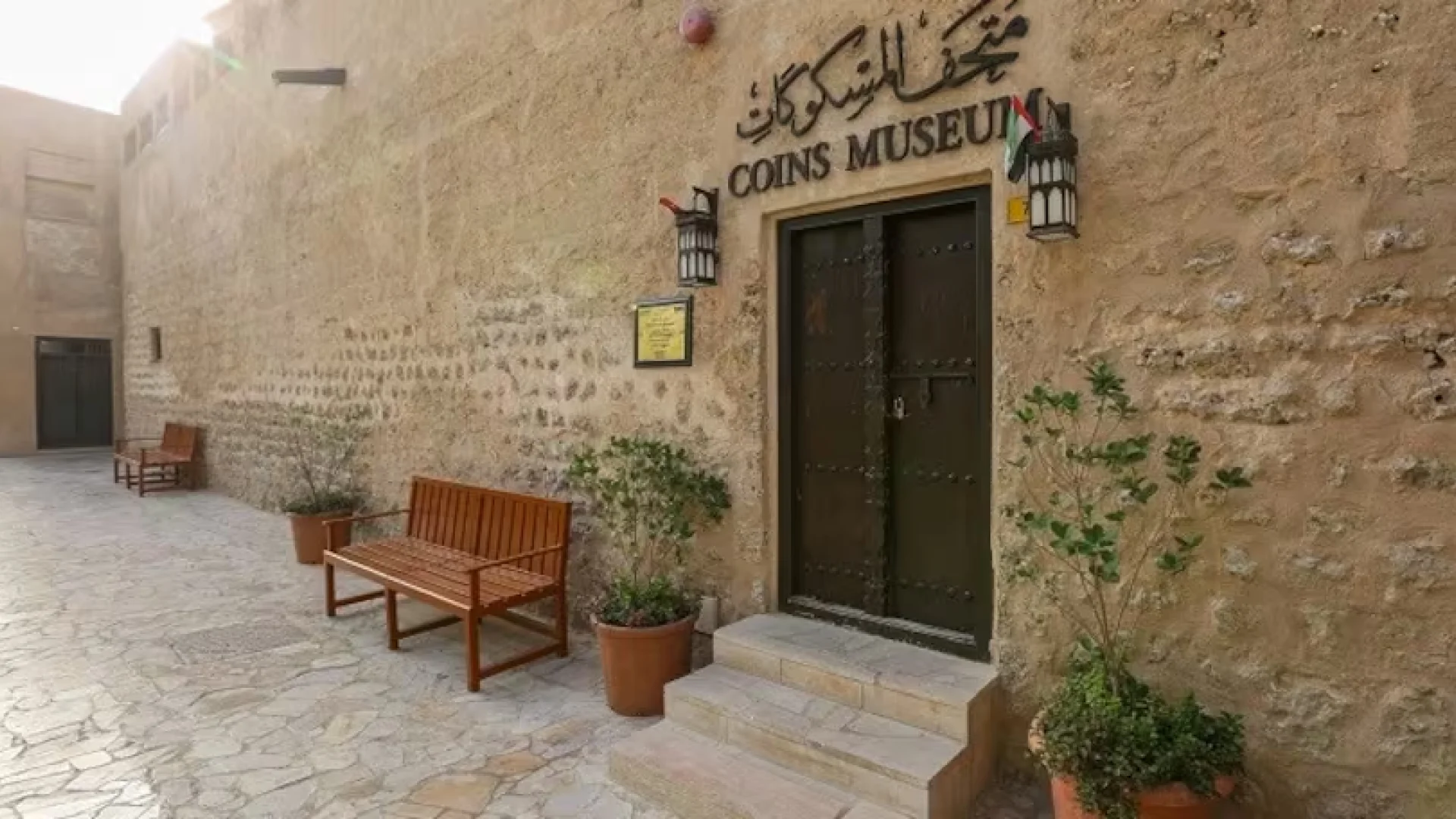
Mud-brick walls, wind towers and a hush that feels like memory: inside Dubai’s Coin Museum, centuries of trade and daily life glint from silver and copper. Across eight rooms, hundreds of coins from Islamic dynasties, the Indian Ocean world and Europe trace the routes that carried pearls, coffee and ideas to the Gulf. Guided tours connect the dots—from early dirhams in austere Kufic script and the globe-trotting Maria Theresa thaler to regional currencies that predate today’s UAE dirham. If you want to understand how the Emirates took shape, start here—with a magnifier in hand and history sparkling at millimeter scale.
The courtyard is cool. A salty lick from the Creek, a ribbon of sun sliding up the limewash. The group bunches up. A guide lifts a dull, small disc into the light. The edges catch. Lines turn into ornament. “See the script?” he asks. A boy nods; his mother leans closer. Across the room, magnifiers snap open and shut. Click. Click. The sound of curiosity.
Dubai’s Coin Museum in the Al Fahidi Historical Neighbourhood feels like a time machine with sand in its hinges. Inside a wind-tower house, the milestones of old routes sit in slim drawers: early Islamic dirhams, rupees from the years when the Gulf beat in rhythm with the Subcontinent, stout European silver that once rang across pearl markets. This isn’t a dry hall of labels. Every drawer is a door. Behind it: routes, people, wagers of trust.
“Picture the merchant,” the guide says, sliding a tray forward. “Leather ledger, a knot in his cloth purse, and this in his palm: weight, strike, promise.” He taps a coin carved in tight geometry. Kufic—more than decoration, a voice of authority. Opposite, a screen blows up loops and dots until script becomes a landscape. A school group whispers. “Is it gold?”—“No, but it travelled like a passport.”
The exhibition changes time zones with each room. One chamber smells of the Indian Ocean: crowned heads, Devanagari, Arabic legends in dialogue. Trade rode the monsoon out and the land-wind home. Next door, a European shimmer; one name returns—an empress whose silver outlived borders and bureaucracies. Her thaler became the caravan’s common tongue, the dhow’s steady ballast. Trust sounded like a familiar clink.
But the museum is also intimate. Late cases trace the step into modernity: regional issues, interim currencies, the careful making of a symbol that now jingles in every supermarket queue. The contemporary dirham is more than tender; it’s everyday poetry in aluminium and nickel. Numbers curl; words tessellate. A small design that travels pocket to pocket, day to day.
Guided tours stitch the collection into a narrative arc. Instead of dates to memorize, you get anchor points: how script manufactures trust; why weight is politics; how a coin can outlast an empire but not a tide. Headsets rest on tables; trade maps vein the walls. Arrows cross seas and desert; nodes flare where goods, stories and people pooled.
Outside, a muezzin calls. Inside, the AC hushes. You feel how deeply this place is locked into its neighbourhood. Two alleys away, coffee breathes from a clay cup. A camera clicks, someone laughs, a suitcase rumbles over old stone. After the tour, you may drift through the shady sikkas, peek into courtyards, and let the Creek’s breeze edit your thoughts. The city looks older, but also clearer—like a face you finally see in its lines.
This is not a museum for rushing. It’s a museum for pauses. The present sprints; here you set it to slow motion and find, in metal, things that feel alive: handwriting, hope, exchange. It’s astonishing how much of today gleams in old coins when you give them time.
Al Fahidi is more than a pretty backdrop; it’s a thesis in urban value. In Dubai’s micro-location chessboard, this historic quarter anchors culture-led footfall with rare walkability, museum clustering and tight proximity to the Creek, Souks and Al Seef. For operators—galleries, cafés, craft retail, boutique hospitality—that chemistry means steady traffic, strong dwell time, and the kind of shareable aesthetics that turn visitors into marketers.
Three lenses matter for investors. First, regulation: heritage conservation and adaptive reuse need finesse, but they confer scarcity and brand distinction. Second, mix: culture attracts F&B, F&B stabilizes street retail, together they extend stays and lift ticket-per-visit. Third, story: brands that braid the district’s DNA—craft, trade, sea—outperform in heritage settings because their proposition feels native, not pasted on.
Yield here is programmed, not accidental. It grows from curation—calendars of small exhibitions, collaborations with museums (the Coin Museum among them), limited editions by local artisans, all smoothing peaks and troughs. Residential concepts benefit from compact formats with shared courtyards that echo the wind-tower house. Hospitality wins when it goes low-rise, courtyard-centric, and locally textured—meeting guest expectations while controlling OpEx and amplifying ADR through place-authenticity.
Bottom line: the Coin Museum shows how narrative creates value—cultural, social and financial. Where story, touch and space align, a property outgrows its square meters. Investing here is a wager on meaning—and meaning compounds.