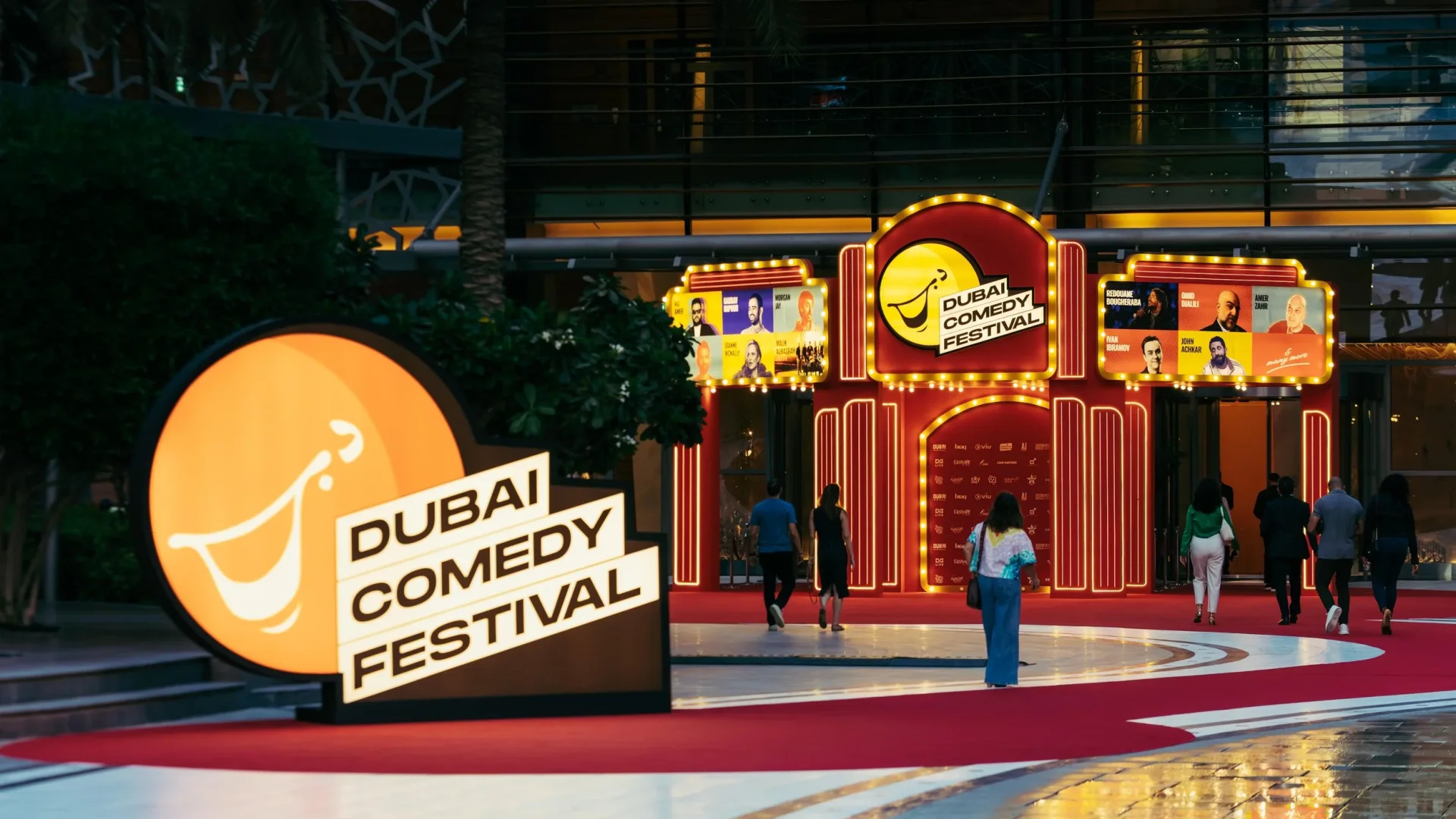
For a second, Dubai goes quiet—then the room cracks open with laughter that feels louder than the traffic outside. Dubai Comedy Festival is confirmed for 2026, bringing an international line-up of touring headliners, crowd favourites and fresh voices to stages across the city. Expect a packed calendar of stand-up and festival-style mixed bills, with shows spread across multiple venues and nights. It’s not just a gig list—it’s a week (or more) where Dubai’s glossy skyline turns into a soundtrack of punchlines and shared relief.
The lobby is cold enough to raise goosebumps. Outside, the air is warm and sweet with that Dubai mix—perfume, heat, and the faint bite of car exhaust. Inside, everyone is doing the same small choreography: brightness up on the phone, ticket ready, a quick glance at the time, a second glance at the name on the screen as if it might change.
“I just need to laugh,” a guy behind me says, half to his friend, half to the universe. His friend answers without missing a beat: “Same. No work talk tonight.”
That’s the thing about comedy in Dubai. It isn’t background noise. It’s a switch. The city runs fast—meetings, launches, brunches, timelines. And then, for a few hours, a roomful of strangers agrees to drop all of it. To sit in the dark and let someone else tell the truth, sideways.
Dubai Comedy Festival is officially returning in 2026, with a newly revealed line-up and a programme built like a proper festival—multiple nights, multiple venues, and a range of styles designed to pull in everyone from comedy purists to first-timers who “only came because the group chat insisted.”
The core promise is clear: international names, big touring energy, and a schedule that lets you build your own run—one headline show, or a whole week of nights that blur together in the best way. In a city that’s famously global, comedy becomes the most democratic language in the room. You don’t need the same passport to laugh at the same moment.
On festival nights, Dubai feels different. The roads are the same, the towers still glitter, but the mood changes. Taxis and ride-hails drop people at doors that suddenly matter: venues, theatres, ballrooms re-skinned for performance. You can tell who’s going to a show. There’s a little more excitement in the walk. A little more intention in the outfit. A little less rush.
And there’s always that micro-scene at the entrance—two people checking the seating plan like it’s a treasure map.
“We’re Row H.”
“Is H good?”
“H is perfect,” someone says, as if they know. As if comedy has best rows and worst rows. As if laughing needs strategy.
Festival line-ups are built for contrast. One night you want a master storyteller who can hold a room with a whisper. The next night you want speed—punchlines that land like drum hits. Dubai Comedy Festival 2026 leans into that variety, pairing big names with mixed-format evenings and crowd-pleasing concepts.
The best part is the emotional geography of it. Comedy isn’t one flavour. It’s a menu. And Dubai, with its endless mix of cultures and accents, is a rare place where that menu makes sense. A joke about moving countries. A joke about family expectations. A joke about dating apps. A joke about the strange intimacy of living in a city where everyone is new, and everyone is pretending they aren’t.
Every great set has a hinge moment. The comedian tests the waters. The audience gives a cautious laugh, then a bigger one, then suddenly the room is theirs. You can feel it physically—the shoulders drop, the faces soften, people stop guarding their reactions.
A woman two seats away covers her mouth, shaking. Not from sadness. From that helpless kind of laughter that makes you look briefly ridiculous. She tries to breathe. She fails. She laughs again. Her friend pats her arm like she’s been hit by a wave.
On stage, the comedian pauses just long enough to let it happen. That pause is a skill. A quiet flex. Like: Yes, I know what I’m doing. I brought you here.
Dubai doesn’t struggle to attract attention. It struggles—if anything—to prove depth behind the spectacle. A recurring comedy festival is part of that proof. It says: this is a place where people don’t only come to consume; they come to gather. To listen. To be surprised. To sit next to strangers and feel, for a couple of hours, like the city is one shared living room.
And there’s an economic rhythm to it too. Festivals create movement: visitors planning trips, residents planning weekends, restaurants timing reservations, hotels seeing spikes, ride-hails getting busier. A good line-up isn’t just culture—it’s footfall.
You arrive early because Dubai traffic is a story with too many possible endings. You promise yourself you’ll be calm. You aren’t. The queue forms. Someone’s laughing already, too loudly, like they’re preheating the mood. Another person is checking their phone with the intensity of a trader watching a market graph.
Then the doors open. The room is darker than you expect. The stage looks smaller than it did online. People always forget that screens lie. A microphone on a stand. A glass of water. A spotlight that turns the air into a visible cone.
The first line lands. Not perfectly. Yet. The second line lands better. The third line—there it is. The first real wave of laughter rolls back through the seats like wind through a corridor. Your body joins in before your brain can evaluate it. That’s when you know you’re in for a good one.
Because the 2026 programme is structured across multiple nights and venues, the smartest way to attend is to treat it like a mini-season rather than a single outing. Pick one anchor night (a headliner you’d regret missing), then add a second show that’s pure discovery.
And leave space for surprise. The comedian you’ve never heard of can become the story you tell for months. Outside the venue, someone will say it—someone always does.
“I thought I was just tagging along,” they’ll admit, almost annoyed at themselves. “But that was the best part of my week.”
Comedy feels intangible—until you look at what it does to a city’s liveability and spend patterns. Recurring, well-marketed festivals strengthen Dubai’s positioning as a year-round lifestyle hub, and that has knock-on effects for hospitality, short-term stays, and residential demand in neighbourhoods with strong venue access.
For investors, the practical takeaway is to watch the overlap between event corridors, transport connectivity, and mixed-use ecosystems. Where the city gathers at night tends to correlate with where demand stays resilient by day.