
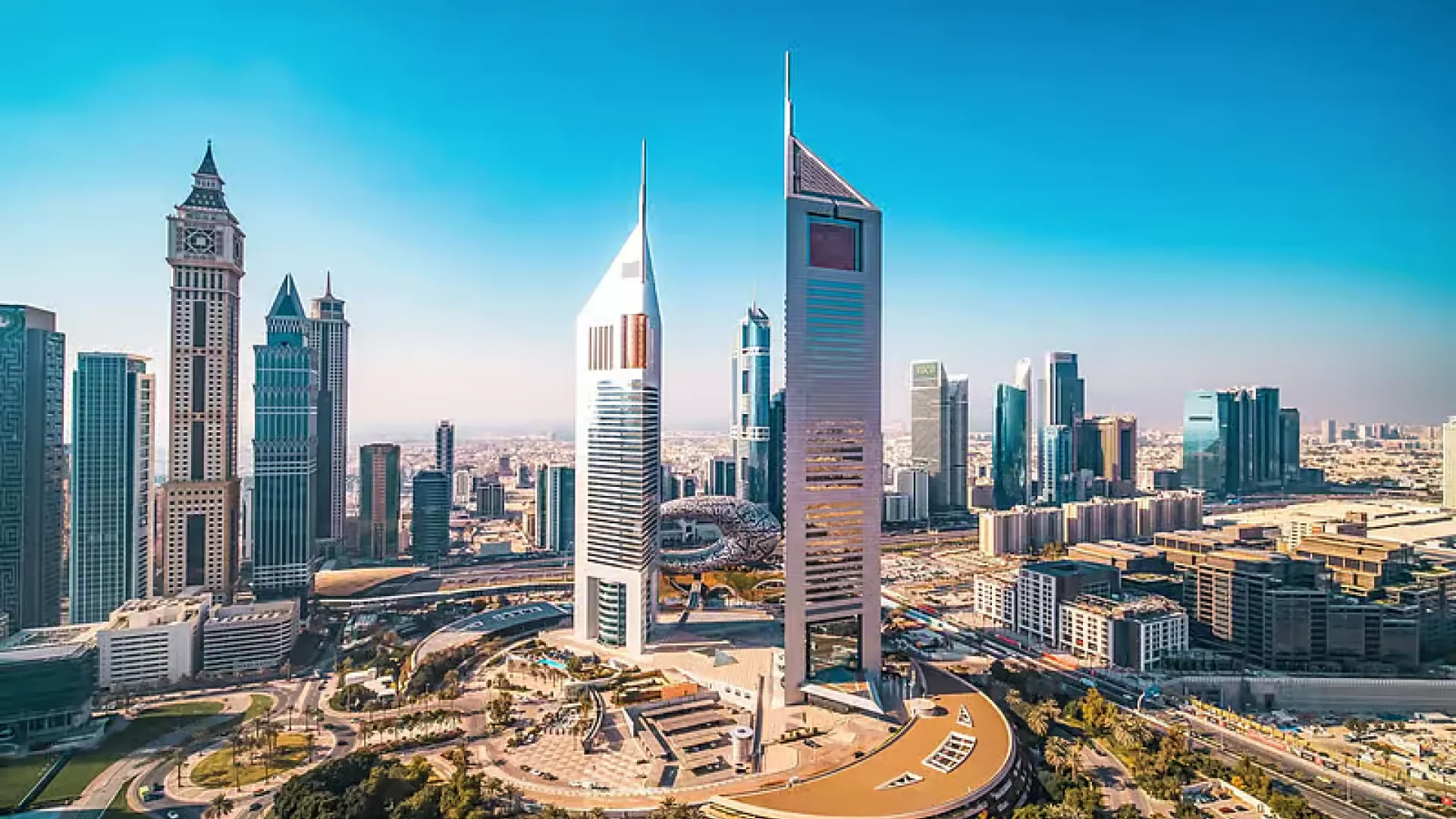

Dubai’s commercial property market delivered a jolt in March: prices jumped 28% despite rising regional tensions. The move reflects persistent demand across offices, retail and logistics, and Dubai’s pull as an operational “safe-haven” for companies, capital and talent. But a fast market is also a picky one—prime locations, building quality and lease structures are increasingly deciding who wins and who overpays. Walk the city’s business districts and warehouse corridors today and you can feel it: the future is being negotiated in square metres.
The elevator doors open like a curtain. Cool air spills out, and for a second the city sounds far away—no horns, no construction grind, just the soft hum of a lobby that smells faintly of polished stone and espresso. Then the glass doors slide back and Dubai snaps into focus: sunlight ricocheting off towers, heat shimmering above the road, a stream of people moving with purpose.
“We’ve got another viewing in twenty minutes,” a broker says, half to me, half into his phone. He doesn’t sound excited. He sounds busy. There’s a difference. Excitement is a spark; busy is a fire that’s already taken hold.
And that’s the surprise running through the market right now. While regional conflict dominates the news cycle—exactly the kind of backdrop that usually makes boards hesitate and investors tighten their spreadsheets—Dubai’s commercial property prices jumped 28% in March, according to the reported figures. Not a gentle climb. A leap.
Dubai has spent years turning itself into an instruction manual for momentum. Flights that connect, rules that are understood, services that answer the phone, and an ecosystem where a company can land on Monday and operate by Friday. In that kind of environment, uncertainty doesn’t always freeze decisions; sometimes it concentrates them.
“People still need to trade,” a logistics executive tells me later, tapping the edge of his coffee cup as if it’s a metronome. “They still need to move goods. They still need teams. So they choose where things work.” He says “work” the way you’d say “breathe.”
This is the context behind a 28% jump: demand that refuses to disappear, and supply—especially in the best parts of the market—that can’t stretch infinitely just because appetite grows.
In a bright corridor on a high floor, a building manager lifts the blinds with a small flourish. The skyline is right there, sharp as a postcard. “This is what they pay for,” he says. “Not just the view. The feeling.”
In many global cities, offices have become a debate: hybrid work, downsizing, “do we really need the space?” In Dubai, the conversations I hear are different. “We’re hiring.” “We need client-facing meeting rooms.” “We need to be closer to the metro.” “We need a better lobby.”
And once you’ve heard enough of those sentences, you understand why office demand can stay resilient. The office isn’t only a place to sit. It’s a signal: to clients, to recruits, to the market. In premium towers and well-connected districts, that signal is expensive—and getting more so.
In the late afternoon, the light goes honey-coloured and retail streets start to wake up. A shopkeeper adjusts a display with the care of a stage director. Two tourists stop, point, laugh, take a photo, move on. A family pauses at a window, the children pressed close to the glass.
“Footfall’s strong,” the shopkeeper says, as if admitting it might tempt fate. “Weekends are busy. And brands want visibility.”
Retail in Dubai doesn’t live on local demand alone. It feeds on arrivals: tourists, business travellers, new residents. When those flows are steady, the best retail locations behave like magnets—and magnets don’t bargain politely. For owners of well-leased retail units in proven corridors, that can translate into firmer pricing and confidence in cash flows. For tenants, it means the best spots don’t sit empty for long.
Drive out toward the industrial zones and the city changes its outfit. Less gloss, more grit. The soundtrack becomes diesel and the beep of reversing forklifts. Yet this is where some of the market’s clearest strength shows up.
A warehouse supervisor slides open a roller door. Inside, pallets stack like disciplined soldiers. Cardboard, metal, plastic wrap—the smell of commerce. “We’re full,” he says. “If we expand, we need more space.”
That sentence is the engine of industrial real estate. Demand comes from e-commerce, regional distribution, food and pharma supply chains, spare parts, last-mile operators—businesses that don’t care about skyline views but care deeply about ceiling heights, loading bays, power capacity and access to highways and ports.
Markets aren’t brave or fearful in a single direction. They’re selective. Regional conflict can raise risk perception, yes. But it can also make decision-makers value stability and operational reliability more than ever—especially if they’re running teams across borders and time zones.
Dubai’s appeal in that moment is practical: it’s a platform where contracts are enforceable, services are available, and international business is routine. For some companies and investors, that translates into a “safe-haven” premium—less about emotion, more about continuity.
“We can’t pause,” a consultant tells me in a café where laptops outnumber plates. “So we choose where pausing isn’t required.”
A single month’s number is always a snapshot. It can be influenced by the mix of deals—more prime transactions, fewer secondary ones—or by the comparison base. But even with those caveats in mind, a 28% move is loud. It says March wasn’t normal. It says buyers competed harder, sellers held their lines, and assets that tick the right boxes found pricing power.
Those boxes are increasingly specific. Not “commercial in Dubai,” but: Which micro-location? What building grade? What service charges? What lease clauses? How strong is the tenant? How long is the term? Is there indexation? Can the floorplate be split? How much capex is waiting behind the façade?
As the sun slides lower, the towers turn copper and the city looks almost theatrical. It’s easy to forget the headlines for a moment. In the lobby, someone signs a document. In a meeting room upstairs, a team argues over fit-out costs. Outside, a delivery van pulls in and a security guard lifts the barrier with a practiced wave.
That’s the real story of a market that can jump 28% in March: Dubai doesn’t stop moving. And when a city keeps moving, prices tend to follow.
For investors, the reported 28% March price surge is a momentum signal—and a warning label. Momentum can compress yields quickly, particularly in core assets, and it can punish anyone buying “Dubai” as a concept instead of underwriting a specific building with a specific cash-flow profile.
1) Yield compression and pricing discipline: In fast repricing phases, capital typically crowds into prime offices, well-located logistics and proven retail corridors. Prices rise faster than rents at first, pushing initial yields down. The winning move is not chasing yesterday’s comps, but modelling tomorrow’s income: realistic rent growth, downtime assumptions, capex schedules and tenant incentives.
2) Conflict risk vs. safe-haven premium: Regional tension can widen risk premiums through financing costs, insurance, and corporate risk committees. At the same time, it can strengthen Dubai’s role as an operational hub, supporting occupancy and tenant demand. Investors should run stress tests (lease rollover, vacancy, refinancing) and prioritise resilient tenant covenants and locations with diversified demand drivers.
3) Sector implications:
4) Strategy for the next 6–18 months: Consider a barbell approach: stabilised, income-secure assets for defence, paired with carefully chosen value-add plays where the business plan is clear (capex, leasing timeline, target tenants, and exit buyers). In a market moving this quickly, execution risk becomes as important as market risk—delays in fit-out, permitting or leasing can erase the upside of buying into momentum.
Bottom line: The March jump reinforces that Dubai’s commercial market is attracting users and capital even under regional stress. For investors, opportunity is real—but it increasingly belongs to those who underwrite micro-locations, lease mechanics and building quality with precision.