
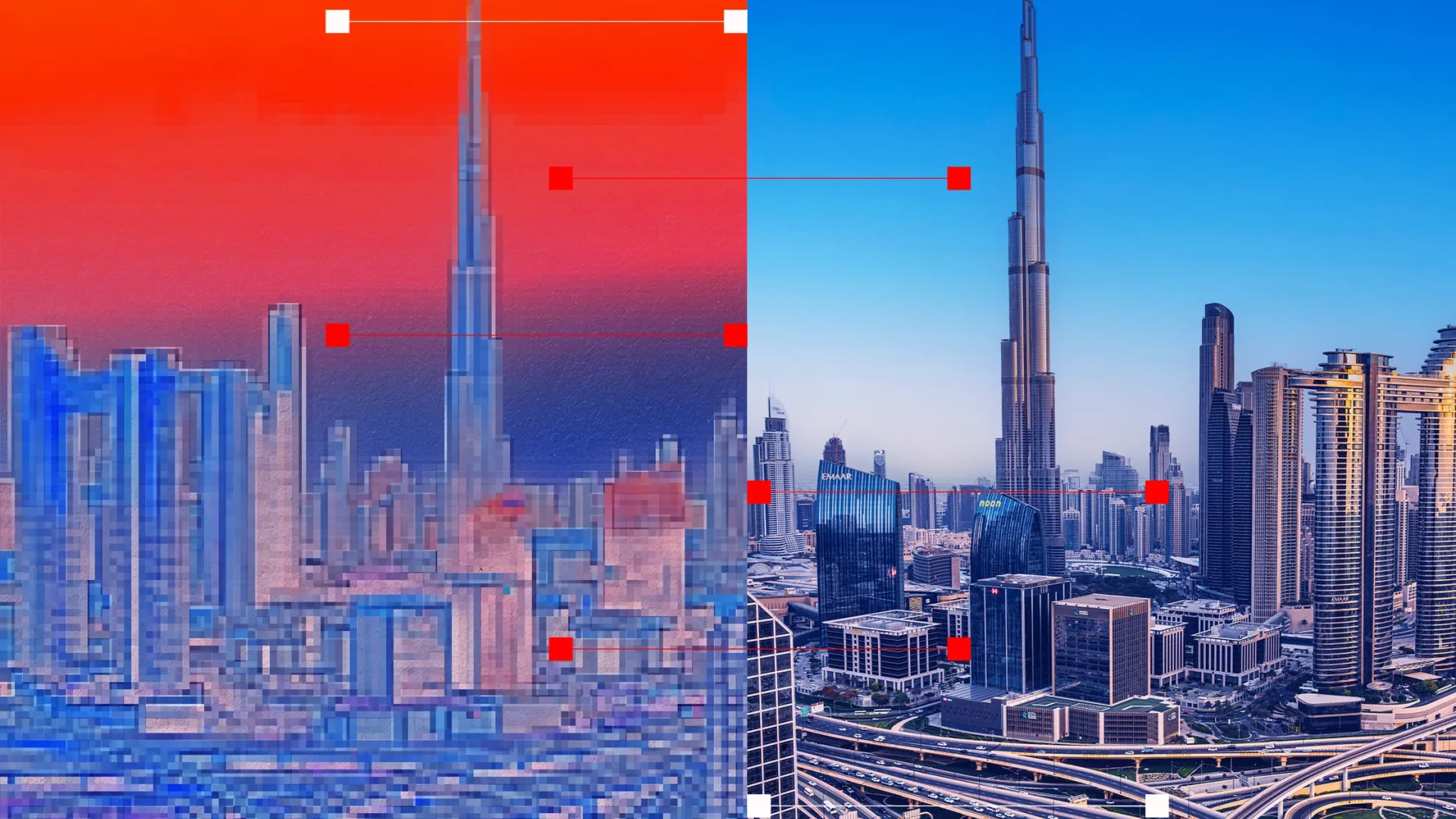

From the outside, Dubai looks like pure momentum—towers rising, highways humming, districts appearing almost overnight. But a second Dubai now lives in parallel: a digital twin that fuses detailed 3D city models with operational data to simulate “what-if” futures, from road closures and mega-events to long-term urban growth. The aim is sharper planning, faster coordination across agencies, and more resilient responses when reality deviates from the plan. It’s not sci‑fi spectacle so much as a new kind of city governance—one that tries to rehearse tomorrow before pouring today’s concrete.
The air shimmers above the highway like a mirage you can’t quite touch. Cars slide past in tight formation, their paint catching the sun in quick flashes—silver, white, a sudden red. Somewhere between an on-ramp and a line of towers, a driver leans on the horn. “Two exits,” the taxi driver says, eyes fixed ahead. “If it’s clear.” He pauses, then adds, almost to himself: “If.”
In Dubai, that tiny word—if—has become a design problem. And the city’s answer is unusual: build a second Dubai that never sweats, never honks, never sleeps. A Dubai made of polygons and probabilities. A digital twin.
At first glance, “digital twin” sounds like another tech buzzword, the kind that floats through conferences and vanishes. But Dubai’s version is meant to be operational: a high-fidelity 3D representation of the city linked to data streams and planning inputs so that officials can simulate changes before they happen.
Think of it as a rehearsal studio for urban life. You don’t just see the city; you poke it. You ask: What happens if we close this lane? If a new district opens here? If an event pulls tens of thousands into a single corridor at 6 pm? The twin doesn’t promise perfection—but it promises a faster feedback loop than trial-and-error on real streets.
Traditional city management is often a relay race: transport holds one baton, utilities another, planning a third. Decisions move through emails, spreadsheets, meetings that end with “Let’s follow up.” A digital twin tries to make the city legible in one shared frame—less a map on the wall, more a cockpit display.
In that cockpit, the questions get sharper. Instead of debating in abstractions—“Traffic will increase” or “This junction is a problem”—you can model flows and constraints, compare scenarios, and build consensus around something everyone can point to. The value isn’t just visualization; it’s coordination.
The most seductive feature of a city-scale twin is time. Not time travel in the cinematic sense, but the practical kind: the ability to fast-forward the consequences of a decision. Close a road in the model and watch bottlenecks migrate. Add a new connection and see whether it relieves pressure or simply moves it to the next intersection. Overlay a construction schedule and you can start to feel the city’s future friction points before they harden into daily routines.
And then there’s resilience—the moments when the city doesn’t behave. Emergencies, unexpected surges, disruptions. A well-integrated twin can help decision-makers understand dependencies and options quickly: what routes remain viable, what infrastructure is critical, where crowds concentrate. In a place built on speed, speed of response matters.
There’s a quiet temptation in any simulation: to treat it like a crystal ball. But a twin is only as trustworthy as the data feeding it and the assumptions behind its models. Garbage in, glossy garbage out. The real work is less glamorous: getting agencies aligned, cleaning data, keeping the model current, deciding who has access and who is responsible when the model says one thing and street reality says another.
Still, even with limits, a twin can do something cities desperately need: reduce guesswork. It turns a planning debate into a testable hypothesis. It makes “We think” a little closer to “We measured.”
Dubai is famous for building at scale—and at tempo. Big projects arrive with big deadlines, and the city’s systems have to keep up: roads, services, permitting, operations. A digital twin fits that rhythm. It compresses the time between idea and impact by letting teams preview interactions that used to be discovered only after launch.
Dubai isn’t alone—cities worldwide are building digital twins—but the ambition here is to make the twin more than a showcase. The goal is a practical layer of governance: a place where planning and operations meet, where decisions can be played out with fewer surprises.
The taxi slips into the exit lane. A truck signals late. For a second, the driver’s shoulders tighten; the city narrows to a few meters of asphalt and a split-second choice. Then it opens again—more lanes, more light, more forward motion.
Somewhere, in a server room and on a screen, that exit exists too. Not as a memory, but as a possibility. A scenario. A question. Dubai’s digital twin won’t eliminate chaos—cities are too human for that. But it offers something rare in modern urban life: the chance to make mistakes in the mirror, before making them in concrete.
For developers, investors, lenders and asset managers, a city-scale digital twin can shift the advantage from intuition to evidence. Better scenario modeling can reduce planning risk, improve underwriting assumptions, and help position projects for demand patterns that are still forming.
Investor takeaway: In fast-moving markets, the best returns often come from seeing friction early—mobility constraints, infrastructure timing, and shifting footfall. A mature digital-twin ecosystem can turn those signals into strategy, from land acquisition to exit timing.
{{real_estate_section}}