
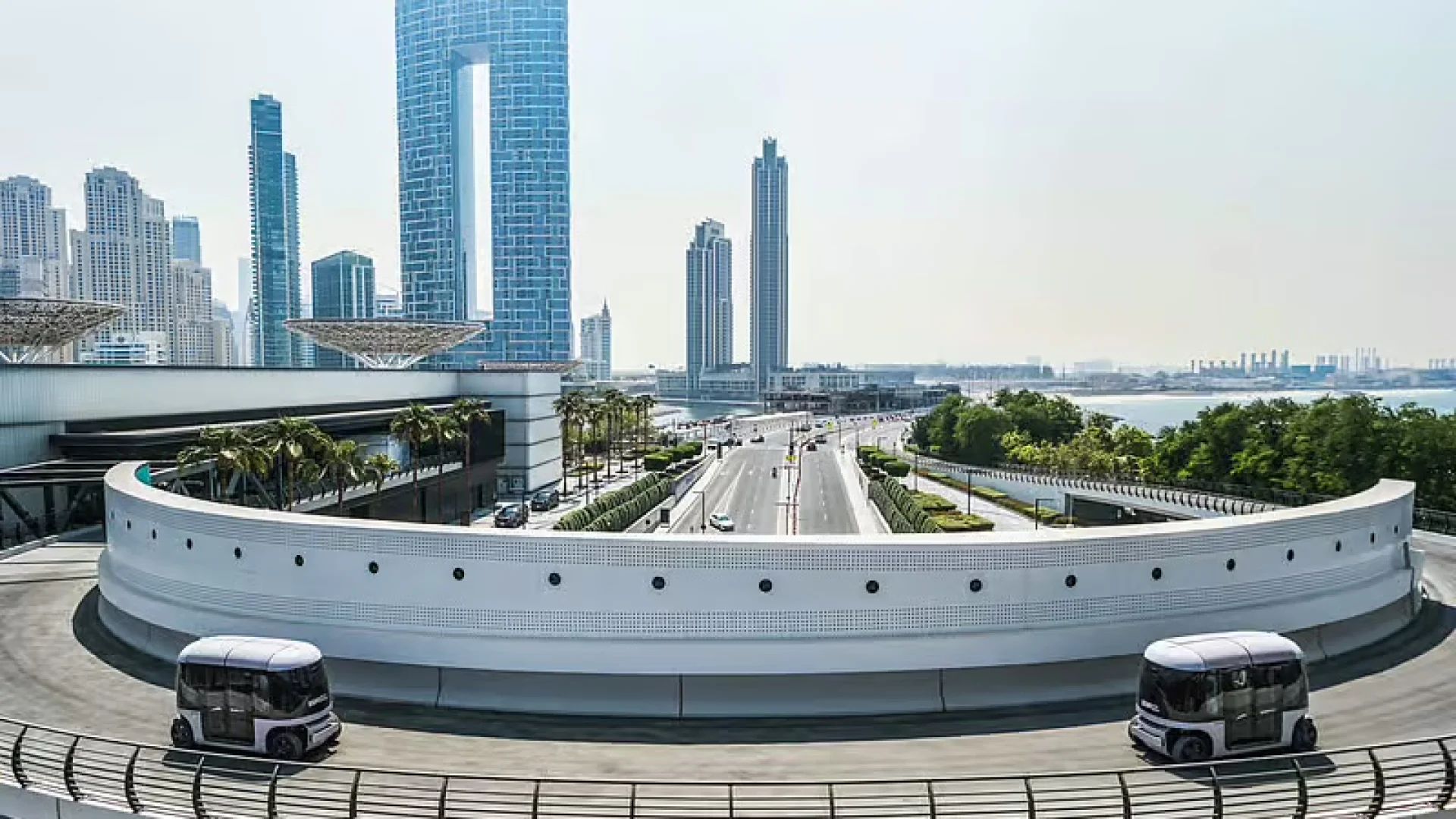

A small vehicle has been moving across Bluewaters Island without a driver at the wheel. Dubai has completed a trial of autonomous electric pods designed to test how driverless mobility performs in a real urban setting shaped by visitors, residents, hotels, restaurants and retail. The project adds another practical chapter to the emirate’s ambition to build a cleaner, more connected and increasingly automated transport system.
The first thing you notice is the silence. No engine growl. No impatient horn. Just the soft movement of a compact vehicle along the road, with the sea shimmering beyond the palms. Inside, passengers sit where a driver’s seat might normally be. But there is no driver. The pod is moving on its own.
That is the scene Dubai set out to test on Bluewaters Island. The trial of autonomous pods has now been completed, giving the emirate another real-world look at how driverless vehicles could serve short urban journeys. The aim is not to replace every bus, taxi or train. It is to explore what happens in the space between them.
“Does it really drive by itself?” a visitor might ask as the pod glides past. The answer is built into the vehicle’s technology. Sensors scan the surroundings, onboard systems interpret the route and the pod responds to its environment. It slows down, stops and continues without a conventional driver taking control.
Bluewaters Island is a natural setting for such an experiment. It is compact, but it is not empty. The island brings together homes, hotels, restaurants, shops, promenades and leisure attractions. People arrive, pause, wander and change direction. A vehicle operating here has to deal with more than a marked route. It has to coexist with the rhythm of a lively destination.
That makes the trial significant. A controlled track can demonstrate basic movement. A mixed-use island reveals the details that matter in daily life. How does the pod react when someone steps towards the road? Can it stop smoothly? Does the journey feel comfortable? Can passengers understand what the vehicle is doing? These are not glamorous questions, but they decide whether autonomous transport can move beyond a demonstration.
The pod’s most useful role may be on short connections. A guest leaves a car park and needs to reach a hotel entrance. A resident wants to travel from one part of the development to another. A visitor has finished dinner and wants to reach the promenade without walking through the heat. These are small journeys, yet they shape how a place is experienced.
Autonomous pods are designed around a simple idea: make short urban trips easier, cleaner and more efficient. Their electric drive reduces local emissions and gives the ride a smooth, almost floating quality. There is no need for a large vehicle on every short route. A smaller pod can fit more naturally into a district where buildings, public spaces and people share the same limited ground.
The technology may be advanced, but the promise is very practical. Good transport is often invisible. It gets people where they need to go without making them think about the machinery behind the journey. A pod that arrives on time, moves calmly and feels safe can become part of the background of a neighbourhood.
Dubai has spent years developing a reputation for ambitious transport experiments. Autonomous pods fit into that broader direction, alongside digital traffic systems, connected infrastructure and new forms of urban mobility. The city’s long-term vision is not based on one magic vehicle. It is based on a network in which different modes do different jobs.
Metro and tram systems handle larger flows. Buses serve wider areas. Taxis offer direct journeys. Small autonomous vehicles could connect the gaps: the hotel to the station, the parking area to the waterfront, the residential building to the retail district.
Bluewaters demonstrates why the final connection matters. Visitors do not experience a destination as a transport map. They experience it as a sequence of moments: arriving, crossing a plaza, finding a restaurant, walking towards the water and returning to a hotel. Every difficult or uncomfortable connection interrupts that experience. Every smooth connection strengthens it.
Technical performance is only half the story. The other half is human trust. Passengers want to know that the pod will recognise an obstacle, stop when needed and provide help if something unexpected happens. They want the technology to be understandable, not mysterious.
That is why a completed trial should be seen as a learning milestone rather than a final announcement. Each journey provides insight into vehicle behaviour, passenger comfort, safety procedures and the relationship between automated transport and public space. The results can help shape future pilots, operating rules and infrastructure decisions.
There is also a psychological shift taking place. The first driverless vehicle attracts attention. People photograph it. Children point. Visitors ask questions. But the long-term goal is almost the opposite: autonomy should become ordinary. The pod should eventually feel as familiar as a lift arriving at a building entrance.
For property owners and developers, autonomous mobility is not merely a transport story. Access has always influenced the value of a place. In the future, the quality of a local mobility network could matter as much as proximity to a major road or rail station.
Autonomous pods could connect hotels, residential towers, parking structures, shops, public spaces and transit stops. That may allow developers to rethink the ground plane. If fewer cars circulate in search of parking and more short journeys can be handled by compact electric vehicles, space could be released for landscaping, shaded walkways, cafés and community areas.
The implications are particularly relevant for master-planned districts and waterfront destinations. These areas often need to balance pedestrian comfort with practical access. A well-designed autonomous shuttle service could help keep streets calm while maintaining convenient connections for residents, guests and visitors.
Investors will also watch the economics closely. A project becomes more attractive when mobility is reliable, easy to understand and integrated from the beginning. Yet the success of autonomous transport will depend on more than novelty. Safety, operating costs, maintenance, regulation and passenger acceptance will determine whether pods become permanent services or remain limited pilots.
For now, the image remains compelling: a small electric vehicle travelling without a driver along an island built for modern urban life. It does not roar into the future. It simply rolls forward, quietly, one short journey at a time. On Bluewaters, Dubai has offered a glimpse of what transport may look like when the road itself begins to think.