
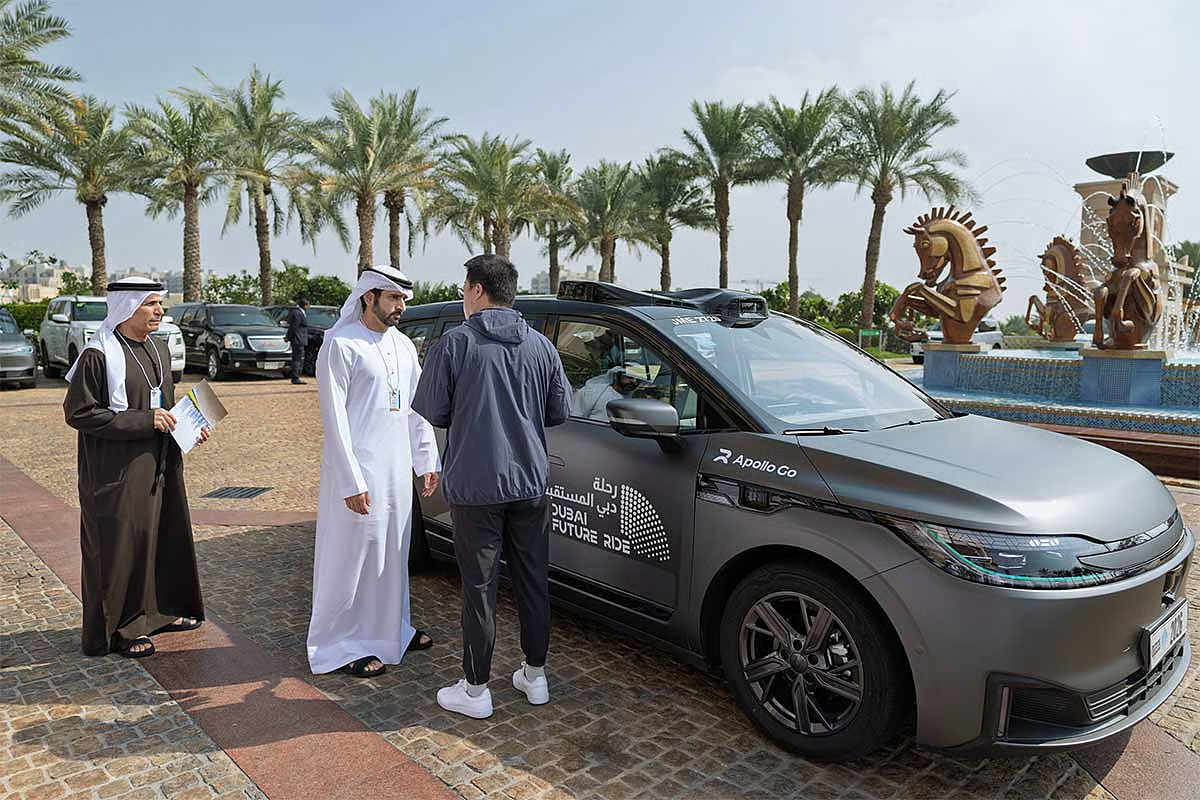

Dubai’s next “how is this real?” moment arrives in March: a driverless taxi service is set to start operating, announced by Sheikh Hamdan bin Mohammed bin Rashid Al Maktoum. The move signals more than a flashy tech trial—it’s a step toward integrating autonomous vehicles into the city’s transport mix. For residents and visitors it promises a new kind of ride; for planners and investors it hints at how quickly accessibility, neighbourhood appeal, and infrastructure priorities could shift across Dubai.
Dubai has a particular kind of morning—quiet, but never still. The towers look freshly polished, the roads hum like a distant machine, and the air carries that faint desert brightness even before the sun fully commits.
At the curb, an ordinary-looking car waits. Clean lines. Tinted glass. The sort of vehicle you’d ignore if you were late for a meeting. Then you notice what’s missing: a driver.
“So… who’s taking us?” a man nearby asks, half-laughing, half-checking if this is a prank. A staff member gives a small, calm nod. “The system,” he says. The door clicks open. The cabin feels cool and composed. And suddenly, the future isn’t a concept—it’s a seatbelt.
Dubai is set to start operating a driverless taxi service in March, an announcement made by Sheikh Hamdan bin Mohammed bin Rashid Al Maktoum. In a city famous for turning bold ideas into daily routines—fast—this is the next chapter: autonomous mobility stepping out of pilot mode and into the public rhythm of commutes, errands, airport runs, and late-night trips home.
Dubai doesn’t merely adopt new technologies; it stages them. The rollout of a driverless taxi service fits neatly into that broader narrative of smart infrastructure, high-speed execution, and a constant push to make the city feel seamless. But the real story isn’t the headline. It’s what happens when the novelty wears off and the service becomes… normal.
Because taxis in Dubai are more than transport. They are the in-between space of the city: between hotel lobby and conference hall, between a beach afternoon and a downtown dinner, between a resident’s routine and a visitor’s “I’ll just see one more place.” Put autonomy in that in-between space, and you change the texture of the day.
“Operating in March” is a phrase that lands with weight. It suggests a real-world service—vehicles running as part of a structured offering—rather than a closed-track demonstration. In the language of urban mobility, that’s the moment a concept touches the curb.
And when an announcement comes directly from Sheikh Hamdan, it reads like a signal flare: this isn’t a side project. It’s aligned with the city’s vision and priorities. Dubai has spent years building an identity around efficiency and innovation; autonomous taxis are a logical extension of that identity, one that can influence everything from travel behaviour to how people choose where to live.
Watching an autonomous vehicle move is almost anticlimactic. That’s the point. The most impressive thing it can do is appear unremarkable—safe, smooth, predictable.
But beneath that calm surface is an orchestra of sensors and software: detection, localisation, mapping, decision-making, and constant recalculation. The vehicle must recognise the world not as scenery, but as a living set of variables—cars drifting across lanes, pedestrians hesitating at crossings, delivery bikes darting like commas in a sentence.
Dubai adds its own special twist: an intensely international driving culture. Different habits. Different expectations. Different interpretations of the same road space. In that environment, “autonomous” doesn’t just mean following rules—it means reading the city.
Imagine your first trip. You sit down and instinctively glance toward the front seat. Your brain expects a person. A nod. A “Where to?” Instead there’s a clean dashboard, a composed interface, a voice that sounds politely unbothered by traffic.
“Please fasten your seatbelt.”
The doors seal with a soft thud. The car eases forward. The acceleration is careful, almost conservative, as if the vehicle is determined to make a good first impression. You start noticing details you’d normally ignore: the exact moment it decides to brake, the way it holds distance, the patient pause before a turn. It drives like someone who is never late—and never angry.
“It’s actually doing it,” someone whispers, like saying it out loud might jinx the spell.
Autonomous taxis are often framed as a tech spectacle. In Dubai, they also function as policy: a tool to expand mobility options as the city grows, densifies, and diversifies. The promise is simple—more accessible transport, more efficient movement, and eventually, a system that can scale without relying solely on traditional staffing and fleet models.
There’s also a brand logic. Dubai competes globally for business, tourism, and talent. A city that feels frictionless is a city that feels powerful. If you can step out of a tower, summon a car, and glide across the city with minimal waiting and predictable travel, you’re not just saving minutes—you’re reinforcing a sense of order.
The impact of a new service rarely arrives with fireworks. It arrives with habits.
A resident takes a driverless taxi to the metro station because parking is annoying. A tourist chooses it after a concert because it feels safer and more straightforward. An office manager tries it for guest transport because it’s consistent. Over time, these micro-choices can shape traffic patterns, pickup zones, and even how developers design entrances, drop-offs, and street frontage.
Autonomy is ultimately a trust transaction. People will ride if they believe the system is not only smart, but cautious—and that there are clear operational safeguards behind it. Dubai’s approach to innovation typically blends ambition with structure: defined rollout phases, regulations, monitoring, and adjustments based on performance.
And then there’s the emotional shift. Traditional taxi rides can be tiny human exchanges—recommendations, small talk, someone’s story in the time it takes to cross town. A driverless cabin removes that. It replaces it with something else: quiet, consistency, and a new kind of comfort for those who prefer their commute like a private capsule.
In March, Dubai’s streets won’t just carry cars. They’ll carry a question: how quickly can the extraordinary become routine?
Mobility is one of the most underestimated forces in property markets. It quietly determines what feels “close,” what feels “easy,” and what feels worth paying for. Dubai’s move to begin operating driverless taxis in March matters to investors because it signals momentum in smart infrastructure—and because autonomy, once scaled, can reshape how neighbourhoods compete for demand.
1) Accessibility premiums may shift. Today, price premiums often cluster around metro stations, major highways, and established hubs. Autonomous, on-demand mobility adds another layer: service accessibility. If a community consistently receives fast pickups and reliable routing, it can feel more connected—even if it sits outside the traditional “prime” map. Over time, that can support stronger rental demand and improve liquidity in select secondary locations.
2) Design priorities: from parking to pick-up. If autonomous ride-hailing expands, developers and asset managers may gradually re-balance space:
3) Boost for hospitality, short stays, and serviced living. Hotels, serviced apartments, and short-term rentals thrive on frictionless guest movement. Reliable, novel mobility can enhance guest experience and support occupancy, particularly for event-driven demand. Areas that previously required a rental car may become more appealing if autonomous taxis make door-to-door trips effortless.
4) “Smart-ready” communities gain a marketing edge. Masterplanned areas with clear street grids, well-managed curbs, and strong digital infrastructure are typically easier to integrate into advanced mobility systems. For investors, that translates into a practical screening question: is the location built to accommodate future transport models, or will it face operational constraints?
5) Data as a new micro-location tool. As autonomous services scale, the underlying mobility data can sharpen market intelligence: true travel-time heatmaps, peak-demand corridors, and event impact patterns. Investors who track these signals can identify improving micro-locations earlier than traditional comps-based analysis.
Investor takeaway: The March launch is a high-confidence signal of Dubai’s execution speed in mobility innovation. Short term, it enhances the city’s “future-ready” brand, supporting sentiment and demand. Medium term, wider adoption could influence where tenants want to live, how assets are designed, and which districts capture new premiums based on frictionless access. For acquisitions and development, it’s increasingly rational to evaluate not only roads and metro proximity, but also the trajectory of on-demand autonomous coverage.