
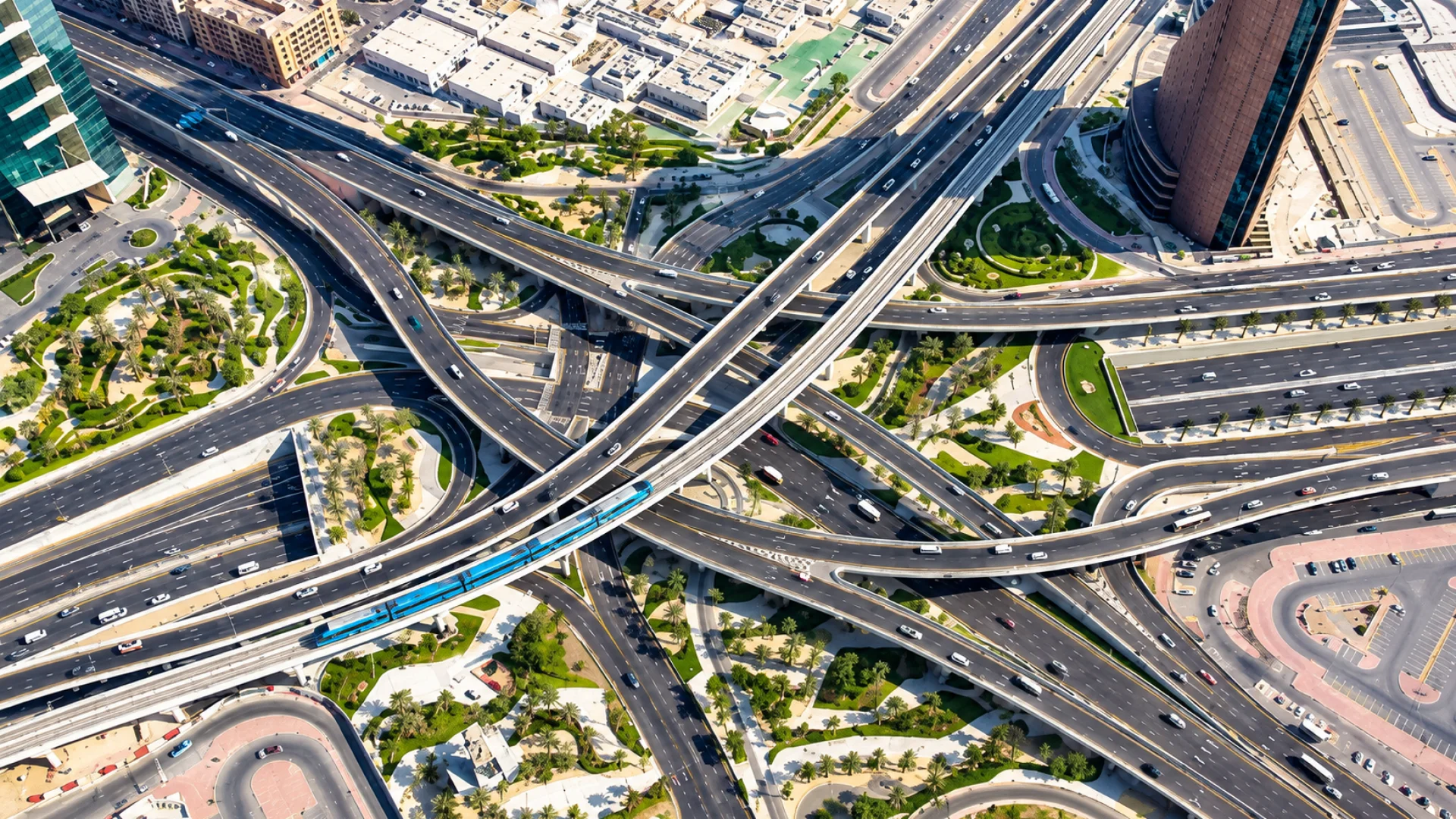

The last bridge at Dubai’s Trade Centre Roundabout is now open, completing the transformation of a crucial junction in the heart of the city. The connection is designed to streamline traffic around the Dubai World Trade Centre, Sheikh Zayed Road and surrounding business districts by separating key movements across multiple levels. For commuters, visitors and businesses, the opening promises clearer routes, fewer interruptions and a more reliable journey through one of Dubai’s busiest urban corridors.
The morning light hits the road first. It slides across the lanes, catches the glass towers and turns the new bridge into a bright silver ribbon above the traffic. Cars move beneath it. A taxi climbs the ramp. Somewhere nearby, a driver checks the signs and says, “This way now?” Then the stream continues without stopping.
Dubai has opened the final bridge at Trade Centre Roundabout, bringing a major upgrade of the central junction to completion. There is no need for a spectacular skyline ceremony to understand what has changed. The clearest proof is in the movement itself: vehicles that once competed for space can now follow more direct routes through a layered road network.
Trade Centre Roundabout is one of those places that visitors may remember without knowing its name. It sits in a highly visible part of Dubai, close to the Dubai World Trade Centre and connected to major routes including Sheikh Zayed Road. Commuters pass through on their way to offices. Exhibitors arrive with equipment. Hotel guests head toward conferences. Taxis, buses, delivery vans and private cars all converge in the same urban space.
At busy times, a junction like this behaves almost like a living organism. One small delay travels backward. A vehicle changing lanes slows the next one. A queue at an exit reaches the previous intersection. During major exhibitions, the pressure increases further. Thousands of people can arrive within a short period, many unfamiliar with the roads and dependent on clear access to the venue.
The final bridge adds another layer to the system. Instead of forcing every movement through the same roundabout or signal-controlled crossing, the upgraded layout guides traffic along separate paths. Some vehicles can pass above the junction. Others continue at ground level or use dedicated ramps. The result is not simply a new piece of concrete. It is a new choreography for the city.
“Keep moving” is what good infrastructure says without words. Drivers may notice the bridge on their first trip. After a few days, they may barely look up. That is the paradox of successful transport planning: the structure is enormous, but the experience becomes ordinary. A journey feels shorter because it contains fewer moments of hesitation.
The opening also closes a chapter of construction. For road users, the building phase meant changing lanes, temporary barriers, diversions and a constantly shifting understanding of the route. The completed bridge replaces that uncertainty with a permanent connection. Now the real test begins: how the junction performs during the morning rush, the evening return journey and the intense peaks created by major events at the Trade Centre.
For the Dubai World Trade Centre, access is more than a convenience. It is part of the visitor experience. A conference starts long before the first presentation, often with the journey from the hotel or airport. If that journey is confusing or unpredictable, the impression of the entire destination suffers. A clear, resilient road network helps the district absorb large movements while keeping everyday traffic flowing.
The project reflects a familiar Dubai principle: plan for the city that is coming, not only the city that exists today. Dubai continues to attract residents, companies, visitors and events. Every new office tower, hotel, residential building and exhibition programme creates additional journeys. Road capacity must therefore be considered as part of the wider urban ecosystem.
That ecosystem extends beyond cars. Reliable access supports taxis and commercial vehicles. It helps service staff reach hotels and offices. It makes event logistics more predictable. It can also improve the practical appeal of public transport connections, because buses and taxis operate more effectively when surrounding roads are less congested.
There is a human detail hidden inside all this engineering. A commuter leaving home before sunrise wants to know that the route will behave as expected. A family arriving for an exhibition wants to find the entrance without circling the block. A business visitor with ten minutes before a meeting wants the final kilometre to feel simple. Infrastructure earns its value in these small moments.
The bridge also changes the visual identity of the district. Elevated roads are part of Dubai’s urban language, where movement, architecture and engineering share the skyline. From a distance, the structure joins the city’s network of ramps and viaducts. Up close, it becomes a sequence of concrete edges, lane markings, signs and headlights. The scale is impressive, but its purpose is practical.
Connectivity is one of the quiet forces behind Dubai’s property market. Around Trade Centre, the relationship between roads, offices, hotels and event venues is particularly direct. Businesses want locations that employees and clients can reach. Hotels benefit from proximity to exhibitions and major attractions. Serviced apartments appeal to professionals who need a central base with reliable access to the rest of the city.
The completed bridge can strengthen that location story. It may make journeys to nearby properties more predictable and improve the first impression of the district. For landlords, that can support tenant appeal. For investors, it adds another infrastructure layer to a neighbourhood already defined by visibility, employment density and access to major destinations.
Infrastructure should not be viewed in isolation. Property performance still depends on the building, management, amenities, leasing conditions and wider market cycle. Yet transport improvements can contribute to long-term resilience. A location that works on ordinary weekdays and during major events has a broader demand base than one that functions only under light traffic.
For investors assessing the area, the relevant questions are practical: How quickly can residents reach work? Can hotel guests access the venue district without complicated diversions? Does the road network support deliveries and ride-hailing? How does the property connect with rail, bus and pedestrian routes? The new bridge does not answer every question, but it improves one of the most visible parts of the equation.
By night, the traffic lights glow beneath the bridge and the towers reflect in the windscreens. Most drivers will not celebrate the final stage of a road project. They will simply take the ramp, cross the junction and continue toward their destination. In a city built on movement, that quiet continuity is the real headline.