
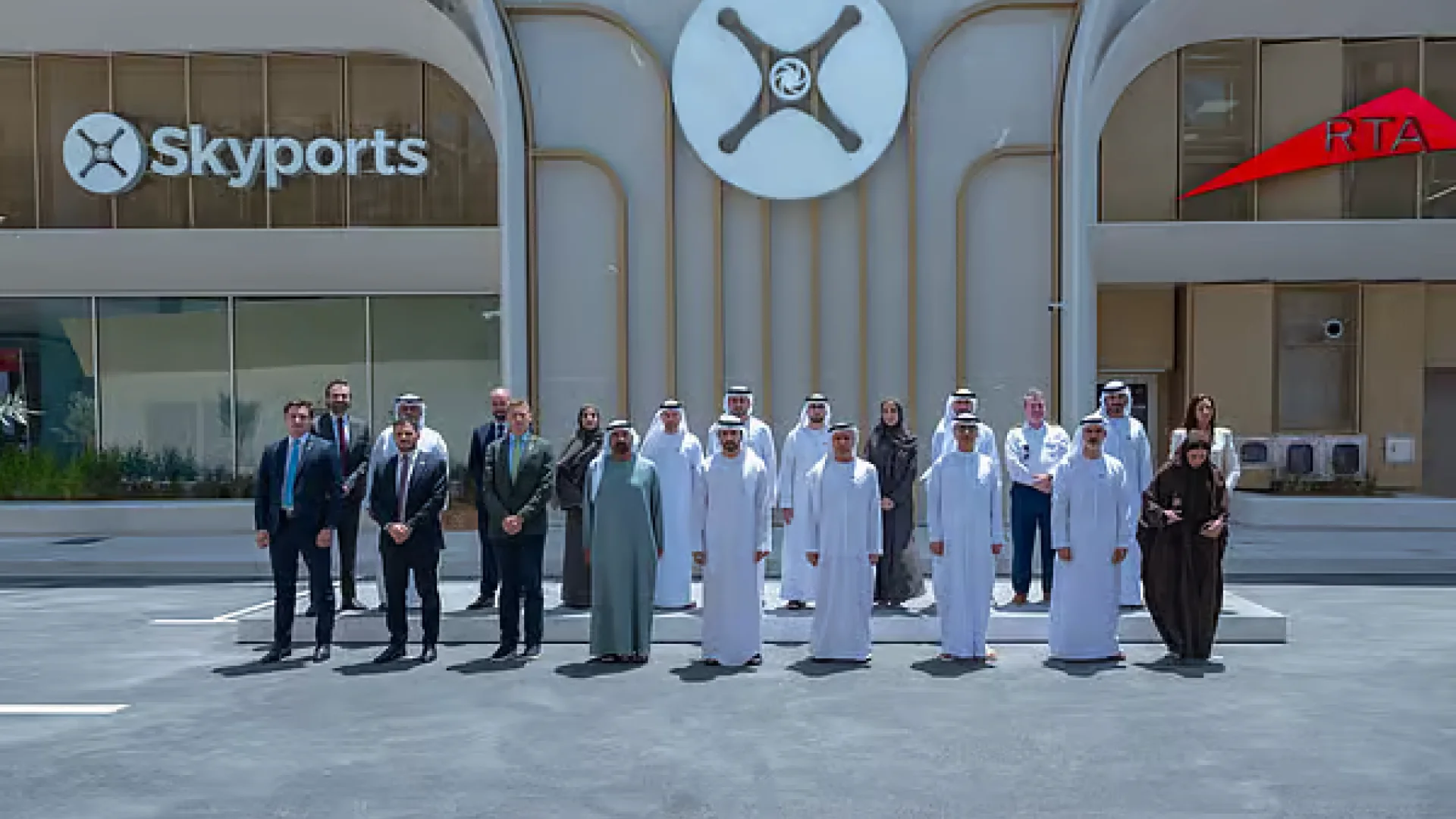
Dubai has put a physical stake in the future: the emirate’s first air taxi station, located near Dubai International Airport (DXB), is now ready, as announced by Sheikh Hamdan bin Mohammed bin Rashid Al Maktoum. The site is designed to support electric vertical take-off and landing aircraft (eVTOLs) and anchor a wider network connecting key districts such as Downtown Dubai, Dubai Marina and Palm Jumeirah. With passenger operations targeted for 2026, the move shifts air mobility from concept to concrete infrastructure. And once minutes replace kilometres, real estate value maps tend to redraw themselves fast.
The heat around Dubai International Airport has its own shimmer, a silver tremble that makes the horizon look like it’s breathing. Planes land with their familiar thunder. Taxis queue, inch, pause. Somewhere between the roar and the wait, a new kind of sound is about to arrive—something closer to a deep, electric hum than a helicopter’s chop.
“Ready,” Sheikh Hamdan bin Mohammed bin Rashid Al Maktoum announced—one word that changes the mood of the whole scene. Dubai’s first air taxi station, positioned near DXB, is complete. Not a teaser video. Not a glossy model. A built piece of city infrastructure, sitting in the airport’s gravitational field, prepared for a new layer of movement: electric air taxis, the eVTOLs that lift straight up and slide forward into the skyline.
Dubai is a city that measures life in quick turns: a meeting that starts on the dot, a delivery that arrives before you think to check, a skyline that changes between weekends. Yet traffic—no matter how wide the roads, how smart the signals—still has the power to steal time.
That’s the promise embedded in this new station near the airport. The plan is simple to describe and radical to experience: step off the ground, skip the jam, land close to where you actually want to be. Dubai’s air taxi programme aims to start passenger operations in 2026, and this first ready-to-use station is the kind of milestone investors and planners watch closely. Because when infrastructure is poured, wired, and signed off, timelines stop being abstract.
Imagine the future version of an arrival at DXB. You roll your suitcase across a cool floor. Someone checks your booking. A short security routine. A pause that feels like an elevator moment. Then lift—straight up. The airport becomes a diagram. The city opens like a map you can fold and unfold with your fingertips.
Sheikh Hamdan’s announcement isn’t only about one station. It signals a system: vertiports positioned at strategic points, linked by routes, procedures, and regulation. Dubai’s ambition is to create a network that connects major destinations—names that function like magnets in the emirate’s daily life and visitor economy: Downtown Dubai, Dubai Marina, Palm Jumeirah.
Those districts already command premium status. The air taxi layer aims to tighten the city’s time geometry even further—turning what might be a 45-minute drive at the wrong hour into a short, scheduled hop.
Most cities grow by adding lanes, lines, and links. The air taxi concept adds something else: a different relationship with time. It’s not only about being faster; it’s about being predictable. That’s what business travellers pay for. That’s what luxury hospitality sells. That’s what residents begin to demand once they’ve tasted it.
There’s a particular kind of relief in knowing your commute won’t suddenly double because a bottleneck formed near an interchange. Dubai understands this psychology. The city has always traded in controlled experiences: curated views, curated routes, curated arrivals. Air taxis fit the brand, but they also fit the economics.
“Can you make it in time?” someone asks over the phone, the question loaded with the usual Dubai variables—traffic, distance, the unpredictable pulse of the day.
“Twelve minutes,” comes the reply. Not bravado. Just a new calculation.
In a hotel lobby, a concierge points upward—not to a tower, but to a direction. In a meeting room near DIFC, a team quietly shifts a schedule because the airport is no longer a long commute away; it’s a short aerial connection. On a balcony in the Marina, a visitor looks up at a moving dot and realises the sky has become a roadway.
Placing the first station near Dubai International Airport is a statement in itself. Airports are complex: controlled airspace, strict safety layers, constant movement. If a city can integrate eVTOL infrastructure in the orbit of DXB, it signals operational seriousness—coordination with aviation authorities, procedures for passenger handling, and a willingness to fit a new mode of transport into the tight choreography of an international hub.
It also makes practical sense. DXB is a gateway for business and tourism, and a vertiport nearby turns arrivals into immediate mobility. Not later. Not after the traffic. Now.
Dubai’s property market has always been deeply tied to accessibility and story. “Beachfront.” “Metro-connected.” “Five minutes to Downtown.” These phrases aren’t just marketing; they’re pricing tools.
Air taxi stations introduce a new phrase: “One hop away.” Once the network expands, neighbourhoods will be measured not only by road distance, but by aerial connectivity. Places that feel far today could feel close tomorrow—if a vertiport sits within a short drive, a walk, or a well-designed last-mile connection.
Of course, the scale of the impact depends on what comes next: how many stations, what routes, what ticket pricing, what operating hours, what capacity. But the psychology shifts as soon as the first station becomes real. The city starts to imagine itself differently—and imagination is the first step to behaviour change.
The completion of Dubai’s first air taxi station near DXB is a tangible milestone for investors because it turns urban air mobility from a concept into build-out reality. In real estate, that matters: values respond to infrastructure once it can be visited, measured, and integrated into underwriting assumptions.
1) Vertiport proximity as a new premium
If passenger services begin in 2026 and the network expands toward Downtown Dubai, Dubai Marina, and Palm Jumeirah, properties with convenient access to those stations could command an “accessibility premium” similar to metro-adjacent assets—particularly where time savings are meaningful for end users.
2) The DXB zone: repositioning opportunities
Areas near airports are often viewed as functional rather than aspirational. An air taxi station nearby could tilt that equation for specific asset types: short-stay accommodation, corporate housing, meeting-and-event venues, and certain medical/wellness concepts that rely on quick regional access.
3) Underwriting the network, not the headline
Investors should model the value impact based on network density and operational realities: number of vertiports delivered, regulatory approvals, flight corridors, capacity, pricing, and reliability. A single station is a start; a functioning network is what moves demand curves.
4) Development strategy: “air mobility-ready” districts
For developers, future vertiport locations can become anchors for mixed-use planning, similar to transit-oriented development. Projects that integrate strong last-mile links—shuttles, walkable access, curated arrival experiences—may capture early demand, especially in premium segments.
5) Risk lens: routes, noise profiles, and micro-location
Even with quieter eVTOLs, investor diligence should consider approach/departure corridors, operating hours, and any constraints on nearby development. The best-performing assets may not be the closest ones, but those that are conveniently close without being directly exposed.
Investor takeaway: Treat the DXB air taxi station as the first data point in a new accessibility layer for Dubai. As the rollout progresses toward 2026, expect location narratives—and the pricing attached to them—to evolve quickly.