
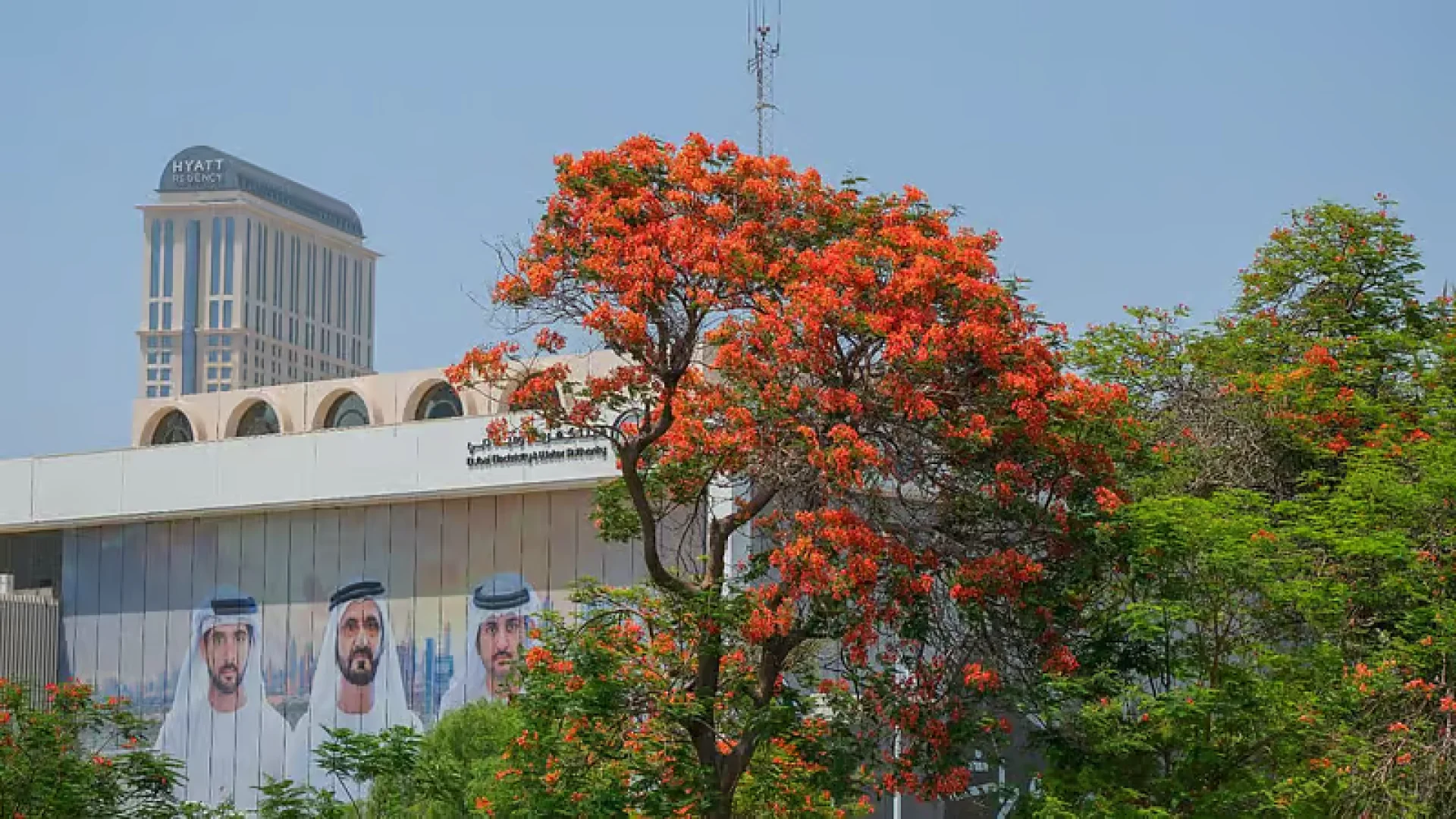

Step off Dubai’s sunlit pavement and into the shade of a flame tree, and the city feels like it exhales. A senior official has highlighted a striking figure: in shaded areas, these trees can reduce ground temperatures by up to 5°C. It’s a small number with big consequences—cooler sidewalks, more usable public spaces, and neighborhoods that feel walkable for longer. In a climate where heat shapes daily life, the humble canopy is starting to look like essential infrastructure.
The first thing you notice is the glare. Noon in Dubai turns every pale stone into a mirror and every dark tile into a hotplate. You cross a stretch of open sidewalk and the heat climbs up your legs like invisible flames. Then—almost by accident—you drift under a wide, feathery canopy. The light softens. The air changes texture. Your shoulders drop.
“Stand here,” a worker says, tapping the ground with the toe of his boot. He holds a small device in his hand like a magician about to reveal a trick. “Now step out.” You do. The pavement outside the shade feels aggressive, as if it’s storing anger. You step back under the tree. Relief. Not dramatic, not cinematic—just immediate.
Dubai’s officials are now putting numbers to that feeling. According to a top official, flame trees—those flamboyant, red-orange bloomers known botanically as Delonix regia—can reduce ground temperatures in shaded areas by up to 5°C. Five degrees doesn’t sound like a headline until you live inside it. Then it becomes the difference between “Let’s walk” and “Let’s not.”
Flame trees are show-offs in the best possible way. When they flower, the canopy looks sprinkled with embers—clusters of vivid red and orange against soft green leaves. In photos, they read as decoration. On the street, they behave like equipment.
Because the real spectacle isn’t the color. It’s the shadow.
Dubai, like many fast-growing cities, is built from materials that love heat: asphalt, concrete, stone, glass. They drink sunlight all day and release it slowly, long after sunset. That’s the urban heat island effect in plain clothes. And it’s why measuring the ground—not just the air—matters. Hot surfaces radiate heat back into the space where people actually live: at waist height, stroller height, dog-walking height. The city’s warmth is often a ground-up story.
There’s a certain choreography to summer in Dubai. People move fast between shade patches. They angle themselves along walls. They wait for the elevator in the narrow shadow of a sign. Outdoor life becomes a game of geometry.
Now imagine a street where shade is not an accident but a continuous ribbon—tree after tree, canopy after canopy. Suddenly the same block becomes readable in a different way. You can stroll. You can push a stroller without hunting for relief. You can wait for a ride without squinting into the sun.
A reduction of up to 5°C at the surface can translate into tangible comfort on:
That’s not just “nice landscaping.” That’s mobility. That’s public realm performance. That’s a city staying usable for longer hours of the day.
Picture a bus stop. The metal rail is too hot to hold for long. A handful of people stand in a thin strip of shade cast by an advertising panel, shoulder to shoulder but politely quiet—the shared etiquette of heat.
A few meters away, a flame tree spreads its crown like an umbrella that refuses to be small. A mother guides her child into it. “Here,” she says, decisive. The child tilts their head back, eyes following the branches.
“Why is it called a flame tree?” the child asks.
“Because it looks like fire,” the mother replies.
A beat. Then she adds, almost amused: “But it makes things cooler.”
That’s Dubai in one sentence—heat outside, cleverness inside.
When a city starts talking about trees in degrees Celsius, you know something has shifted. This is not a brochure argument—“green is good.” This is a performance claim: shade equals cooling, cooling equals comfort, comfort equals use.
And use is everything. A plaza that empties at noon is dead space for half the day. A walkway that feels punishing discourages short trips, then encourages cars, then adds traffic, then adds emissions—a chain reaction that begins with a hot slab of pavement.
In that sense, the flame tree becomes a quiet piece of climate strategy. Not the only one, not a silver bullet, but a tool that works at the scale of daily life.
The cooling comes from two familiar forces working together: blocking solar radiation and evapotranspiration, the process where leaves release water vapor and nudge the microclimate toward cooler conditions. A wide canopy does the first job immediately; a healthy, well-watered tree strengthens the second over time.
Dubai’s context makes that second part crucial. Keeping trees healthy in a desert city is not passive. It’s irrigation, soil management, pruning, long-term planning. Shade is a service—and services require operations.
Which is exactly why officials highlighting measurable cooling is significant: it reframes planting as an investment with returns, not a one-off beautification project.
Real comfort is rarely about a single heroic spot of shade. It’s about continuity—shade where you walk, where you wait, where you decide whether to linger or leave.
That’s where the placement logic becomes almost architectural. Trees have to be positioned to shade:
Do that well and the city feels softer. Do it poorly and you get photogenic greenery with no one sitting under it.
There’s also the thing you can’t fully capture with a thermometer. Shade changes mood. Under a canopy, people slow down. Faces unclench. Conversations stretch a little longer. The street becomes less of a corridor and more of a place.
That matters in Dubai, where the ambition is not only to move people efficiently but to build neighborhoods with outdoor life—cafés that spill out, promenades that invite, parks that stay populated beyond the cool months.
In other words: the flame tree doesn’t just cool ground. It cools the pace.
For real estate investors, the “up to 5°C cooler” figure is a signal that microclimate is becoming quantifiable value. In a hot-market city, outdoor comfort influences everything from tenant satisfaction to retail sales—especially as buyers and renters grow more sensitive to heat resilience and ESG performance.
Investor takeaway: During due diligence, walk the site at peak heat hours. Trace the path from parking or metro to lobby. Where does shade actually fall? If a flame tree can make the ground up to 5°C cooler, then the masterplan that delivers continuous shade is not landscaping—it’s competitive advantage.