
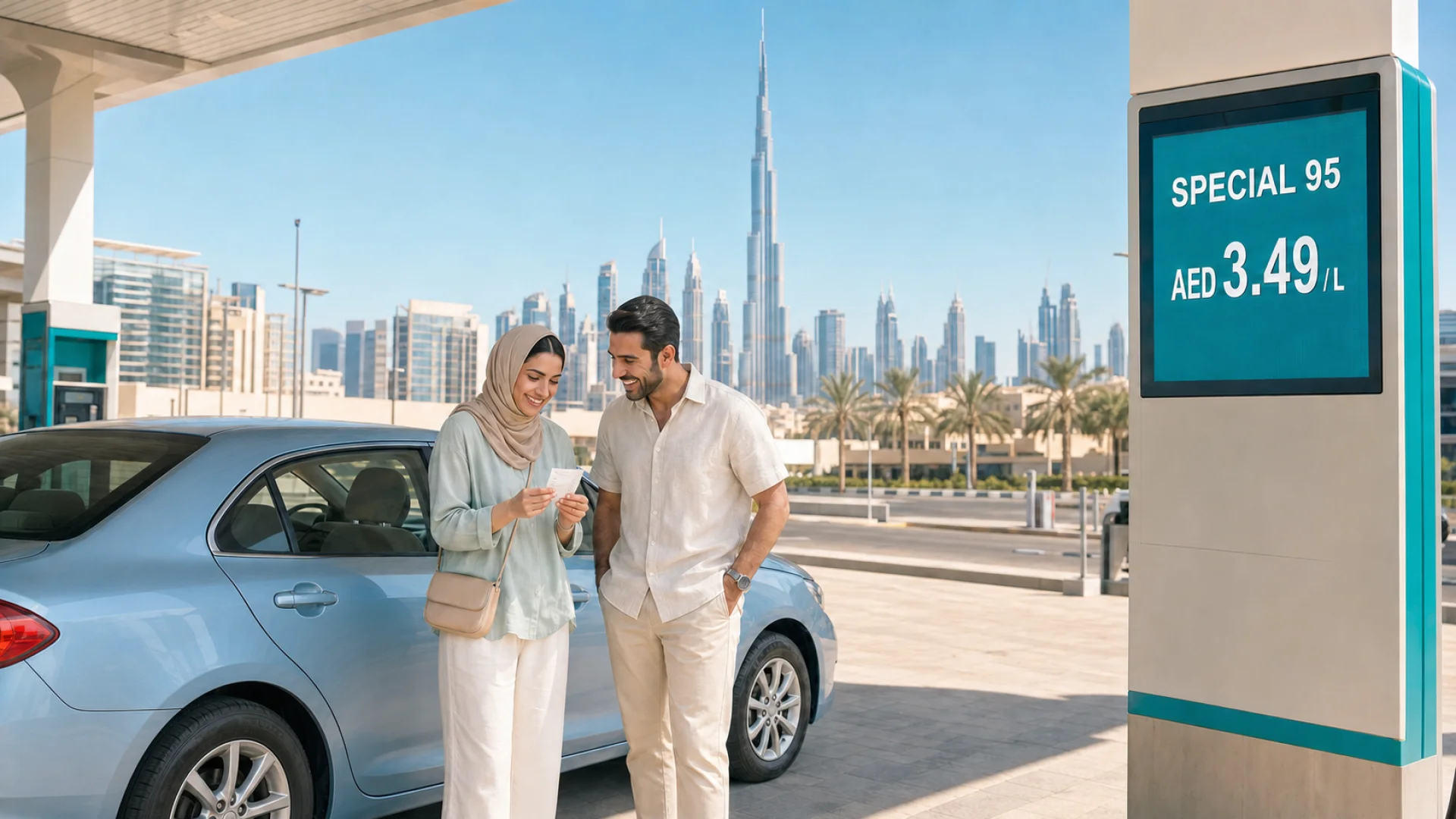

The first refuel in Dubai can feel like a pleasant glitch in reality: the pump clicks, the digits climb, and the total still looks… gentle. With monthly adjusted official prices, petrol typically sits around 2.9–3.1 AED per litre (depending on grade) and diesel around 3.0–3.2 AED—often translating to roughly 0.70–0.85 EUR per litre, depending on exchange rates. The stations are bright, fast, and service-driven, turning the stop into a neat pit‑lane moment rather than a painful budget ritual. For anyone arriving from Germany, the message is immediate: here, fuel prices don’t put a leash on your day—they loosen it.
The heat hasn’t left the pavement, even though the sun is gone. A forecourt in Dubai glows like a film set: white light, polished tiles, pumps lined up like tidy sculptures. A black SUV slides in. A uniformed attendant appears at the driver’s window as if summoned.
“Full?” he asks—short, calm, routine.
A nod. A click. The soft mechanical hum of fuel moving fast.
I do what every German driver does almost automatically: I brace for the number. The one that stings. The one that makes you mutter at the screen. But the digits keep rising and the total stays strangely… friendly. Not free. Not trivial. Just nowhere near the ache we’ve trained ourselves to expect.
Fuel prices in the UAE are typically updated on a monthly basis and then applied broadly across the country, which means you see a consistent price level at major brands such as ENOC/EPPCO, ADNOC and others. The current range in Dubai sits roughly here, depending on grade:
Converted into euros, that often lands around 0.70–0.85 EUR per litre, depending on exchange rates. If you’re reading this from Germany, you already feel the distance between those numbers and your everyday reality.
In Germany, fuel prices aren’t just a cost—they’re a mood. They shape decisions in small, constant ways: whether you take the long way, whether you drive across town, whether that weekend trip happens at all. You learn the choreography: checking apps, hunting for a station that’s two cents cheaper, timing your fill-up like a tiny financial strategy.
In Dubai, that choreography loosens. The city is built wide; the roads pull you outward. And when fuel doesn’t punish the impulse to move, your world quietly expands. Dinner in another district? Sure. A late-night drive to the beach? Why not. A quick run to see the mountains in Hatta? It starts to feel normal, not extravagant.
The station is busy, but it doesn’t feel tense. Cars glide into lanes with the smoothness of practiced habit. Someone steps out, checks a message, calls to a friend: “Coffee?” A laugh, a gesture toward the convenience store. Inside, it smells like fresh pastries and chilled air. Outside, the attendant replaces the nozzle and taps lightly on the window.
“Done, sir.”
I watch the receipt print. I watch the total again. And I realise the real surprise isn’t the price alone—it’s the absence of dread. The tank stop is a quick pause, not a small crisis.
Dubai sits within a region that produces and refines energy, and the local price structure carries a different mix of taxes and levies than most European markets. At the same time, the UAE’s monthly adjustment mechanism ties prices to global market movements, logistics, and refining economics, so it isn’t a frozen bargain forever. Prices move. But from a German perspective, the baseline often remains strikingly low.
That shows up in the street scene: large vehicles, long commutes, air-conditioning running like a heartbeat. Dubai has traffic, of course. But the question “Should I drive today?” is less likely to be answered by your fuel gauge.
Make it tangible. Take a 60-litre tank—common in many mid-size SUVs and sedans. In Dubai, a full refill might land roughly around 175–190 AED depending on the fuel grade. In euros, that often comes in under 50. For many Germans, that number feels almost like a time machine: a reminder of what mobility used to cost—or what it could cost—when the pump isn’t weighted down by a heavy tax burden.
And this is where the conversation stops being about petrol and becomes about psychology. Expensive fuel doesn’t only drain wallets. It narrows lives. It turns distance into a guilt trip. In Dubai, the city stays open late, and the roads feel like invitations rather than negotiations.
Later, I drive under a ribbon of streetlights. Glass towers blink gently like distant ships. The lanes are wide, the signage crisp, the skyline ahead looks staged—even though it’s simply Tuesday. I think back to that first pump screen and how quickly it rewired my assumptions.
A friend who’d arrived from Germany that same week said it best. He looked at his first receipt, then up at me, half laughing: “I expected more.” A beat. “I think I’ll go to the sea tonight.”
Lower fuel costs are not just a lifestyle perk in Dubai—they’re a structural factor that can influence how residential demand spreads across the city. When driving remains comparatively affordable, many residents are willing to trade prime centrality for more space, newer communities, or better amenities, as long as road access is good.
For investors, it’s worth watching communities with strong road connectivity, practical parking, and predictable travel times—because in a car-shaped city like Dubai, convenience doesn’t stop at the front door. It continues down the highway, all the way to the next bright forecourt.