
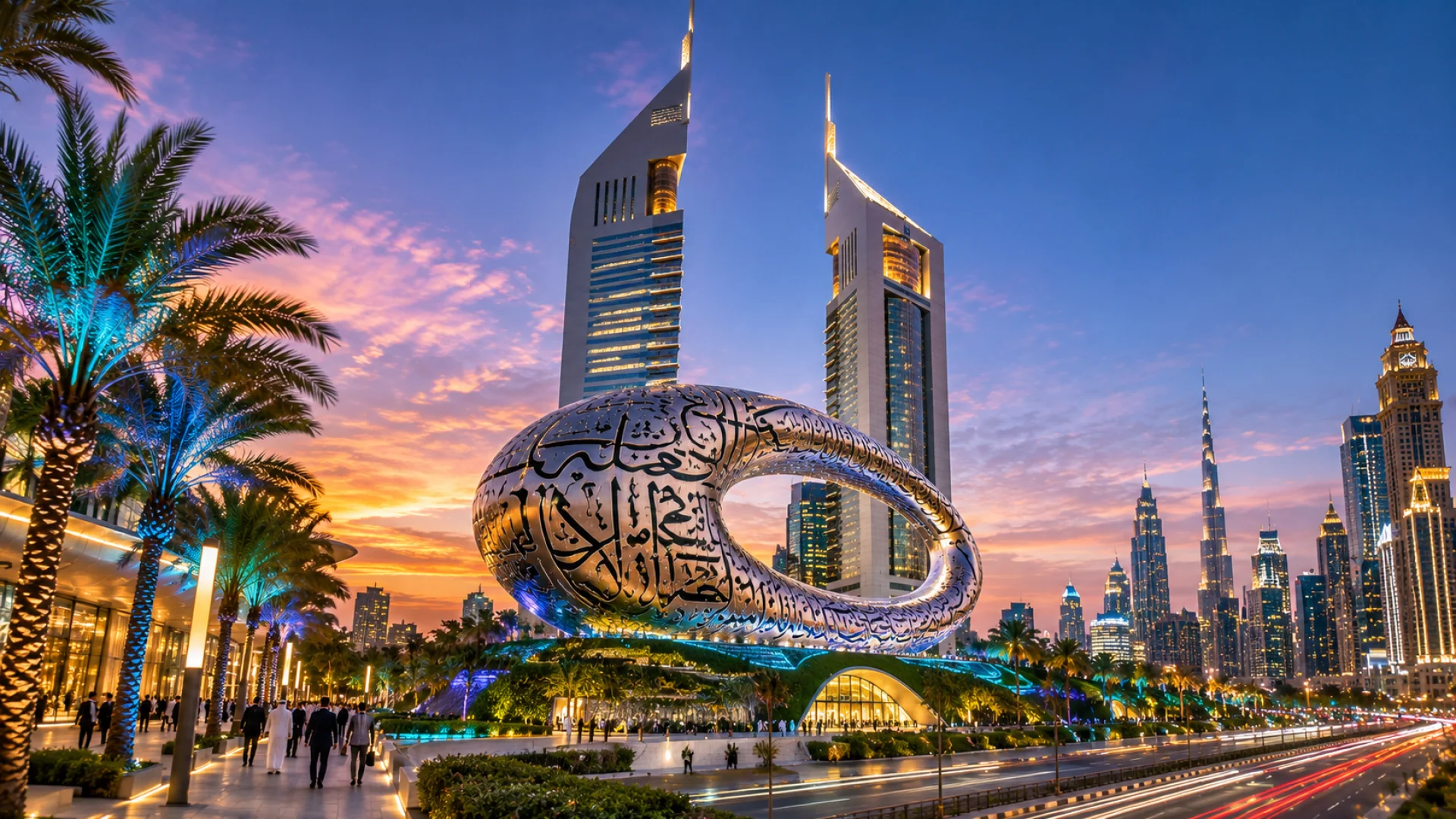

Dubai Future Week 2026 begins on 18 November, placing technology, innovation, social change and economic opportunity at the centre of an international conversation. The event explores how the future can be designed rather than simply predicted. Against Dubai’s rapidly evolving urban landscape, the week connects ambitious ideas with practical questions about cities, investment, work and everyday life.
Dubai is already shining when the future officially arrives. Sunlight runs across the glass towers, traffic moves beneath digital signs, and inside conference rooms, laboratories and innovation hubs, people are asking what comes next. On 18 November 2026, Dubai Future Week begins.
The event is built around a simple but powerful idea: the future is not a distant place. It is being negotiated now – in boardrooms, research centres, public institutions and start-up studios. Dubai Future Week brings together thinkers, entrepreneurs, researchers, investors and decision-makers to examine the forces changing economies and societies.
What happens after artificial intelligence becomes ordinary? How will cities respond to new patterns of work, mobility and consumption? Which technologies will move from experiment to essential infrastructure? The week places these questions at the centre of its programme.
Dubai is a natural setting for this conversation. The city has spent years building an international platform for technology, capital and talent. Its skyline is a visible record of ambition, but the deeper story is found in the systems behind it: digital services, smart infrastructure, new mobility concepts and an expanding innovation ecosystem.
That makes the event more than a showcase. Dubai itself functions as a living case study. Ideas about connected buildings, efficient transport, renewable energy and data-driven services can be considered against a city that is growing quickly and operating on a global scale.
Visitors may arrive expecting spectacular demonstrations. They are likely to leave with more complicated questions. Does a technology solve a real problem? Who benefits from it? How should it be governed? And can it scale without increasing inequality or environmental pressure?
The most compelling innovations are often quiet. A building that uses less energy. A transport network that anticipates demand. A digital service that saves residents an hour. A medical or educational platform that reaches people more efficiently.
Dubai Future Week looks at the connection between ambitious technologies and these practical outcomes. Artificial intelligence, automation and digital platforms are not isolated trends. They affect housing, offices, logistics, education, healthcare and public administration at the same time.
Each theme leads to another. Smart buildings depend on data. Data requires security. Security requires trust. And trust is built through transparent decisions, reliable services and visible benefits.
The week is designed for people who want to move beyond discussion. Start-ups can meet investors and potential partners. Established companies can explore new applications. Researchers can test ideas against commercial and public-sector realities. Governments and institutions can compare experiences and consider coordinated responses.
That human exchange matters. A polished presentation can explain a technology, but a conversation reveals whether it belongs in the real world. A question from an investor may change a business model. A comment from a city planner may expose a problem no prototype had considered.
Dubai Future Week 2026 begins on 18 November with a message that suits its host city: the future will not be delivered as a finished product. It will be built through experiments, partnerships and decisions made before certainty arrives.
For the property sector, the event offers a valuable lens on the next generation of urban demand. Technology changes not only how buildings operate, but also how locations are valued. Efficient energy systems, flexible floor plans, integrated mobility and high-quality digital connectivity can influence a building’s long-term appeal.
Mixed-use districts are particularly relevant. When homes, offices, services, leisure and transport connect smoothly, a neighbourhood can become more resilient and attractive to residents, companies and international talent. At the same time, owners must consider cybersecurity, data protection and the cost of maintaining increasingly complex systems.
Investors should therefore look beyond futuristic images. The strongest opportunities may lie in practical solutions with clear users, measurable savings and the ability to scale. Dubai Future Week provides an opportunity to observe the technologies and business models that could shape the property market in the years ahead.