
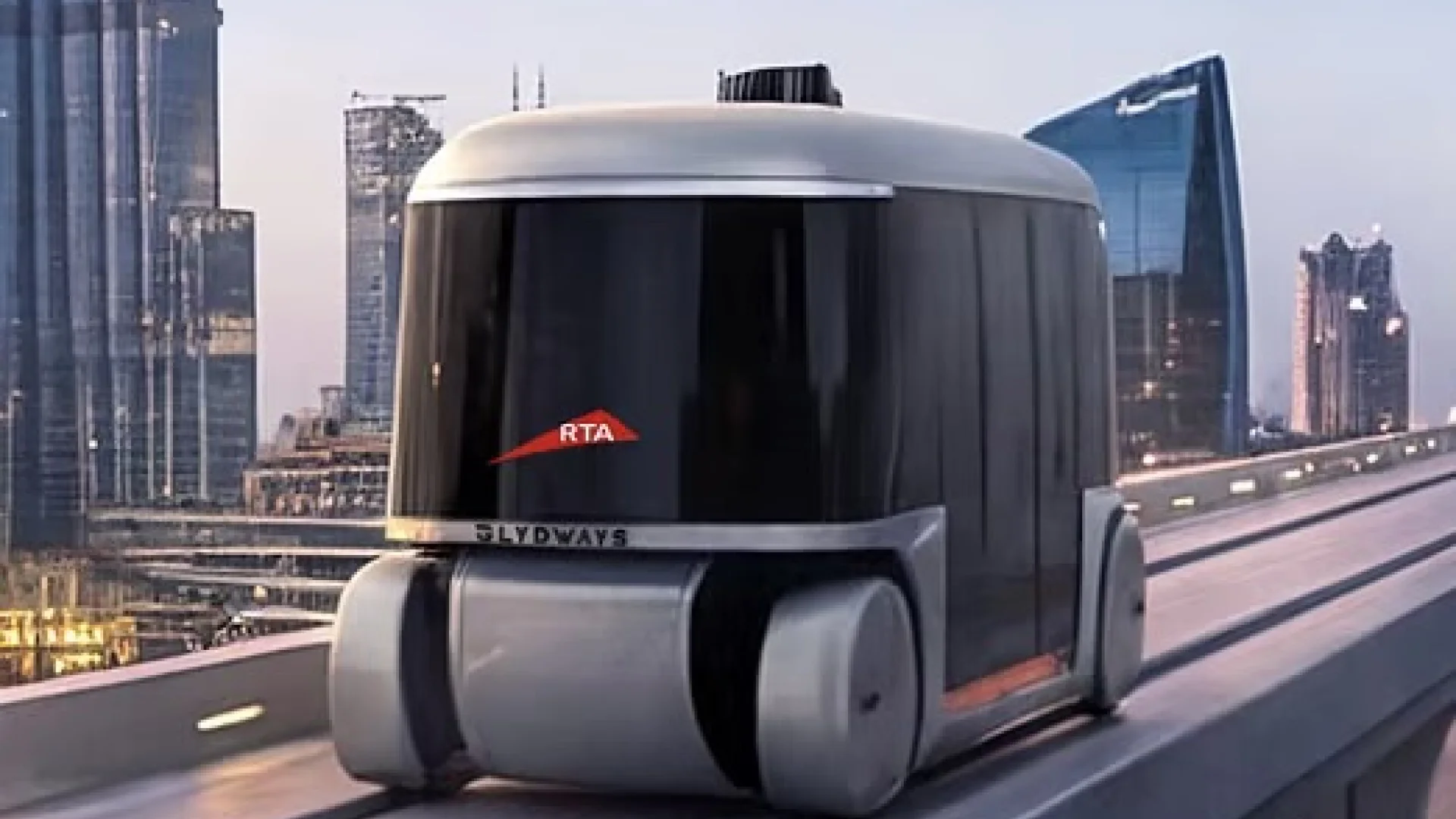

Dubai is preparing for a new kind of movement: compact, driverless electric pods designed to glide on their own protected guideway and stitch together parts of the city that still feel awkwardly far apart. Backed by Glydways, the concept aims to sit between metro-scale rail and street-level shuttles—on-demand, frequent, and built to avoid the unpredictability of mixed traffic. The promise is simple but powerful: shorter transfers, fewer cars for short hops, and a calmer, quieter commute in a city where minutes can evaporate in congestion. If the network lands in the right corridors, it won’t just change how people travel—it will reshape which neighborhoods feel “close,” and that has real implications for property values and investment strategies.
The heat arrives early in Dubai, like a curtain pulled back too fast. Glass towers catch the sun and throw it around in sharp white flashes. On the road, cars whisper past in waves—then bunch up, brake lights blooming red as the city’s morning logic kicks in: everyone moving at once, everyone trying to arrive on time.
And then there’s this small capsule of a vehicle waiting quietly, almost politely, as if it doesn’t want to interrupt. No steering wheel. No driver’s seat. No human in the front to nod at you in that universal “Hop in” way. Just a smooth cabin, clean lines, and a strange feeling in your chest: this is what a commute might look like when it stops arguing with itself.
“So… it really drives itself?” someone asks, voice pitched between doubt and delight. The reply is calm, practiced. “That’s the whole point.”
Dubai has seen plenty of transport headlines—new metro extensions, upgraded roads, ambitious plans that sound like they were drafted with a ruler and a deadline. But the Glydways idea, now being talked about as a way to connect parts of Dubai, plays in a different register. It’s not a bigger highway. It’s not a conventional rail line. It’s a new layer.
Glydways’ driverless pods are designed to run on a dedicated, protected guideway—think of it as “rails without rails.” The vehicles are small and electric. The system is built to be frequent and on-demand, more like calling an elevator than waiting for a bus timetable. And the dedicated path matters: instead of battling delivery vans, sudden lane changes, and chaotic intersections, the pods move in an environment designed for them.
That separation is the quiet revolution. Many autonomous shuttle trials around the world stumble not because sensors can’t see, but because cities are messy. Mixed traffic is full of negotiation—eye contact, hand gestures, tiny improvisations humans perform without thinking. A protected guideway replaces that social chaos with predictable choreography.
Dubai is a city of distances that masquerade as short. A location might look close on a map, but the reality is measured in heat, interchanges, parking hunts, and the invisible tax of traffic. It’s also a city of nodes: metro stations, business districts, waterfront destinations, residential clusters, tourist magnets. Whoever connects the nodes smoothly doesn’t just improve mobility—they rewire daily life.
This is where a system like Glydways can be seductive. Metro and tram remain the backbone, carrying high volumes along major corridors. But what about the gaps? The areas where a full rail project is too expensive, too slow to deliver, or too inflexible once built? The “last mile” that becomes a last two kilometers? That’s the space these pods want to occupy.
The pitch is crisp: on-demand trips, short waits, electric operation, and a guideway that helps keep travel times stable. In a city pushing sustainability narratives and future-facing infrastructure, it also fits the brand: quiet, clean, and just unusual enough to make people look twice.
Imagine you’re not standing at the curb, scanning for a taxi, doing the little dance of phone apps and pickup points. Instead, you walk to a station that feels more like a sleek lobby than a bus stop. Doors slide open. Cool air spills out. You step inside.
The cabin is simple: a few seats, soft lighting, a display that tells you where you’re going. No small talk. No radio chatter. The pod starts moving with a glide rather than a jolt, and for a second your brain reaches for the missing driver—then lets go.
Outside, the city scrolls by: palms, concrete, reflections. Nearby lanes thicken with cars, a familiar slow squeeze. But the pod keeps its rhythm because it doesn’t have to negotiate every decision with everyone else. It’s in its own lane of reality.
“It’s like the metro,” someone says, watching the smooth motion, “but… personal.” That’s the sweet spot. Public transport logic with a private-transport feeling—without turning every trip into another car on the road.
It’s tempting to treat driverless pods as a novelty, the kind of futuristic accessory Dubai collects the way other cities collect monuments. But the real value is structural: connectivity. If parts of Dubai become easier to reach—more predictable, less stressful—people change their habits. They choose different restaurants. Different gyms. Different offices. Different homes.
Mobility isn’t just about moving bodies. It’s about moving choices.
When that stitching works, the city feels smaller—not in square kilometers, but in effort. The difference between “too far” and “easy” is often just one reliable connection.
Technology can be brilliant and still fail the city test if it doesn’t integrate with real life. Where do stations sit? Are they shaded, comfortable, safe at night? Do they connect cleanly to sidewalks, crossings, and metro entrances—or do they drop you on an island of asphalt? Is ticketing seamless? Do you pay once, or do you stack apps and fares like luggage?
And then there’s the human factor: trust. Autonomy asks people to surrender a small piece of control. A protected guideway helps because it reduces the number of unpredictable encounters and makes the system easier to explain: this path is for pods. That clarity can be as important as the underlying software.
Dubai also moves fast when it decides to move. The moment guideways become visible—concrete, stations, signage—the project stops being an idea and starts becoming a habit. People plan around what they can see.
In the end, the most meaningful mobility upgrades are the ones you stop thinking about. They become the default. You don’t “try” them; you just use them. If Glydways in Dubai reaches that point, it won’t feel like a futuristic demo. It will feel like the city learning a new, calmer way to breathe.
For property markets, mobility is never just infrastructure—it’s a pricing mechanism. If Dubai deploys Glydways pods in the right corridors, the system could create a new, fine-grained accessibility layer on top of the metro: not just “near a station,” but “effortlessly connected” to several nodes. That shift tends to re-rank neighborhoods, tighten rental demand in newly connected pockets, and influence where developers place the next wave of mixed-use density.
1) The last-mile premium, redefined
In Dubai’s climate, walkability is seasonal—and often aspirational. Areas that are technically close to a metro stop can still feel functionally far. A reliable, air-conditioned pod connection can convert that functional distance into convenience, which may translate into:
2) Stations as micro-centers
Transit nodes often generate retail gravity—coffee, convenience, gyms, clinics, quick services. If pod stations are designed as comfortable, safe “mini-hubs,” the surrounding 5–10 minute walk radius can benefit disproportionately. Investors should watch for station placement and the quality of pedestrian access (shade, crossings, direct building entries). In many cases, the last 200 meters determines whether a transport improvement is felt—or ignored.
3) Development economics: parking, design, and marketing
If on-demand pods reduce short car trips, developers may eventually argue for smarter parking ratios in certain asset types (serviced apartments, co-living, workforce housing near employment nodes). Less parking can mean lower costs or more sellable/leasable area. Buildings directly connected to a pod stop could market a new kind of amenity: guideway-connected living, similar to today’s “metro-connected” premium but potentially more personalized.
4) Investment diligence: what to verify
Because the value uplift depends on actual service quality, investors should track operational realities, not headlines:
5) Strategic opportunity: buying the “new closeness”
The biggest gains often go to those who invest before a corridor is fully priced in—when a district is still perceived as slightly inconvenient, but connectivity is about to improve. If Glydways guideways successfully compress travel friction between employment centers and residential zones, the winners may include well-positioned mid-market communities, mixed-use projects at interchange points, and retail assets that live off footfall created by new station routines.
In other words: when a city changes how it moves, it changes what feels valuable. A pod guideway is not just a transport line—it’s a new map of perceived distance, drawn in minutes instead of kilometers.