
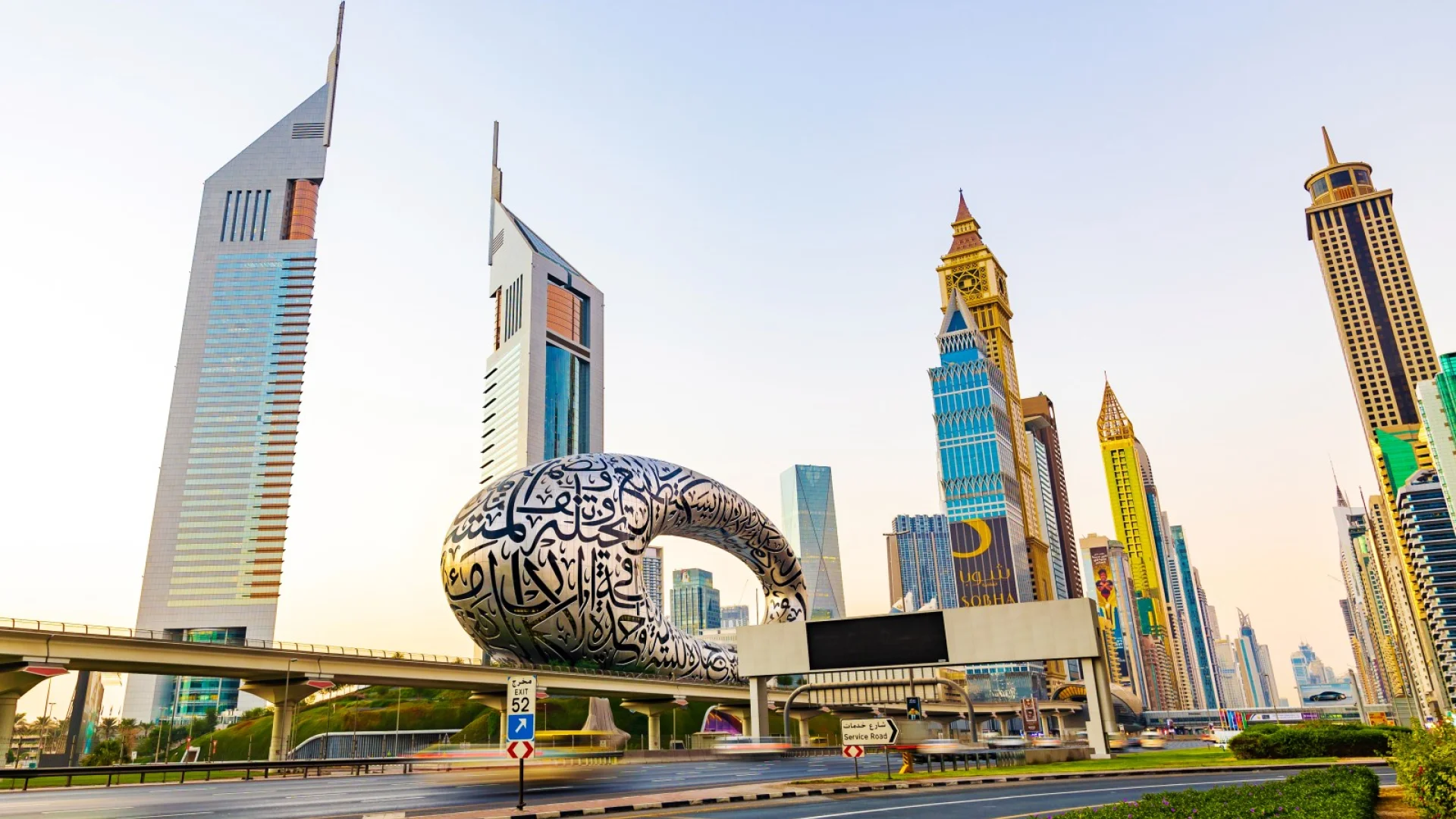

Dubai is turning its next chapter into a software update: under the direction of H.H. Sheikh Hamdan bin Mohammed bin Rashid Al Maktoum, the emirate is sharpening its 2026 IT and digital agenda with a focus on faster, more seamless government services, stronger cybersecurity, and wider adoption of AI and automation. The message is practical—cut friction for residents and businesses, connect systems, and turn pilots into everyday tools. Alongside technology, talent is a headline theme: building skills and attracting global specialists to keep Dubai competitive as a smart-city and innovation hub. For the market, the implication is equally concrete: a city that runs smoother digitally is a city where companies scale faster and investors can underwrite timelines with greater confidence.
The morning heat arrives early in Dubai. It presses softly against glass towers, turns the horizon into a pale shimmer, and makes every movement look slightly cinematic—like the city is always in transition. Down on the street, a delivery rider checks his phone twice before crossing. Up above, in meeting rooms cooled to a polite chill, the conversation is about something you can’t see at all: systems, networks, security, speed.
“Faster,” someone says, not as a slogan, but as a requirement—like water pressure in a high-rise. You need it, or everything above the tenth floor becomes complicated.
That’s the tone around Dubai’s latest direction, as reported by the Dubai Media Office: under H.H. Sheikh Hamdan bin Mohammed bin Rashid Al Maktoum, the emirate is pushing a sharper IT and digital drive for 2026—one that treats government technology not as support, but as infrastructure. The kind that decides whether a city glides or grinds.
Dubai has always understood the power of the visible: the skyline, the bridges, the clean lines of ambition. But the next competitive edge is increasingly invisible. It sits in the way digital services behave, the way departments share information, the way a resident gets something done without needing to “know someone” or chase a paper trail.
The ambition behind the 2026 IT push is simple to describe and hard to execute: make government services quicker, more connected, and more reliable—so life and business feel lighter. Not because “digital” is fashionable, but because time is the most expensive commodity in a global city.
A customer service manager puts it in a half-joking, half-serious line: “If we do it right, people won’t feel the government. They’ll just feel the result.”
Behind the scenes, Dubai’s priorities revolve around modern platforms, integrated data, cybersecurity resilience, and the practical rollout of AI and automation. The direction isn’t about one app or one portal—it’s about the way the machine runs end to end.
It’s the kind of list that can feel abstract—until you imagine the daily friction it is meant to erase. The extra email. The extra signature. The “please resend the document” loop. Dubai’s bet is that those small frictions, multiplied by millions of interactions, are what separates a good city from a great one.
In Dubai, speed has always been part of the identity. But in the digital era, speed isn’t only cranes and concrete. It’s approvals, integrations, secure identities, clean data, and services that don’t break under demand.
A startup founder in the fintech space describes the difference like this: “You know whether a city is truly digital the first week you try to set up. Does the system push you forward, or does it make you stop and explain yourself ten times?” He pauses. “Dubai wants the system to push.”
That push matters because it translates into productivity. A government that processes faster becomes a market that moves faster. And in a region where competition is sharp and global attention is real-time, that’s not a nice-to-have—it’s a strategy.
The more services go online, the more the city becomes a target. That’s why cybersecurity isn’t a footnote in this new direction—it’s one of the pillars. Because a smart city without trust is just a shiny interface.
Cybersecurity in this context is not only about firewalls; it’s about standards, governance, resilient architectures, and response capability. A senior IT lead frames it plainly: “People need to believe their data won’t travel where it shouldn’t.”
That belief has economic weight. It affects whether companies host sensitive workloads, whether banks and insurers expand digital offerings, whether residents adopt new services without hesitation.
Dubai’s conversation about AI tends to be practical. Less “robots are coming,” more “how do we remove delays?” AI and automation can help with pattern recognition, service personalization, and operational efficiency—but only if the right data is available and the right people are trained to deploy it responsibly.
So talent becomes part of the storyline: upskilling programs, capability-building, attracting global experts, and creating conditions where startups can test, build, and scale. In other words, the software needs engineers—and the city wants them to see Dubai as a place where their work lands in the real world, not on a slide deck.
One HR lead in tech recruitment tells a small anecdote: “Candidates don’t ask only about salary. They ask, ‘Will I be able to ship?’ That’s the question.” Ship, as in: build and deliver. Dubai’s message is that the runway is here.
If the strategy works, the early signs won’t be dramatic. They’ll be subtle—and that’s the point. A faster permit. A clearer status update. Fewer repeated submissions. Better coordination across agencies. The city becomes less of a maze and more of a flow.
A hospitality operator describes the impact in the language of opening nights: “Every week you save is a month you win.” She glances at her phone, as if expecting the next approval to arrive like a message. “When the city gets faster, we get faster.”
In that sense, the 2026 IT push is not just about technology. It’s about removing drag from the economy—so new ideas can move from intention to action with less resistance.
In property, time is a line item. It lives in interest during construction, in delayed handovers, in idle capital, in vacancy risk. That’s why a more seamless digital government environment can translate into real, measurable advantage for developers, investors, and occupiers.
The larger signal is strategic: Dubai continues to invest in the city’s operating system. For investors, that matters as much as transport links or skyline views—because a digitally reliable city can execute faster, manage risk better, and convert growth into performance.