
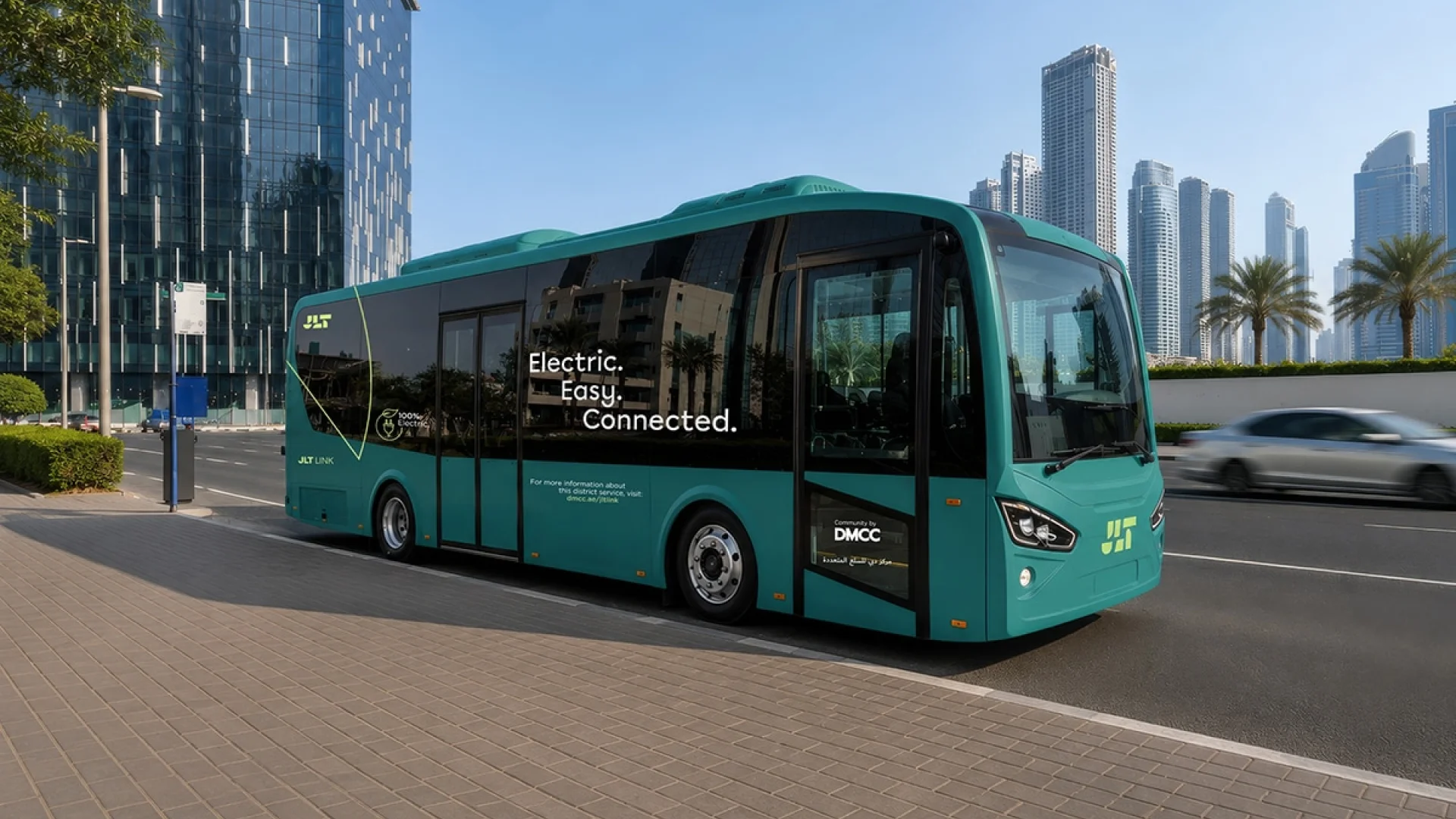
In Jumeirah Lakes Towers, a new kind of commute is arriving with barely a sound. Dubai has rolled out its first all-electric community bus network in JLT, designed for short hops that stitch together towers, promenades, and public transport access. The idea is simple: make the last mile inside a dense mixed-use district feel effortless—less heat-soaked walking, fewer short taxi rides, and a calmer street atmosphere. For residents, workers, and visitors, it’s a small vehicle with a big message: cleaner mobility can be everyday, not just aspirational.
The first thing you notice is what you don’t hear.
In Jumeirah Lakes Towers, the morning usually arrives on a soundtrack of engines—taxis edging forward, delivery vans idling, the occasional impatient rev that ricochets between glass façades. Today, a bus turns the corner and the noise doesn’t follow. It glides in like a thought. Doors sigh open. A driver lifts his chin in a quick greeting.
“Metro?” a man in a crisp shirt asks, half talking to the driver, half to his own schedule.
The driver nods. “Hop on.”
This is Dubai’s newest move in plain sight: the city has launched its first all-electric community bus network, starting in JLT. Not a one-off shuttle meant to impress for a weekend, but a neighborhood-scale network built for repetition—for the thousands of tiny trips that make up a day in a dense district. The kind of trips people don’t post about. The kind that decide whether a place feels frictionless or frustrating.
JLT is a vertical neighborhood. Towers stack homes and offices high above the lakes; cafés and mini-marts fill the ground level; the promenade catches joggers at sunrise and families after sunset. It’s compact on the map, yet time behaves differently on the street. Heat stretches minutes. A heavy laptop bag adds weight to the last few hundred meters. A quick run to the waterfront becomes a decision: walk, wait, hail, drive?
That’s the gap the new e-bus network is aiming at—the last mile inside the community. It’s designed to connect the points that matter most in everyday life: where you live, where you work, where you transfer to the wider city. The promise is modest but powerful: fewer unnecessary car trips for short distances, and a more comfortable way to move around the neighborhood.
Inside the bus, the atmosphere feels more like a lobby than a vehicle. You hear conversations instead of combustion. A coffee lid clicks. Someone laughs softly at a voice note. When the bus accelerates, it doesn’t lurch—it simply goes, smooth as an elevator starting its climb.
At the next stop, a woman with a gym bag steps in, scanning the seats. “Finally,” she says, almost to herself. Not a press-release kind of finally, but the kind that comes from experience: too many short rides that felt wasteful, too many walks that felt longer than they should.
Community buses are about frequency and convenience, not grand distances. They’re built to be used casually, repeatedly, without planning your day around them. And when they’re electric, the benefits are immediate and sensory: quieter corners, cleaner air at street level, less of that constant background tension that traffic can bring.
JLT is the kind of mixed-use district where mobility is not a nice-to-have; it’s the operating system. The neighborhood’s appeal comes from proximity—home near office, coffee near the lake, errands near everything. But proximity only works if the connection is pleasant. A last-mile network helps turn “near” into “easy.”
Dubai’s decision to start with a full electric community bus network here reads like a test with real stakes: dense footfall, constant churn of residents and workers, and a built form that rewards good circulation. If it works in JLT, it’s a model that can travel.
The story isn’t just “electric buses exist.” It’s how they’re used: short loops and practical stops that make the district feel stitched together. The buses are meant to serve the everyday flows—between towers, promenades, and transport links—so fewer people feel forced into quick taxi rides or short car trips.
It’s a small shift in behavior the city is chasing: if the convenient option is also the cleaner option, people take it without needing to be persuaded. A service that removes hassle often changes habits faster than a campaign ever could.
Dubai understands spectacle. Yet the most valuable upgrades are sometimes nearly invisible. A quieter street changes how long you linger at an outdoor table. Cleaner air changes how a waterfront walk feels at dusk. A reliable neighborhood connection changes the mental math of your day: “Should I go?” becomes “I’ll just go.”
In that way, the all-electric community bus network is not only transport. It’s placemaking. It helps a district behave like a cohesive neighborhood rather than a collection of towers separated by asphalt decisions.
For real estate, last-mile mobility is a quiet value driver. Buyers and tenants may tour a view, but they live with the commute. In a high-density mixed-use location like JLT, an electric community bus network can influence perception, performance, and ultimately pricing—especially for units positioned as “metro-accessible” or “walkable” in practice, not just on paper.
The takeaway for investors and owners is straightforward: infrastructure that makes a dense district feel effortless tends to compound value. In JLT, the future isn’t arriving with a roar. It’s arriving with a soft door hiss and a smooth, silent loop around the lakes.