
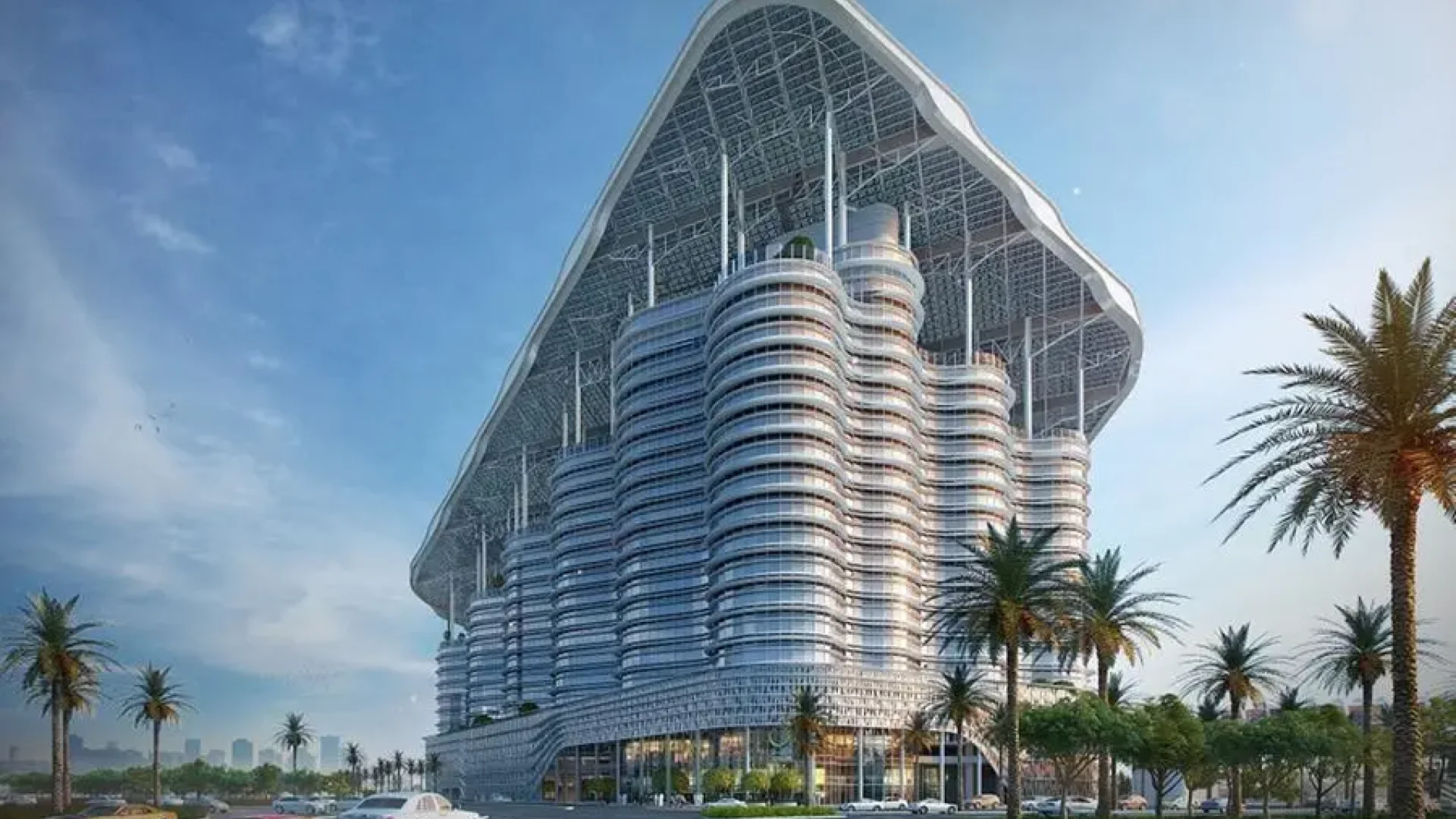

In Dubai, where the sun can feel relentless, a new government building has decided to turn that intensity into its greatest asset. Sheikh Mohammed bin Rashid Al Maktoum has inaugurated what officials describe as the world’s largest positive-energy government building—designed to produce more energy over a year than it consumes. The project aligns with the Dubai Clean Energy Strategy 2050 and positions sustainability as a lived, measurable reality rather than a slogan. Step inside and the message is immediate: the future can be bright without being wasteful.
The heat outside is the kind that makes you blink twice—white sky, shimmering asphalt, the air itself vibrating. But as you walk toward the new government building, something shifts. The glare softens. Shade gathers in a clean, deliberate line. Above you, a vast canopy stretches out like a wing, and it isn’t just shelter—it’s a power plant.
“Look up,” a guard says, almost casually, as if pointing out a familiar landmark. Solar panels spread across the roof in disciplined geometry. In Dubai, superlatives are common currency, but this one lands differently: not tallest, not biggest, not fastest—smartest. A building that doesn’t merely save energy. It makes it.
Sheikh Mohammed bin Rashid Al Maktoum’s inauguration of the building reads like a ceremonial moment—and a strategic one. Officials describe it as the world’s largest positive-energy government building: a facility designed to generate more energy across the year than it consumes. That phrase, “positive energy,” sounds almost like a mood. Here, it’s a balance sheet.
Government buildings tend to be hungry machines: lights on, elevators moving, servers humming, cooling systems fighting the climate hour after hour. This project flips the expectation. Instead of being a permanent draw on the grid, it aims to become a net contributor—an administrative hub that quietly exports surplus power.
In many cities, the sun is a pleasant extra. In Dubai, it’s the main character. It dictates construction materials, glass choices, shading strategies, and—most critically—cooling demand. The genius of a positive-energy building here isn’t just the PV array. It’s the idea that architecture, engineering, and operations have been choreographed to treat sunlight as both challenge and fuel.
Inside, the transition feels almost cinematic. The lobby is bright but controlled, the kind of daylight that makes you stand a little taller. Surfaces absorb sound. The air is steady—cool without being aggressive. A staff member pauses near the entrance, glances up at the ceiling lines, then back at the space as if taking a second reading. “It feels… different,” she murmurs, half to herself.
The building’s opening ties directly into the Dubai Clean Energy Strategy 2050, a long-term push to reshape how the emirate produces and consumes power. Dubai has a reputation for announcing big ambitions—and then building them. This facility is the physical proof-of-concept: sustainability presented not as a distant target, but as a working public asset.
And there’s a subtle shift embedded in that. When the government’s own offices are expected to hit net-positive energy performance, it raises a quiet question for everyone else: if this can run on a yearly surplus, what should the next office tower, school, or hospital be aiming for?
Somewhere down a corridor, a technician steps out of a control room holding a tablet, the screen alive with charts and status indicators. He glances once, nods, and keeps walking. “All green,” he says to a colleague, like he’s talking about traffic lights.
That’s the hidden story of high-performance buildings: they’re less like static structures and more like managed systems. The architecture you photograph is only the first layer. The real work happens in the way lighting responds to occupancy, how cooling loads are smoothed, how the building envelope limits heat gain, and how energy production is monitored and optimized day after day.
Even if visitors experience it emotionally—cool shade, calm interiors, a sense of intentionality—the achievement is technical. Positive-energy performance depends on multiple pieces locking together. The headline feature is the solar generation, but the supporting cast matters just as much: efficient mechanical systems, smart controls, and a design that reduces demand in the first place.
Dubai’s skyline has always been a statement. But a positive-energy government building is a different kind of landmark—one that proves itself through performance rather than silhouette. Its success isn’t counted in floors or meters. It’s counted in kilowatt-hours, peak loads, and the quiet confidence of a system that can produce a surplus.
And that’s why the opening matters beyond the ribbon-cutting. It suggests a future where civic architecture isn’t just symbolic. It is operationally ambitious—meant to be measured, audited, improved.
There’s also something cultural about the place. Government buildings are often spaces people enter reluctantly—because a form must be filed, a document stamped, a process completed. Here, the building feels designed to be visited, even showcased. Light is treated as a material. Circulation feels intuitive. Technology isn’t hidden; it’s part of the narrative.
A visitor stops at a display that visualizes energy flows—generation, consumption, surplus—like a living diagram. The lines move gently as data updates. “So the building is working even when we’re just standing here,” he says. It’s a small comment, but it captures the point perfectly. The building doesn’t wait for the future. It’s already practicing it.
When a government publicly celebrates a net-positive building, it sends a message to the entire market: performance expectations are rising. Developers hear it. Contractors hear it. Corporate tenants hear it. And investors—especially those thinking in multi-year holds—should hear it too.
In a hot-climate market, energy performance isn’t a niche. Cooling loads can dominate operating expenses, and utility volatility can squeeze net income. A building that can materially reduce demand—or even move toward self-generation—changes the economics, not just the aesthetics.
For real estate investors, Dubai’s inauguration of a positive-energy government building is best read as a forward-looking market signal. Iconic public projects often become tomorrow’s baseline: first as a benchmark, then as a procurement requirement, and eventually as a regulatory expectation. The direction of travel is clear—energy performance is moving from “nice-to-have” to “must-prove.”
1) Higher standards and asset readiness: Investors holding older office stock should assess retrofit feasibility—HVAC efficiency, building envelope upgrades, shading, controls, and onsite solar potential. Assets that cannot be improved cost-effectively may face increasing competitiveness risks as tenants and authorities prioritize performance.
2) Operating expense advantage and NOI stability: Reduced cooling and lighting demand translates directly into lower operating costs. In markets where service charges and energy bills matter to tenants, better performance can support occupancy and rental resilience. For landlords, it can mean a steadier NOI profile and less exposure to energy price swings.
3) Tenant demand and ESG leasing: Corporate occupiers increasingly track carbon footprints and energy use. Buildings with monitored, verifiable performance—especially those approaching net-zero or net-positive operation—can become preferred options, supporting longer lease terms and potentially stronger pricing power.
4) Financing and liquidity impacts: Lenders and institutional capital are differentiating assets by sustainability metrics. Strong energy performance, backed by data and credible certifications, can widen the buyer pool at exit and improve access to green financing structures. Conversely, inefficient buildings risk a “brown discount” as the market reprices operational inefficiency.
5) Development strategy in a solar-first city: For developers, the lesson is practical: integrate solar, shading, and smart controls early. Design-to-performance is cheaper than retrofit-to-compliance. The most competitive new-build products may soon be those that market not just views and amenities, but verified energy outcomes.
Investor takeaway: This project is less about one building and more about a new expectation. In Dubai’s next investment cycle, energy performance will increasingly behave like location—a core driver of rentability, financeability, and exit value.