
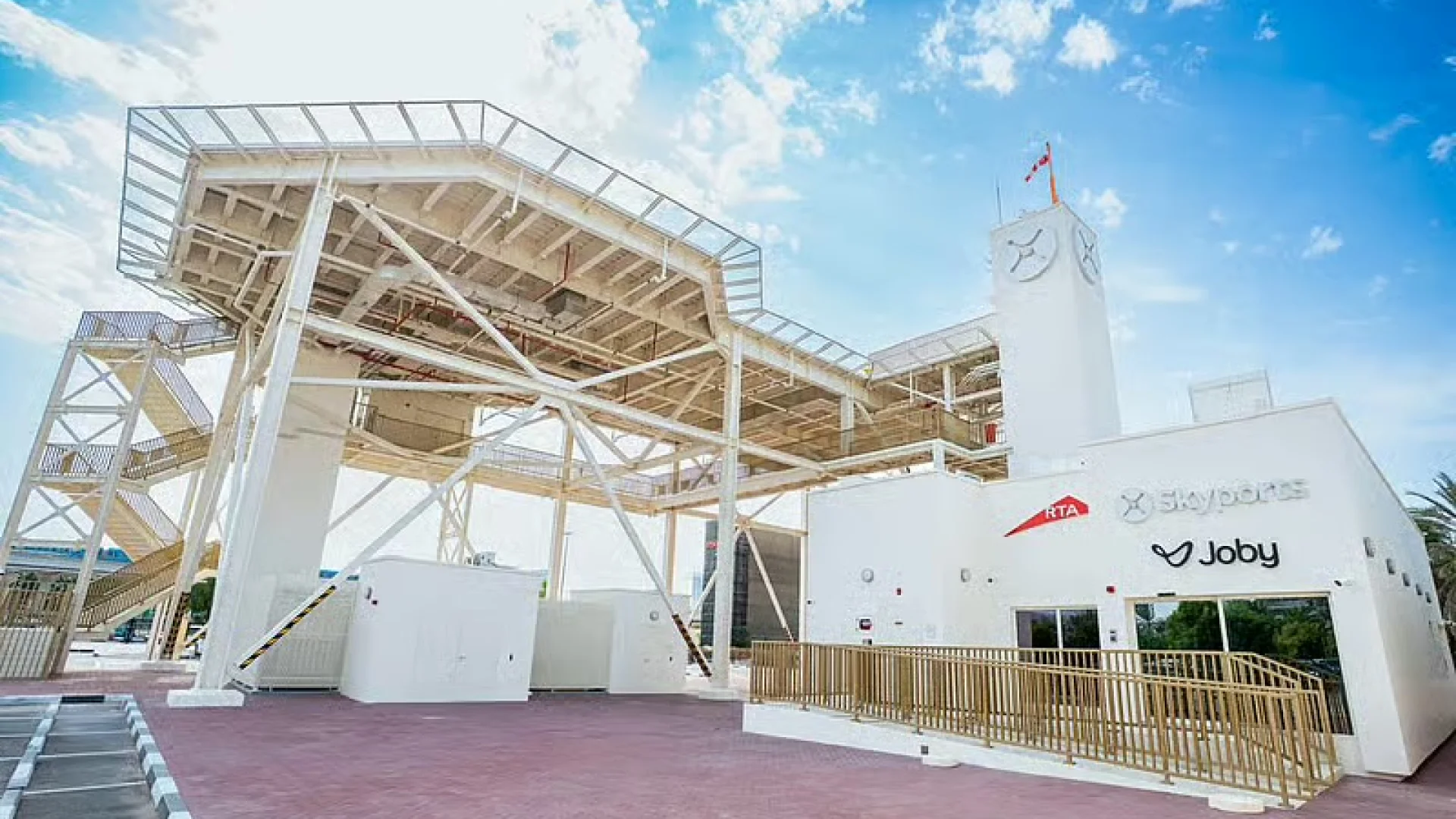
The next transport stop in Dubai Marina is not beside the road but above it. The completed and certified vertiport is designed to serve electric air taxis and connect the waterfront district with Dubai International Airport, Palm Jumeirah and Downtown Dubai. It is a major milestone in Dubai’s plan to launch an air-taxi service from 2026 and cut journey times across one of the world’s most traffic-heavy cities.
The Marina is sparkling below. Cars crawl along Sheikh Zayed Road, their headlights forming a slow, bright ribbon. Above the towers, however, Dubai is preparing a different kind of commute: a landing platform for electric air taxis.
Dubai Marina’s vertiport has been completed and certified. The milestone, led by Dubai’s Roads and Transport Authority, brings the city closer to its planned air-taxi network. Soon, the journey across Dubai may begin not at a taxi rank or metro platform, but at a compact aviation hub woven into the urban landscape.
“How long will it take to reach the airport?” In Dubai, the question is never far away. Distances that look modest on a map can become lengthy drives when traffic builds between the Marina, Downtown and Dubai International Airport. An air taxi offers a new answer: go above the congestion.
A vertiport resembles a small airport, but its purpose is very different. It is designed for short urban journeys, not long-haul departures. Passengers would arrive at a city location, complete the required checks, board an electric vertical take-off and landing aircraft, and lift away without a conventional runway.
Dubai Marina is a natural stage for this experiment. The district combines residential towers, hotels, restaurants, promenades and one of Dubai’s most recognisable waterfronts. It is vibrant, dense and constantly moving. Roads are valuable, and time is even more valuable. A new aerial link could connect the district directly to other high-demand destinations.
The planned network is expected to include four key locations: Dubai Marina, Dubai International Airport, Palm Jumeirah and Downtown Dubai. Together, they could create a fast connection between the airport, the coast, the business core and some of the emirate’s most popular residential areas.
The aircraft planned for the service are electric vertical take-off and landing vehicles, commonly known as eVTOLs. They do not need a traditional runway. They rise vertically from a designated platform, travel above the road network and descend at another vertiport.
The attraction is not simply speed. It is directness. A road journey is shaped by junctions, traffic lights, diversions and bottlenecks. An aerial route follows a much straighter line. A trip that can consume a significant part of an hour on the ground could become a far shorter flight, depending on the route and operational conditions.
Picture the departure. The Marina’s traffic noise fades behind the cabin. The canal becomes a narrow blue line. Tower blocks arrange themselves into a precise pattern below the window. Palm Jumeirah appears not as a distant destination but as the next point in a connected map. The airport is no longer the end of a long taxi ride. It becomes one stop in an urban air network.
The finished structure is the visible part of the story. Certification is the quieter achievement that makes operation possible. It confirms that the vertiport has met the relevant technical and operational requirements for its intended aviation use. In emerging transport systems, that approval is the bridge between a futuristic rendering and a service that can actually welcome passengers.
The RTA is working with specialist partners in aviation and vertiport infrastructure to develop a safe and integrated system. The intention is not to create an isolated luxury ride for a handful of visitors. Air taxis are meant to fit into Dubai’s wider transport ecosystem, alongside roads, metro, tram, airports and digital booking platforms.
The planned launch is set for 2026. Before then, the everyday details must be resolved: how passengers book, how they check in, how vehicles are sequenced, how safety zones interact with surrounding towers, and how the new aircraft share Dubai’s airspace. These questions may sound technical. For passengers, they will determine whether the experience feels effortless or complicated.
Dubai has long treated infrastructure as a declaration of intent. The metro reshaped how the city imagined public transport. The new vertiports add another dimension to that ambition. The next mobility corridor may not run beside a boulevard. It may run above it.
For residents, the vertiport will introduce a new element to the skyline and the soundscape. For visitors, it may become an attraction in its own right. For commuters, the measure of success will be less romantic: Is it reliable? Is it safe? Is it easy to book? And can more than a small circle of premium travellers afford it?
The Dubai Marina facility gives those questions a physical address. It is no longer only a concept shown in a presentation. It is a certified place with a platform, operating requirements and a role in a future network. Standing between the canal and the towers, it turns an abstract promise into a piece of the city.
Transport infrastructure changes more than travel times. It changes the perceived distance between places, and that can influence property demand. A home, hotel or office near a vertiport may become more attractive to international executives, business travellers, short-stay guests and buyers who place a premium on airport access.
Dubai Marina already offers a powerful combination of waterfront living, hospitality, dining and leisure. An air-taxi connection could add another layer to that appeal. The familiar property questions will remain – views, amenities, services and community quality – but a new question may join them: how quickly can residents reach the airport or Downtown?
For investors, the vertiport is best understood as part of a wider infrastructure story. The opportunity is not simply the platform itself. It lies in the relationship between transport access, neighbourhood demand and the movement of international people and capital. A certified vertiport creates a tangible anchor, but its long-term effect will depend on flight frequency, pricing, safety, regulation and public adoption.
The crucial test will be execution. Infrastructure becomes a lasting location advantage only when it operates safely, frequently and predictably. Until then, the vertiport is a promise with a certificate – waiting for the first regular passengers to turn the promise into a routine.
At sunset, the Marina lights begin to shimmer across the water. Cars continue their slow procession below. Above them, a new kind of station waits for take-off, ready to make the city’s next journey not only faster, but vertical.