
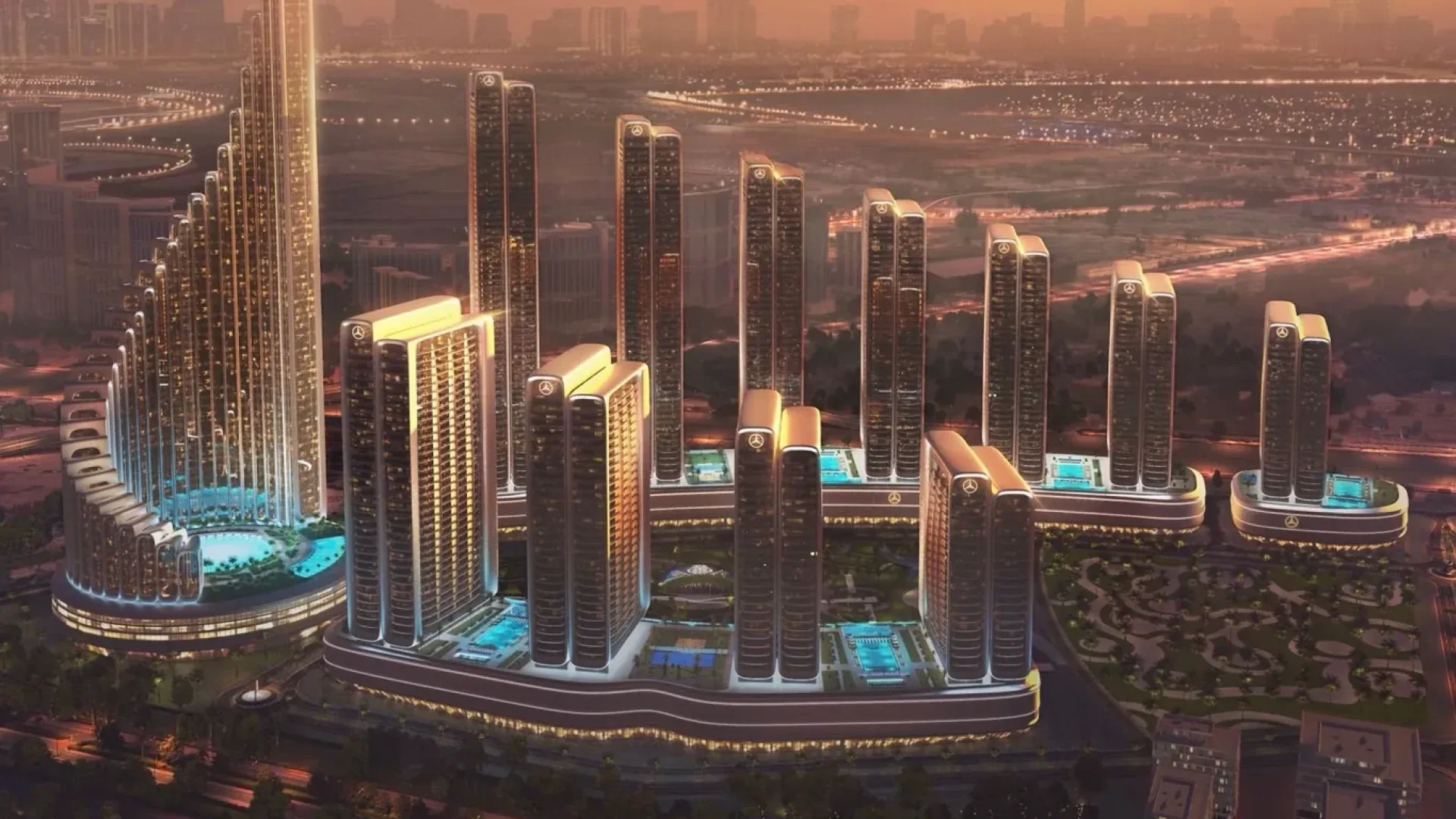

In Dubai, a marketing line is only a few steps away from becoming concrete and glass: “living in the star” is the promise behind Mercedes‑Benz Places. The project brings the global luxury brand into the world of branded residences—high-end apartments, curated interiors and amenities designed to feel more like a private club than a conventional building. Developed with a local partner, the scheme targets maximum visibility in one of Dubai’s prestige growth zones. It underlines a wider trend: in this market, architecture and brand power increasingly move prices, demand and investment narratives.
Dubai at dusk has its own soundtrack. A soft hiss of air conditioning from open-door lobbies. The low, polished growl of cars easing into valet lanes. Light sliding down towers like liquid metal. On the sidewalk, someone pauses in front of a glossy rendering and says, half-joking, half-awed: “So… you can actually live in the star?”
In most cities, that would stay a tagline. In Dubai, taglines come with cranes.
Mercedes‑Benz Places is the name attached to a new luxury residential development planned for the emirate—an attempt to turn the Mercedes brand universe into an address. Not a showroom. Not a themed gimmick. A full-scale, design-forward building where the promise is as much about how life feels as it is about square meters.
Dubai doesn’t just sell homes. It sells recognition. A skyline is a portfolio here; a neighborhood can be a headline. And when a global brand enters the housing market, it brings an instant shortcut to trust, aspiration and—crucially—international comprehension. Buyers arrive from dozens of countries, carrying different tastes and languages. A three-pointed star needs no translation.
The project is positioned as a high-end, branded residence concept: premium apartments, carefully curated interior design, and a lifestyle layer that aims to feel closer to a private members’ club than a standard condominium. The idea is not simply to own property, but to inhabit a brand-coded environment—from the mood of the lobby to the tactility of materials, from the lighting temperature to the way shared spaces are choreographed.
Developers in Dubai have learned that luxury is partly geography and partly theatre. The “where” matters as much as the “what”: proximity to landmark districts, smooth access to major roads, the promise of views and the social signal of a recognizable postcode. Mercedes‑Benz Places is planned in a high-profile development area designed for maximum visibility—exactly the kind of stage where a branded tower can perform.
Even before a single resident moves in, the building is meant to act like a calling card: a piece of skyline that says something about the person behind the front door. In Dubai, that message can be a major part of the purchase decision.
Slide into a modern Mercedes and you’ll notice the obsession with finish: stitching that feels precise, surfaces that read “quiet quality,” ambient light that doesn’t just illuminate but orchestrates mood. That logic is expected to migrate into residential design—less theme park, more design system.
At an event where guests lean over material samples and glossy visualizations, a young professional taps a textured panel and smiles. “It’s like a cockpit,” she says. Then she corrects herself: “No—like a lounge. But with that same precision.” She isn’t alone. Dubai’s high-end buyer pool often wants homes that look and feel intentionally composed, not merely expensive.
Luxury in Dubai has been shifting. Bigger is no longer the whole story. The modern premium offer is about frictionless living: someone answers before you ask; packages arrive without drama; guests flow through spaces that feel protected and polished. Branded residences ride this change by adding hospitality DNA—concierge-style support, elevated shared amenities, and an operations model that keeps the experience consistent.
Mercedes‑Benz Places is designed to sit inside that “serviced living” logic. The appeal is a home that behaves like a well-run hotel—without giving up the permanence and pride of ownership.
Dubai has become a global magnet for mobile wealth, entrepreneurs and executives—people who can choose cities the way others choose neighborhoods. Real estate has responded with products that reduce uncertainty and increase desire. A brand name on a building can do both.
For investors and owner-occupiers, the logic is familiar: a strong brand can help justify a premium, widen the buyer pool on resale, and differentiate a property in a crowded luxury pipeline. In that context, Mercedes‑Benz carries a particular charge—heritage, engineering credibility, and an emotional pull that works across markets.
In other words, the project is not just about design. It is about signal.
The next morning, Dubai feels briefly soft. The skyline is still there, but it hasn’t started shouting yet. A driver rolls down his window and lets in the desert air. “They build everywhere,” he says, steering past another cluster of hoardings and cranes. “But some projects… you can tell they want to become a landmark.”
That’s the bet behind Mercedes‑Benz Places: that the city’s appetite for recognizable, premium, story-rich addresses will keep growing—and that a global emblem can become a piece of the skyline people point at, not just a badge people wear.
And somewhere between the renderings and the reality of concrete pours, Dubai does what it always does: it turns an audacious sentence into a place you can actually unlock.
Mercedes‑Benz Places reinforces a clear trajectory in Dubai: the luxury market is segmenting into brand-led, experience-driven products where pricing power is increasingly tied to identity, operations and global recognizability—not only location and floor plan.
1) Premium pricing and resale liquidity: Branded residences often trade at a premium to comparable non-branded stock. For investors, the key question is whether that premium is durable in the secondary market. A globally recognized brand like Mercedes‑Benz can broaden the international buyer pool, which may support resale liquidity—especially in a market where many buyers are cross-border.
2) Rental demand and tenant profile: Brand-led buildings can attract high-income tenants seeking turnkey quality and status: executives, long-stay visitors, and second-home users. That can support occupancy and rent levels, provided the building delivers consistent service standards. Operational quality becomes a material investment variable, not a footnote.
3) Service charges and operating model: Higher service expectations typically mean higher recurring costs. Investors should model net yields with realistic service charges and maintenance assumptions, and assess governance: who manages the building, how standards are enforced, and how costs are controlled without degrading the brand promise.
4) Cycle sensitivity and supply: Dubai’s prime segment can be more cyclical than end-user dominated markets. Landmark, story-driven projects may outperform in strong demand phases—but can face sharper sentiment swings if supply expands quickly. Entry price relative to nearby alternatives, and the uniqueness of the product within its micro-location, matter greatly.
5) Portfolio role: For diversified investors, a branded luxury unit in Dubai can function as a growth-tilted allocation—targeting capital appreciation and high-end rental demand. More defensive strategies should prioritize proven micro-locations, conservative leverage, and a clear plan for exit timing.
Investor takeaway: The project is a case study in how Dubai monetizes brand equity through real estate. The opportunity lies in differentiation and global demand pull; the risk sits in pricing, operating costs, and market cycle exposure. Thorough due diligence on fees, management, delivery quality and comparable supply is essential to convert the story into performance.