
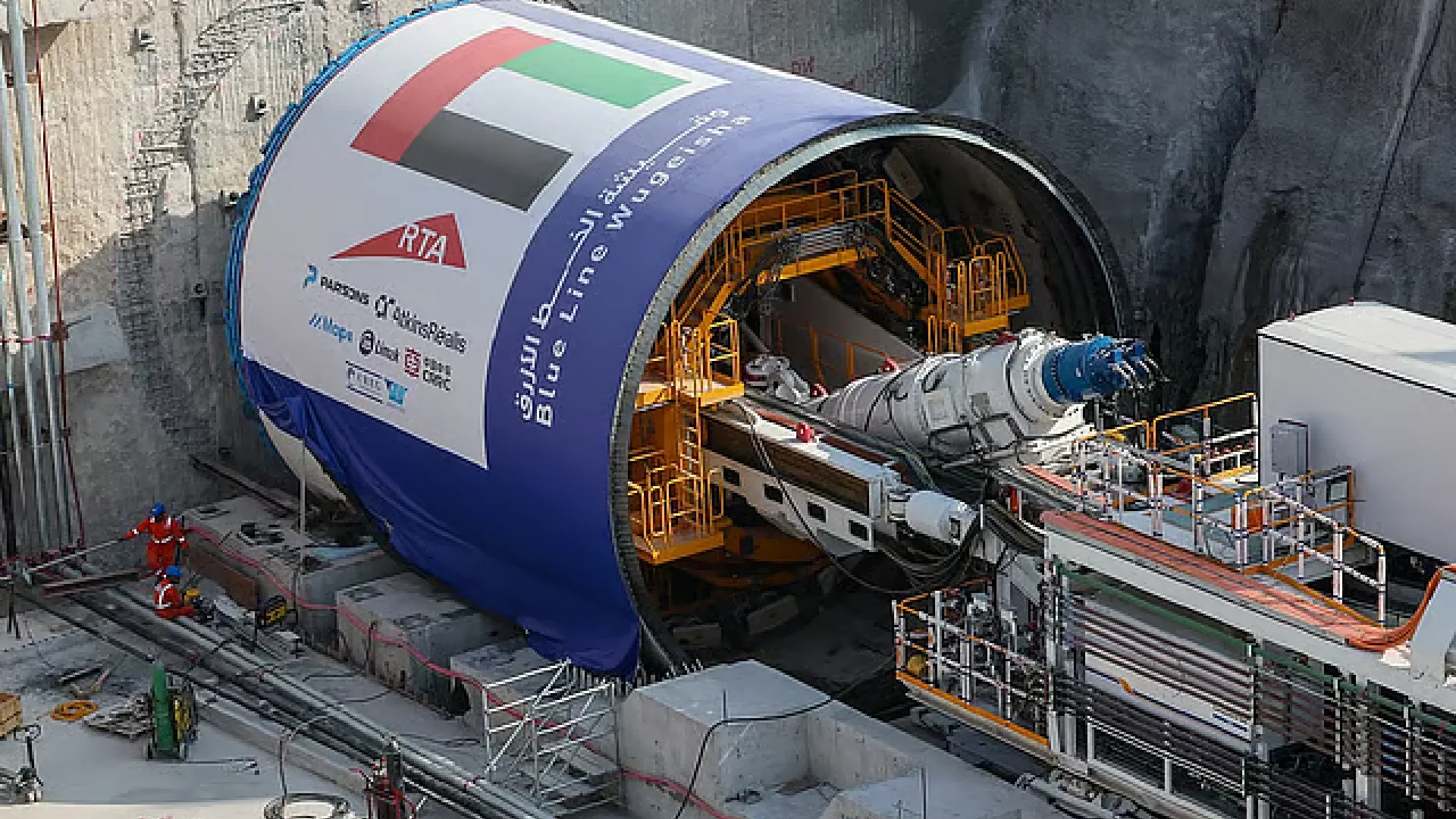

Down where the city turns to rock and rebar, Dubai is moving fast again: the RTA has announced the completion of the first phase of tunnelling for the upcoming Dubai Metro Blue Line—done in only two months. It’s a milestone that hints at tight logistics, disciplined engineering and a broader ambition to make cross-city movement smoother as the emirate grows. Above ground you see hoardings and traffic cones; below, a new daily rhythm is being carved into place. And when metro lines advance, neighbourhoods don’t just connect—they change.
The first thing you notice is the sound: a constant, industrial hush, like the city is exhaling through a giant fan. Then the light—hard white, bouncing off damp concrete, catching the dust in midair. A worker steps aside to let a trolley pass and calls out, half-joking, half-serious: “Careful—Dubai doesn’t sleep, but this tunnel definitely doesn’t either.”
This is where the headlines become real. Dubai’s Roads and Transport Authority (RTA) has announced that the first phase of tunnelling for the Dubai Metro Blue Line has been completed in just two months. Two months. In the language of megaprojects, that’s a quick heartbeat.
Most of Dubai’s big moments are made for skylines: a tower piercing the haze, a bridge arcing over water, a ribbon cut under camera flashes. Tunnelling is different. It happens under the noise, under the heat, under the everyday impatience of traffic. You don’t “see” it—until one day you step into a station that didn’t exist, and your commute becomes a different story.
That’s why this announcement matters. The Blue Line isn’t just another line on a transport map; it’s an investment in time—minutes saved, routes simplified, friction removed from the city’s daily choreography. And an early, fast tunnelling phase is the kind of progress that makes planners breathe easier and contractors walk a little taller.
It’s tempting to treat the number as bragging rights. But down here, speed is never just speed. It’s sequencing. It’s safety. It’s a thousand small decisions made correctly, repeatedly, under pressure.
A site engineer scrolls through a dashboard on his tablet, eyes narrowing as if he’s reading the tunnel’s pulse. “If you lose ten minutes up there,” he says, nodding toward the street level, “you get annoyed. If you lose ten minutes down here, you start moving entire plans.” He taps, zooms, checks. Then he looks up: “So we don’t lose ten minutes.”
Tunnelling means excavation, support, removal of spoil, lining, inspections, ventilation, water management—each step braided to the next. When one link slips, everything behind it shudders. Completing a phase quickly suggests that the links held.
Dubai has grown into a place where distance is both real and psychological. A location can be “close” if the road is clear, “far” if the junction is crowded, and “impossible” if parking becomes a daily negotiation. Metro lines change that math. They turn unpredictability into timetables, and timetables into lifestyle choices.
The Blue Line is set to extend the metro network’s reach and usefulness, offering new connections and strengthening the idea that Dubai’s future commute doesn’t have to be built around steering wheels. For residents, that can mean fewer long drives and more reliable arrivals. For the city, it’s a way to keep growth from turning into gridlock.
Construction sites have their own language—short, sharp, practical. “Where’s the bolt?” “The bolt is where you left your patience.” A laugh, then back to work. A supervisor points at a freshly finished segment. “Yesterday,” he says, “this was ground. Today, it’s structure.”
There’s pride in that sentence. Not the glossy kind, but the quiet kind that comes from repetition done well. Because in tunnelling, the romance is in precision: a line that stays true, a surface that’s secure, a schedule that doesn’t wobble.
Finishing “Phase 1” doesn’t mean the Blue Line is around the corner tomorrow. It means the project has cleared an early hurdle—and early hurdles have a habit of shaping everything that follows. A timely tunnel phase can unlock smoother handovers to subsequent works: station structures, systems installation, trackwork, testing, commissioning. In megaprojects, momentum is a material of its own.
You can often feel a metro line’s impact before the first train runs. It begins with different conversations: cafés scouting corners near future stations, residents asking, “How far is it on foot?” agents quietly adjusting their maps. In Dubai, where summer heat makes walkability precious, being “a short walk to the metro” can shift how a home is valued and how a district is perceived.
That’s the hidden power of announcements like this one. A tunnel finished today is a promise that feels more tangible tomorrow—and in a fast-moving market, tangibility is currency.
As the shift winds down, someone switches off a tool and the silence feels sudden, almost personal. A worker wipes his forehead with the back of his glove. “Up there it’s hot,” he says. “Down here it’s… hot, but with purpose.” He nods toward the newly secured lining. “This stays. This is ours.”
The RTA calls it the completion of the first tunnelling phase. On the ground—or rather, under it—it feels like a small victory carved into the city. Not flashy. Not loud. Just inevitable.
Metro expansion has a repeatable effect on real estate economics: it compresses perceived distance, widens tenant catchment areas and improves the “reliability premium” of a location. The fact that Dubai’s RTA is reporting a fast early tunnelling milestone is meaningful for investors because it can reduce delivery uncertainty—one of the biggest variables in pricing future accessibility.
Investor takeaway: Treat tunnelling completions as early proof-points. They don’t replace full project risk analysis, but they help investors time acquisitions, lease-up plans and exit windows around when “future connectivity” starts becoming present-day behaviour.