
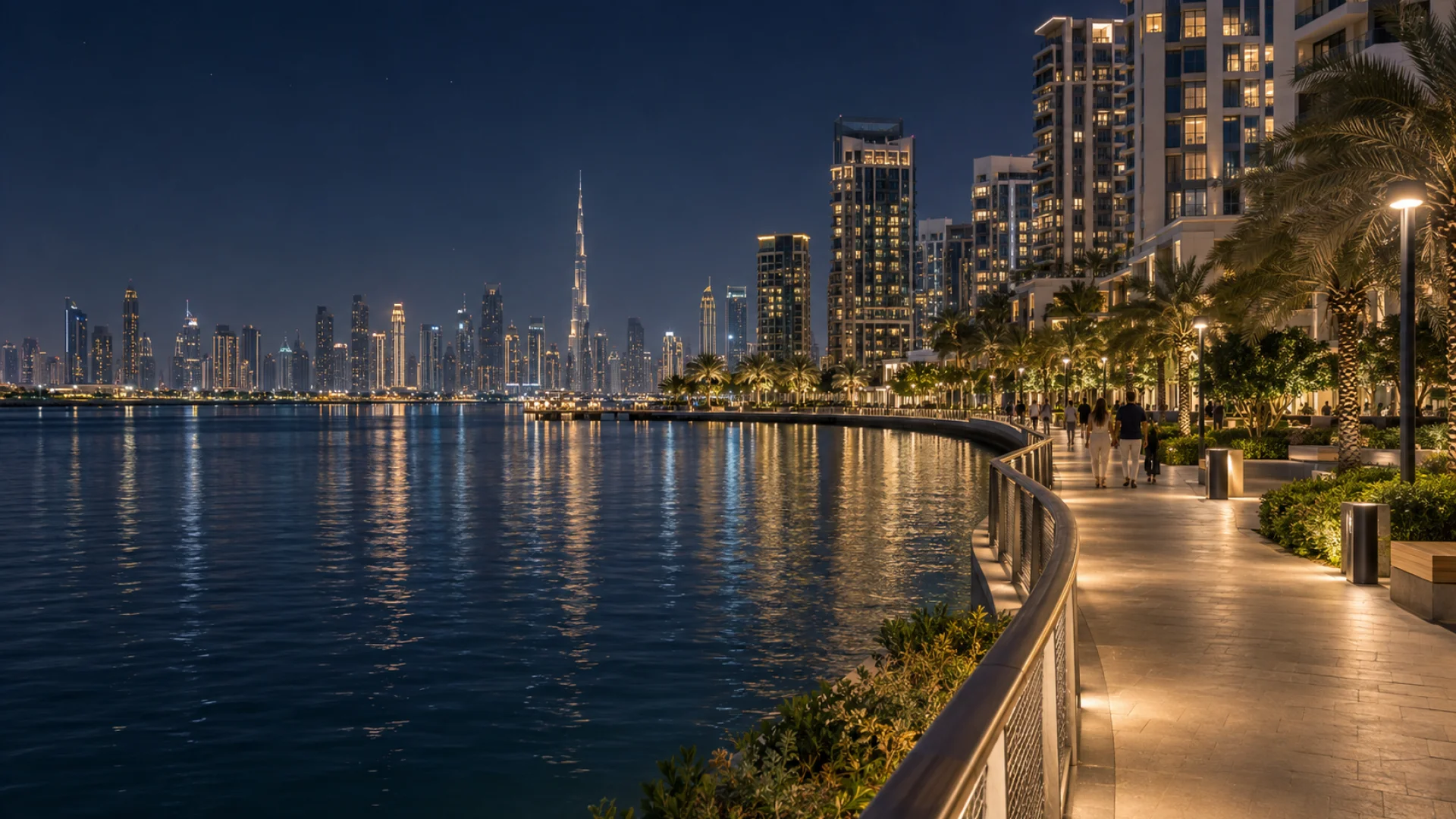

When night slips over Dubai, the city wants the sky a little darker and the streets a lot kinder to the eyes. Authorities are introducing a unified outdoor lighting system and guidelines designed to reduce light pollution and glare while improving road and public safety. Think warm-toned, fully shielded LEDs, beams aimed where people actually walk and drive, and smart controls that dim in quieter hours. The result promises calmer neighborhoods, clearer crossings, better sleep—and meaningful energy savings along the way.
Night arrives like a velvet tide along the canal. The pavement still holds the day’s heat, but the light has changed. No more harsh cones splashing facades and windows. Instead, the glow falls low and even, pooling on the walkway, staying off bedroom curtains, letting the sky deepen to a true, breathable blue-black. A jogger slows, squints out of habit, then laughs: “Hey, this is easier on the eyes.”
Dubai is redrawing the rules of the night. The city’s new lighting system and standards curb the three big offenders—skyglow, glare and light trespass—while sharpening safety where it matters most. Luminaires are fully shielded so nothing leaks upward. Optics send light down and out with surgical precision. Color temperatures are warmer, kinder. And adaptive controls nudge brightness up or down depending on the hour, the place, the people.
At a park gate, a guard tips his cap. “Drivers spot me sooner now—and I see them too.” Across the road, a delivery rider looks up from his phone, surprised by how easily his eyes adjust between sidewalk and street. The transitions are smoother. No abrupt hotspots. Fewer hard shadows. The city feels more readable at night.
The backbone is LED—smart, networked, and meticulously aimed. Fixtures are shaped to block uplift. Beam patterns fit the job: narrow where paths are tight, broader over plazas, asymmetric along curbs. Schedules and sensors adapt output to demand. In calm residential streets light softens after midnight. On main arteries it holds, steady and confident. Near sensitive natural areas and waterfronts, rules are stricter so the night can remain night.
Everything talks to a central platform. Entire districts can be tuned in real time. An empty street? The light eases back. A festival weekend? Brightness rises just enough, no glare, no drama. Maintenance teams see failures before complaints arrive. It’s efficiency you can feel—less wasted light, less wasted time.
Here, safety is not about blasting more lumens—it’s about putting better light in the right place. Cut glare, and pupils can work naturally. Crosswalks pop. Kerbs and bike wheels read as shapes instead of ghosts. At intersections the beam crawls lower along the asphalt so movement shows up sooner. Drivers brake earlier, pedestrians step with more certainty. The city moves with night vision instead of fighting it.
Darker skies are not just a poetic flourish; they’re policy. Less stray light means less strain on sleep, less stress on urban wildlife, and a cleaner backdrop for the stars. Energy demand falls, maintenance cycles stretch, and the carbon tab lightens. If you’ve ever walked home from a late shift, you can feel it in your shoulders and your eyes: this is gentler.
The change won’t bulldoze the night in one go. It’s phased. Existing masts and heads are swapped out district by district; angles are corrected, optics replaced, controls added. New developments must design with the rules from day one—pole heights, spacing, aiming, and signage all aligned to the same playbook. Private compounds, hotels, malls and communities get clear guidance: bright when needed; discreet when not.
Pilot zones help the city learn. Where can shadows be deeper? Where should light stretch farther across a crossing? The answers shape dimming curves and aiming diagrams. Dubai is training its streets to see, not to shine.
“I can read the kerb now,” a taxi driver says at a red light, tapping the wheel. A family pauses at a zebra, and the light unrolls like a soft carpet in front of their steps. “Look, stars,” a child whispers, pointing up. The sky isn’t midnight black—but it’s a sky again, not a canvas of glare.
The bottom line: light follows people again—not the other way around.
This is more than a tech upgrade. It’s a point of view: respect for the night, for eyes and routes, for sleep and skyline. Dubai is editing its nocturnal script—calmer, clearer, safer.
What does a new night mean for owners, developers and investors? Quite a lot—operationally, legally, emotionally. Good lighting is comfort, safety and brand, rolled into one.
Practical playbook for projects:
For investors, the retrofit wave is an opportunity: luminaires, controls, analytics, maintenance-as-a-service. Funds with a thesis around dark-sky-friendly communities are essentially investing in sleep, safety and serenity—scarce urban goods that residents will pay for. In Dubai’s refreshed night, value doesn’t scream; it glows.