
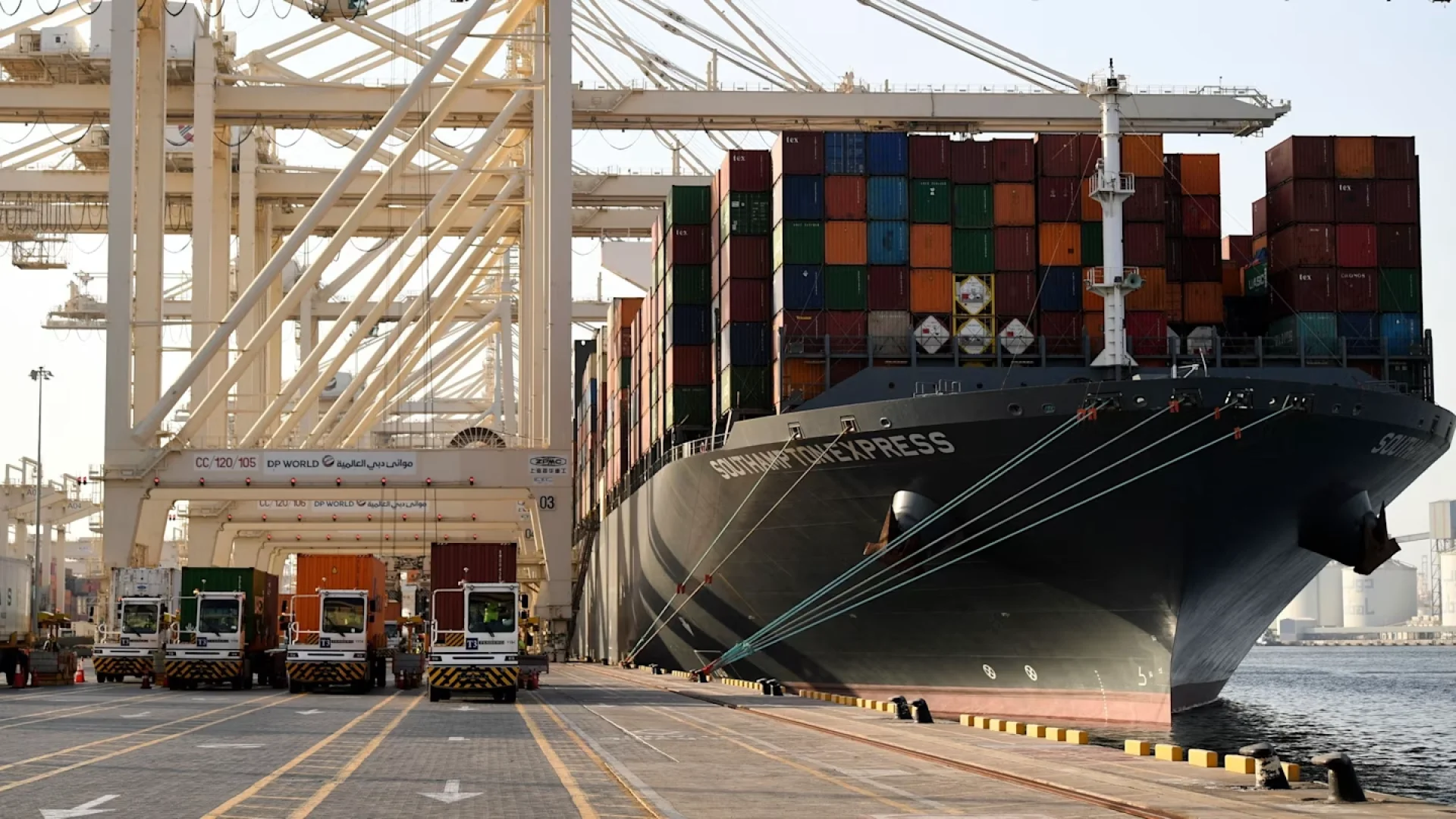

On the UAE’s east coast, Fujairah wakes to the hush of open water—no narrow choke point, just a straight line to the Indian Ocean. According to reports, Dubai is planning a new port here to cut exposure to the Strait of Hormuz, a route that can turn from corridor to bottleneck overnight. The move signals a familiar Dubai instinct: build redundancy before risk becomes reality. It’s logistics as strategy—an extra gate for trade, supply chains, and long-term security.
The first thing you notice in Fujairah is the silence.
Not the empty kind—more the steady, working quiet of a coastline that faces the wide-open sea. The Gulf feels far away here. A fishing boat nudges the sand. A truck idles, patient, as if time has learned to move in schedules. Out beyond the breakwater, a cargo ship hangs in the morning haze like a dark punctuation mark.
“This side is calmer,” a man says, eyes on the water. He doesn’t mean the waves.
That calm is exactly what makes Fujairah strategic. Media reports say Dubai is planning a new port on the UAE’s east coast—in Fujairah—aimed at reducing reliance on the Strait of Hormuz. It’s an infrastructure decision with a geopolitical heartbeat: create another way in and out, outside the Persian Gulf, with a cleaner line to the Indian Ocean.
On a map, the Strait of Hormuz is just a narrow seam between landmasses. In global trade, it’s a pressure point. When tensions rise, shipping doesn’t just worry—it recalculates. Routes lengthen. Insurance changes. Timelines wobble. And suddenly a single passage becomes the kind of dependency that keeps executives awake at 2 a.m.
Dubai’s answer, as reported, is not dramatic—it’s practical: add an alternative. Ports are not only places where containers move. They’re shock absorbers for economies.
Fujairah isn’t built on spectacle. It’s built on function. Stand near the waterfront and you’ll hear metal on metal, the soft grind of machinery, short instructions traded between workers—micro-dialogues that carry the weight of the day.
“If the ship is late, everything is late,” someone mutters, tightening a strap. No complaint. Just the logistics truth.
A new port here would plug into an environment already shaped by energy, storage, and maritime services—an ecosystem that understands throughput and reliability. And crucially, it sits outside the Gulf. For planners, that geographic fact is not trivia; it’s leverage.
Dubai’s rise has always been a story of movement—people, capital, goods. Its ports became legends because they were fast, ambitious, and connected. A project in Fujairah wouldn’t replace those hubs; it would extend the network with a second sea-facing door.
In plain terms, an east-coast port can mean:
Walk the edge of the quay and you’ll see the real reason this matters: logistics is physical. It’s hands on steel, fuel in tanks, time stamped on documents. It’s also fragile—because it depends on passages and permissions and predictability.
In Fujairah, predictability feels more attainable. The ocean is open. The horizon is wide. The route is less like a funnel and more like a highway.
Reports point to Dubai’s intention to develop a new port in Fujairah to reduce dependence on the Strait of Hormuz and strengthen alternative access to global shipping lanes via the Indian Ocean. While specific timelines and technical details are still part of the planning narrative, the direction is clear: build capacity on the east coast to diversify risk.
Ports don’t just move containers—they move property markets. If Fujairah gains major new port capacity, the ripple can travel inland: more demand for logistics land, warehousing, worker accommodation, and service-sector real estate. The opportunity isn’t automatic, but the mechanism is familiar: infrastructure concentrates activity, and activity bids for space.
Investor lens: Track the sequence, not the headline—planning approvals, procurement, road upgrades, tenant announcements, and the formation of adjacent logistics parks. Different phases reward different strategies: land banking with patience, development with execution capability, or income plays via stabilized industrial assets. The winners tend to be those who can deliver usable space fast, close to the flows.
Standing on this quiet coast, the thesis feels simple: when the world’s main door looks crowded, cities like Dubai build another—then make it efficient.