
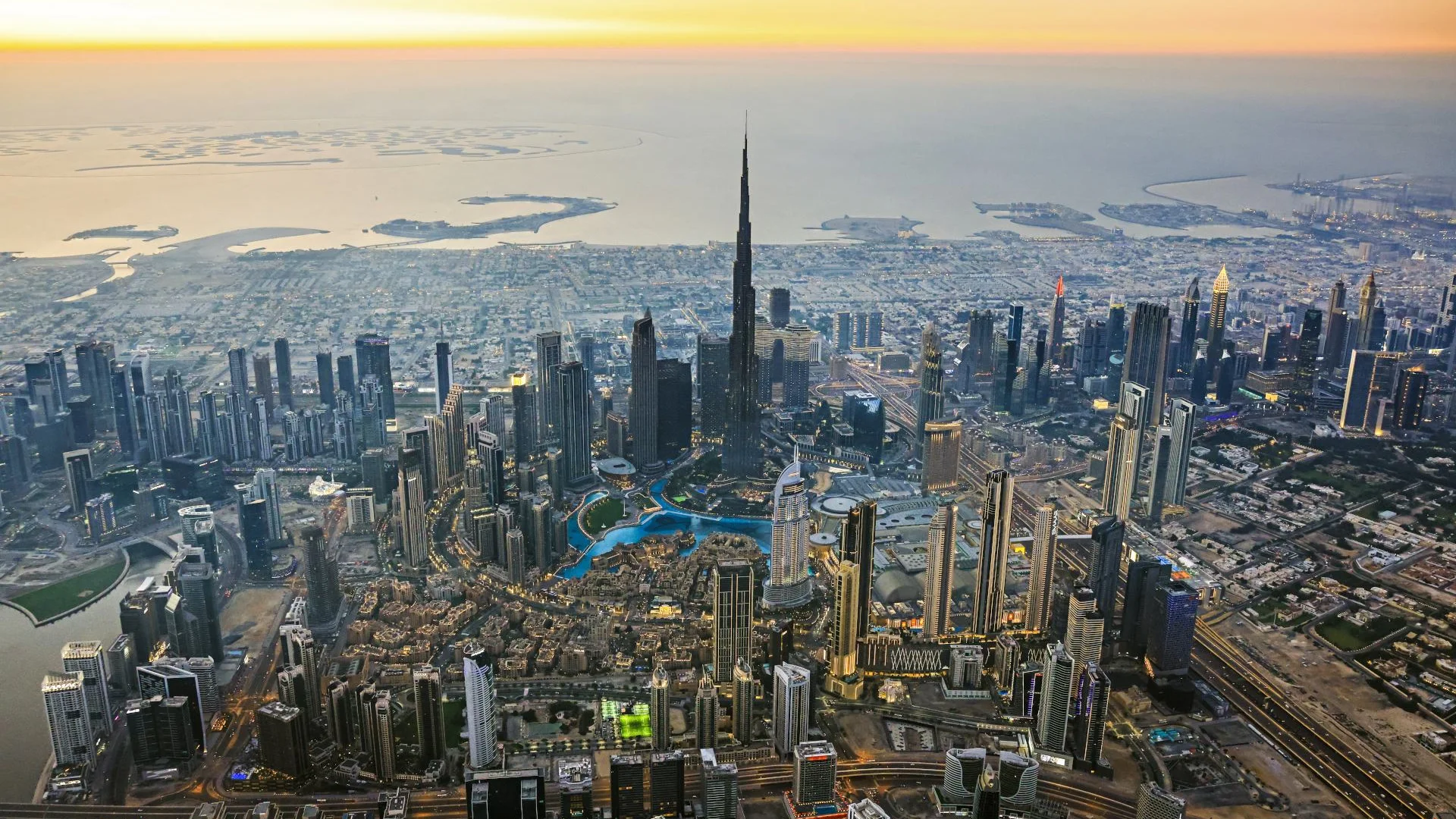

At dusk, Dubai still looks like a postcard—laser-lit towers, packed malls, brunch reservations that refuse to loosen. But after a month of war in the region, the city’s calm has become a carefully maintained public service: steady logistics, tightened security, controlled messaging, and a relentless insistence that life continues. The strategy is as economic as it is psychological, aimed at shielding aviation, tourism, trade and real estate from a sudden shift in perception. Beneath the polished surface, residents and visitors read the same signals with different eyes—asking not what is happening today, but what might happen next.
Dubai is at its most persuasive right after sunset. The heat finally lifts. The skyline switches on like a stage set—glass, chrome, and light poured into the sky. Along the marina, a father crouches to frame his children against the towers. “Hold still,” he says, laughing, and the kids squeal as the water taxis hum by. The city, from a distance, looks unbothered.
Up close, you catch the tiny hesitations. A glance that lingers too long on a news alert. A conversation that lowers itself mid-sentence. A hotel doorman who smiles the same way, every time, but scans the driveway twice. Normal life is happening—yet it is happening with a faint, almost electrical awareness underneath.
A month into a war shaking the region, Dubai is trying to do what it has always sold to the world: certainty. Not as a promise, but as a performance. The lights stay on. The flights keep moving. The restaurants keep filling. And the message—spoken and unspoken—lands everywhere you look: nothing breaks here.
In many places, crisis slows a city down. In Dubai, the instinct is the opposite: keep the machine running so smoothly that anxiety has nowhere to sit. Airports and airlines remain the metronome. Hotels keep their cool. Major venues don’t broadcast disruption; they adjust quietly, reroute, reschedule, soften the edges.
“Everything is fine,” a manager says in a coffee shop near a curtain wall of offices, as if he’s reciting a line he has practiced. He checks his phone, tilts it away, then looks up with a professional ease. Dubai, for years, has treated optics as a form of economic policy. When the product is confidence, you protect the storefront.
Security is present, but rarely theatrical. Extra checks at entrances. More guards in the seams of public space. A stronger sense that the city is watching—quietly, constantly—so you don’t have to. In a mall where the air-conditioning feels like artificial sea breeze, families queue for ice cream. A man reads something on his screen, swallows, pockets the phone, and turns to his daughter. “Chocolate or mango?” he asks, steady and ordinary. The question is small. The intention is huge.
Dubai is a master narrator. It builds its identity in superlatives: tallest, largest, newest, fastest. In calmer times, that’s branding. In tense times, it becomes a stabilizer—a way to hold the city’s self-image in place and keep external audiences from imagining cracks.
You feel this in the tone of official life, in the smoothness of corporate communications, in the way public-facing industries—hospitality, retail, aviation—lean into reassurance. The subtext is simple: Dubai is not the war. Dubai is the exception.
But in a city of expats and transient lives, the private conversation is different. It happens in elevators, in WhatsApp groups, in family calls that begin with the same question. “Are you safe?” A European professional in a co-working space answers his mother every morning, he admits, with the same routine line: “Yes. Look around—everything’s normal.” He smiles, then adds, almost to himself, “I think saying it helps.”
Dubai’s real vulnerability isn’t panic in the streets—it’s a shift in decisions made far away. An insurer changes its model. A company tightens travel policy. A conference organizer chooses a different hub. A family picks a different stopover.
Dubai is a junction city, a place that lives on movement. When movement hesitates, even slightly, the ripple spreads. In hotel bars, you hear it as new kinds of questions: “Any delays?” “Are flights still direct?” “How long are you staying?” The concierge answers with the same calm cadence: “Everything is running smoothly.” Then, a shade softer: “If you need anything, we’re here.” As if “anything” has expanded.
Dubai’s population is famously international, and that means many residents live in two emotional climates at once: the meticulously managed calm of the city, and the anxious temperature of home-country news feeds.
In a small salon, a woman from Southeast Asia scrolls through messages. “My mother sends me screenshots,” she says, rolling her eyes with affection. “I tell her: it’s quiet.” She gestures toward the street—traffic flowing, delivery bikes weaving, a billboard glowing like it always has. “She doesn’t believe me because she only sees the headlines.” She laughs, but the laugh is doing work.
That, more than any dramatic moment, is the daily texture: normal routines laced with contingency thinking. People aren’t necessarily leaving. They’re calculating—mentally rehearsing what they would do if things changed. The habit is subtle, but widespread.
When a city markets certainty, it also learns to plan for uncertainty. Companies run internal briefings. Families quietly discuss options: whether to move travel dates, how quickly they could relocate, what “just in case” means in their specific lives. The tone is rarely hysterical; it’s managerial.
In a supermarket aisle, a man adds an extra case of water to his cart. He pauses, looks at it, then nods once—like he’s signing off on his own decision. “Just in case,” someone beside him murmurs, and the phrase feels like a new piece of vocabulary that everyone understands without needing to define.
Still, the shelves stay stocked. The city stays bright. Construction sites keep their steady percussion. Dubai’s bet is that function creates distance—and distance creates safety, at least in the mind. As long as the machinery runs, the crisis remains outside the frame.
For property investors, Dubai’s push for normalcy is not a cultural footnote—it is a market variable that affects liquidity, risk premiums, and tenant demand. Geopolitical tension rarely hits real estate first through bricks and mortar; it hits through perception, financing conditions, and mobility.
1) Buyer behavior may split into “pause” and “pivot”
Dubai’s demand base is heavily international. In tense periods, some investors delay decisions, expecting better entry points or clearer visibility. At the same time, other buyers may reallocate capital toward Dubai if it is viewed as comparatively stable and operational within the region. The result can be uneven activity: softness in speculative segments, resilience in prime, end-user-driven neighborhoods.
2) Liquidity and price discovery
Uncertainty typically lengthens transaction timelines: more questions, more negotiation, higher sensitivity to payment plans and handover risk. Price discovery can become choppy, especially where recent gains were momentum-driven. Investors should anchor underwriting on rental cash flow and realistic vacancy assumptions rather than pure appreciation narratives.
3) Rental market: supported by employment—vulnerable to travel-dependent demand
If corporate activity, aviation throughput, and events remain stable, rental demand can stay firm. However, micro-markets reliant on business travel and short-term stays may soften faster if travel policies tighten or visitor flows dip. Reviewing exposure to holiday-let/short-stay models versus longer leases becomes crucial.
4) Financing, insurance, and the “perception spread”
Even when local operations remain smooth, global lenders and insurers may adjust pricing due to regional risk perception. That can translate into higher borrowing costs or more conservative valuations. Investors should structure leverage with buffers (lower LTV, interest reserves) and avoid relying on rapid exits.
5) Where opportunities concentrate in volatile periods
Periods of heightened uncertainty often reward quality and operational competence. Potentially more defensive allocations include:
Investor takeaway: Dubai’s core advantage is continuity—its ability to keep the city running and preserve confidence. But in a region under stress, continuity is an active effort, not a passive condition. Investors should watch tangible indicators—flight capacity, hotel occupancy, major event calendars, transaction volumes, listing time-on-market, and rent trend data in target submarkets—before making allocation decisions.