
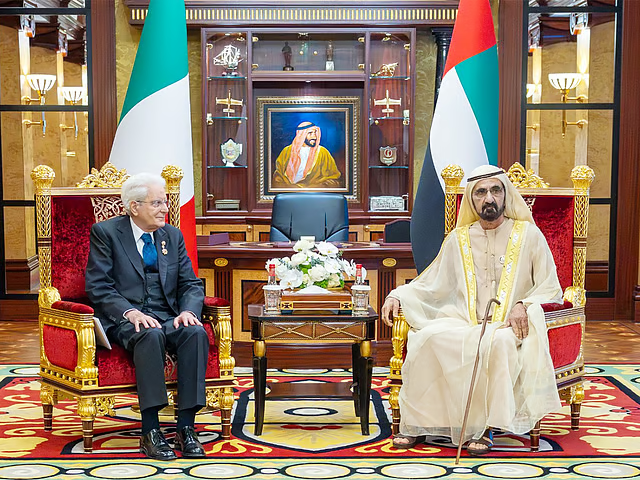
In Dubai, a handshake can be a headline—and a strategy. Sheikh Mohammed bin Rashid Al Maktoum received Italy’s President Sergio Mattarella, highlighting the momentum in UAE–Italy relations and the shared push to deepen cooperation. The meeting underscored Dubai’s role as a bridge between regions and as a place where political trust is built alongside economic opportunity. In a world of shifting alliances, the message was simple: partnership is a form of stability.
Dubai has a way of making diplomacy feel cinematic. The city hums, glass catching the sun like a blade, and then—almost imperceptibly—the tempo changes. A convoy slides past. Doors open and close with soft precision. Voices drop a notch. For a moment, even the skyline seems to hold still.
“Welcome to Dubai.” The words land quietly, but the occasion is anything but small. Sheikh Mohammed bin Rashid Al Maktoum meets Italy’s President Sergio Mattarella. Cameras capture the handshake, the composed smiles, the formal warmth. Yet anyone who has watched Dubai long enough knows the real story is not the photograph. It’s what the photograph signals.
The talks focused on the relationship between the UAE and Italy and ways to strengthen cooperation. On paper, that line reads like standard protocol. In practice, it’s a signal flare—sent to markets, institutions, and decision-makers who read state visits the way traders read charts.
Italy brings deep industrial heritage, global brands, design power, and a strategic position in Europe and the Mediterranean. The UAE brings connectivity, capital, speed of execution, and a model of positioning itself as a crossroads rather than an endpoint. Put those together and you get something both sides value right now: a partnership that can move—fast—across sectors and borders.
Dubai is not shy about being a stage. But it’s also a workshop. It hosts the ceremony and then gets straight to the point: what can be built next?
Step into a downtown hotel lobby and you can hear the world arriving in fragments. Italian near the coffee bar—quick, musical syllables. English by the elevators—deadlines and deal terms. Arabic at reception—smooth and assured. A man in a dark suit leans over his phone: “We’ll move the meeting to next week—same place.” A woman answers without looking up: “Perfect. See you in Dubai.”
This is how the city works. It turns “somewhere in between” into an address. And when a head of state is welcomed here, the implication is bigger than the agenda: Dubai is reinforcing itself as a neutral, efficient, globally connected hub where relationships can be maintained even when the wider world feels unsettled.
There is a pressure in today’s geopolitical weather—supply chains re-routing, energy transitions accelerating, competition for talent tightening. In that context, high-level meetings are not just symbolic niceties. They are reassurance. A reminder that channels are open, that cooperation is being actively curated, that partnership is not an accident but a choice.
The Sheikh Mohammed–Mattarella meeting underlined precisely that: a continued commitment to stronger ties and a mutual interest in expanding the relationship. It’s the kind of message that reaches beyond ministries and into boardrooms.
Every official encounter has its choreography, but there are always small flashes of something personal—an extra second of eye contact, the slight tilt of a head, the half-smile that appears when a comment lands just right. Those details don’t usually make the transcript. They do, however, shape the atmosphere around a relationship.
You can imagine President Mattarella—coming from a country where history sits visibly on every corner—taking in Dubai’s particular kind of ambition. A city that builds as if time is elastic. A place that respects tradition while insisting on momentum. And you can imagine Sheikh Mohammed, for whom Dubai’s international role is not a slogan but a long-running project, measuring the value of relationships in outcomes: connectivity, opportunity, stability.
Then the city exhales. The motorcade moves on. Security earpieces crackle. Somewhere nearby, cups clink against saucers and life returns to full speed. Dubai doesn’t linger. It pivots.
But the message remains—clean, deliberate, and widely readable: the UAE and Italy are keeping the door open, and Dubai is making sure the room is ready.
For property investors, the most important part of high-level diplomacy is rarely the quote—it’s the confidence it produces. Meetings like Sheikh Mohammed’s reception of President Mattarella act as trust signals, especially for cross-border capital that is sensitive to political stability, regulatory predictability, and long-term bilateral alignment.
1) A confidence boost for European capital flows
Italy is home to family offices, manufacturing entrepreneurs, and internationally mobile high-net-worth buyers who increasingly view Dubai as a second base—part lifestyle, part business platform, part portfolio diversification. A visible strengthening of UAE–Italy ties supports that narrative and can translate into greater appetite for Dubai assets, particularly those that are easy to own, lease, and re-sell in an international market.
2) Demand drivers that matter to real estate
Stronger bilateral relationships can coincide with increased business travel, more corporate representation, and broader cultural and commercial exchange. In real estate terms, that tends to support:
3) “Soft power” and market liquidity
Diplomatic visibility strengthens a city’s brand, and brand strength supports liquidity. Markets with strong international confidence typically see deeper buyer pools and quicker transaction velocity in the top segments—important for investors who care about exits as much as yields.
4) Sector-linked opportunities
If cooperation expands across industry, technology, education, logistics, or energy transition themes, investors may find tailwinds in property types aligned with those sectors:
5) Practical investor takeaway
Treat these diplomatic milestones as part of a top-down investment filter. They don’t replace asset-level due diligence, but they help frame timing and segment selection. In periods of stronger international alignment, the first beneficiaries are often internationally tradable, high-quality assets—prime homes, top-tier hospitality, and best-in-class offices—provided investors remain disciplined about submarket supply pipelines, developer track record, and tenant demand.