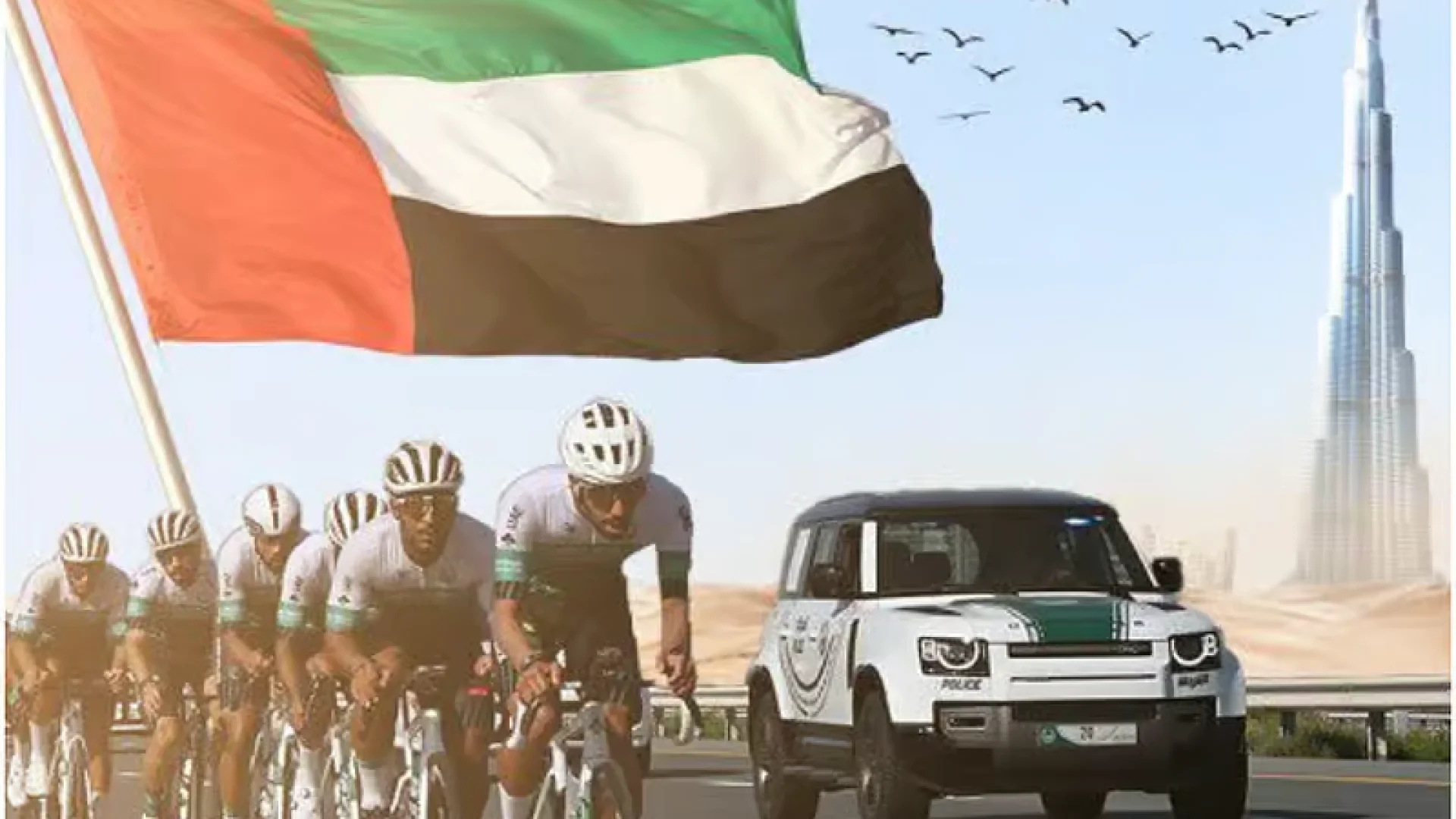
At dawn, Dubai’s wide boulevards turn into a ribbon of motion as Dubai Police hosts the “Proud of UAE” cycling race—part competition, part public message. The event spotlights fitness, community spirit and road-safety awareness, using the city’s futuristic skyline as a living backdrop. More than a finish-line story, it’s a portrait of Dubai’s evolving lifestyle agenda: healthier routines, safer streets and a shared sense of belonging in a global metropolis. For investors and residents alike, it signals how urban experience—mobility, public space and brand image—is becoming a core asset.
The city feels different before it fully wakes up.
Dubai at dawn is softer around the edges—less glare, more hush. The asphalt looks freshly ironed. Streetlights still glow like embers. And in that cool pocket of early morning, you hear it: the tiny, confident sounds of cyclists arriving—cleats ticking on pavement, carbon wheels humming when someone gives a casual spin, a zipper pulled up with purpose.
“You good?” a rider asks his friend, tightening a helmet strap.
“Always,” comes the answer—half grin, half nerves.
Then the uniforms come into focus. Dubai Police, visible but not imposing, lining the start and the route with the kind of calm control that makes a fast event feel safe. This is the “Proud of UAE” cycling race—hosted by Dubai Police—where the pace is athletic, the staging is meticulous, and the message travels as quickly as the peloton: movement belongs in the city, and safety is everyone’s job.
When the riders roll out, it’s almost quiet at first—just chain noise, breathing, the soft hiss of tires. But within minutes the group tightens into a single organism, sliding through Dubai’s modern geometry: glass towers catching the first gold, wide lanes opening ahead like runways, intersections managed with crisp signals and watchful eyes.
A marshal raises a hand. A rider calls, “Left!” Another answers, “Clear!” No drama. No chaos. Just a moving agreement.
Dubai Police didn’t name the event casually. “Proud of UAE” isn’t merely branding—it’s the spine of the day. The race is designed as a civic moment as much as a sporting one: a show of discipline, unity and the idea that public space can be shared elegantly when rules are respected.
In a city famous for speed, the subtext matters: speed is welcome—when it’s managed.
At first glance, a police-hosted cycling race might sound unusual. But stand there, watching the start, and it makes perfect sense. A road race is traffic distilled: many bodies, high stakes, constant decision-making. It’s the real world—compressed into kilometers.
Dubai Police uses that compression to make road safety feel tangible rather than theoretical. Not a slogan on a billboard, but something you practice with your hands and shoulders and eyes. In a peloton, you learn quickly: one unpredictable move can ripple through the group like a shockwave.
So riders signal. They look. They hold lines. They communicate in short bursts—micro-dialogues that sound almost like code but are really just respect made audible.
“Easy.”
“Hold.”
“On your right.”
It’s education disguised as adrenaline.
Dubai has been getting visibly more active—beyond the glossy campaigns and into the fabric of mornings and evenings. Runners along the Marina. Yoga mats on rooftops. Weekend cycling groups forming before the sun turns sharp.
The “Proud of UAE” race plugs straight into that momentum. It turns fitness into a shared ritual and puts cyclists—often marginal in car-first cities—front and center. Not as an afterthought, but as a legitimate part of the urban story.
Along the route, spectators appear in little clusters. No stadium. No grandstands. Just people leaning on railings, phones up, clapping as the peloton flashes past.
A child holds a camera too high, trying to capture both riders and skyline.
Someone yells, “Yalla!” with the warm insistence of a city cheering for itself.
Dubai is international in a way few cities are—languages overlap at crosswalks, accents mingle in elevator lobbies, passports multiply in a single apartment building. In that reality, “pride” can’t be a closed door. It has to be an invitation.
This race feels like that invitation made physical. For a few hours, anyone who lines up, follows the rules and respects the group becomes part of the same moving picture. You don’t need to share a background to share a road.
That’s the quiet power of the event: it performs belonging without speeches.
You can measure a city by how it handles the unglamorous parts of big moments. Detours. Timing. Marshals. Clear signage. Calm interventions when something looks off.
On race day, those details are the difference between spectacle and stress. Here, the choreography is tight. The route feels protected without feeling locked down. Riders move fast, but the environment feels controlled—an important distinction in any conversation about cycling in major cities.
There’s a moment in every ride when thinking shrinks to essentials. Your breathing finds a pattern. Your legs settle into cadence. The skyline stops being a backdrop and starts behaving like scenery in motion—sliding by as if it, too, is riding.
A police officer at the side of the road nods once, a simple gesture that says: we see you, keep going.
A rider beside you mutters, “Good pace.”
And suddenly Dubai doesn’t feel like a place you’re passing through. It feels like a place you’re participating in.
The rise of community races and fitness events in Dubai isn’t random. It fits a broader shift: the city wants to be known not only for building fast, but for living well. That means parks, promenades, safer crossings, and the idea that mobility can be plural—car, metro, walking, cycling—each with dignity.
Cycling is especially symbolic. It’s quiet. It’s efficient. It’s visible. And it changes how people perceive distance—what feels close, what feels doable, what becomes routine.
The “Proud of UAE” cycling race condenses all of that into one morning. A competition, yes—but also a moving statement that the future city isn’t only vertical. It’s also street-level, human-scale and in motion.
For real estate investors, a police-hosted, city-forward cycling event is more than a feel-good headline—it’s a signal about urban priorities. Cities that institutionalize active lifestyles (cycling, running, walkability) tend to see measurable value uplifts in neighborhoods where those lifestyles are easiest to live: along waterfronts, green corridors, mixed-use districts and areas with safe crossings and continuous public realm.
1) Demand premiums for “active-mobility” micro-locations: As cycling becomes normalized, tenants and buyers increasingly reward proximity to promenades, parks, dedicated lanes, and well-connected road networks that feel safe. In Dubai, that can translate into stronger absorption and rent resilience in districts positioned as lifestyle hubs rather than purely transactional addresses.
2) Retail and F&B performance: Active mobility drives street-level footfall and “linger time.” Cafés, convenience retail, athleisure, wellness clinics and bike-service concepts benefit from predictable morning and weekend flows. Investors evaluating mixed-use assets should pay attention to ground-floor design: shade, frontage visibility, seating edges, and access that welcomes pedestrians and cyclists.
3) Development features that rent well: Cyclist-friendly amenities are relatively cost-effective compared to major structural upgrades, yet they support pricing power. Think secure bike rooms, showers and lockers in offices, repair stations, smart wayfinding, and direct links to promenades. These features also align with corporate occupiers’ wellness agendas, supporting office leasing narratives.
4) Governance and operating environment: When a government entity like the police actively champions road safety through public events, it signals institutional capacity—planning, enforcement, crowd management. For institutional capital, this reduces “city friction risk” and supports confidence in long-term placemaking strategies.
5) Actionable investor lens: Track recurring event routes and the districts they showcase. Repetition creates habit—and habit creates demand. The places a city repeatedly chooses to display as its healthy, modern face often become the next winners for hospitality (sports weekends, cycling tourism), branded residential concepts, and resilient cash-flow assets.