
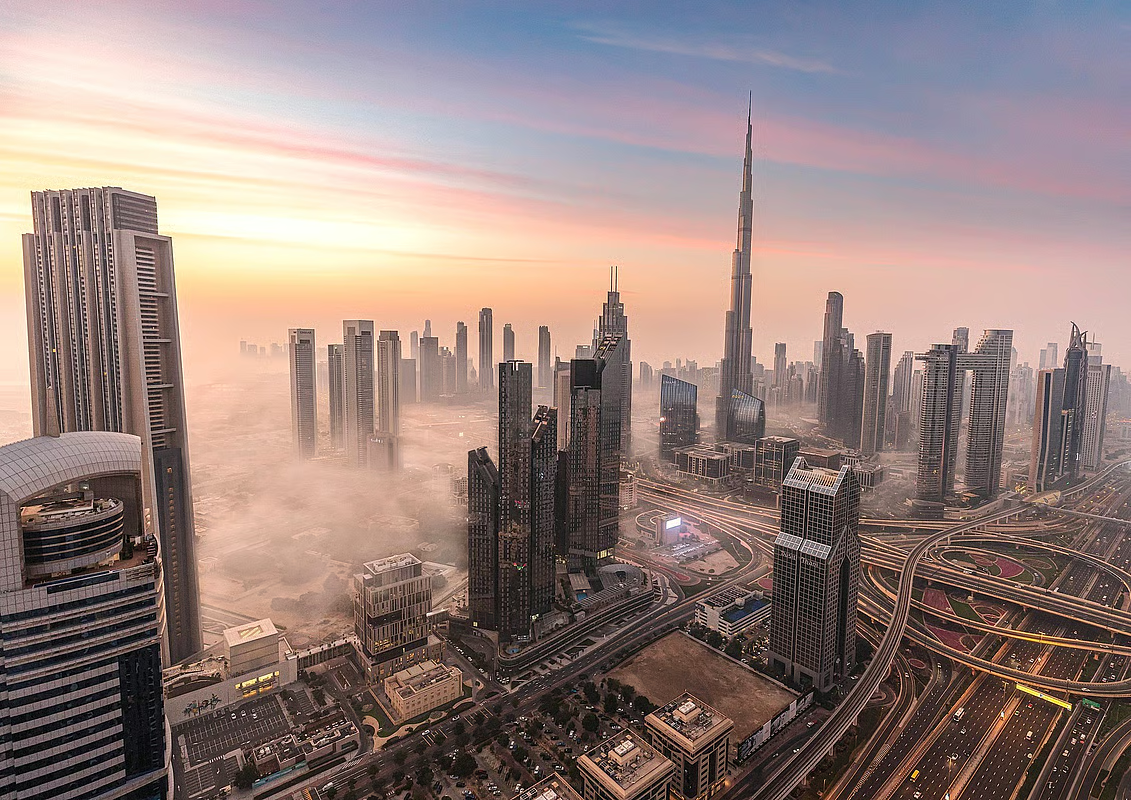

Dubai didn’t tiptoe into year-end—it sprinted. As winter evenings cooled the air and terraces filled, the property market delivered a record-shattering 2025 crowned by a powerful December finish, with deal flow accelerating across both off-plan launches and secondary sales. The story behind the spike is bigger than one month: population inflows, globally attractive rental yields, and a steady, pro-business framework kept buyers—end users and investors alike—leaning forward. In a city that likes its skylines tall and its ambitions taller, 2025 reads like a new benchmark, not a victory lap.
The first thing you notice is the sound. Not the traffic—Dubai always has a soundtrack of engines and ambition—but the softer noise inside a sales gallery: pens tapping on glass tables, a quick inhale before a signature, the tiny ping of a payment-plan screenshot landing in a chat.
Outside, the December air is finally gentle. Marina promenades glow. Downtown feels like a postcard that learned how to breathe. And somewhere between the second espresso and the third site visit, buyers stop saying, “We’re just looking,” and start asking the only question that matters: “What’s still available?”
That’s how Dubai wrapped 2025—without slowing down. According to market reporting, the emirate capped a record-shattering year with a powerful December finish, pushing transaction activity to new highs and underlining a demand profile that stayed broad: investors hunting yield, families upgrading, entrepreneurs planting flags, and international buyers treating a Dubai address as both lifestyle and strategy.
There are years where the market rises like a tide—quiet, inevitable. And then there are years like 2025, where it feels more like a drumbeat. The headlines talk about records and momentum, but on the ground you feel it in smaller, human moments: a couple measuring a balcony with their phone camera; a broker whispering, “If you like it, reserve now”; a buyer stepping into a lobby and deciding in ten seconds whether the building has “the right energy.”
December is supposed to be a month of loose ends—holiday travel, year-end accounting, postponed decisions. In Dubai, it became a month of closure in a different sense: deals closing, units closing out, reservation sheets filling up like theatre tickets on opening night.
Dubai’s property market has seen hot cycles before. What made 2025 distinct was how many drivers lined up at once—and how visible they were in everyday life.
People are arriving. You see it in packed cafés at DIFC, in school waitlists, in new faces learning the rhythm of the city. In real estate, population inflows don’t stay abstract for long; they turn into leases, then into purchases, then into demand for the next community, the next tower, the next “walkable” promise.
Money is comparing. Investors don’t look at Dubai in isolation. They hold it up against other global cities where prices are higher, regulation can be heavier, and yields feel thinner. Dubai’s appeal in 2025 remained its combination of liquidity, modern stock, and rental dynamics that—when a unit is chosen well—can still look compelling on a spreadsheet.
Confidence is compounding. The market’s pro-business posture, ongoing infrastructure growth, and the city’s ability to deliver at speed created a kind of self-reinforcing belief: that buying isn’t merely speculation, but participation in a trajectory.
Walk into an off-plan launch and you’ll understand why this segment stayed a core engine. Everything is designed to feel tangible: the scale model under spotlights, the scented air, the “lifestyle film” looping on a wall where sunsets last forever.
And buyers respond. Off-plan offers what many want in a fast-moving city: access to new locations, newer layouts, amenity-rich living, and often payment plans that feel like a bridge between present cash and future value. In 2025, that bridge was busy with traffic.
A sales manager in a glossy showroom leans in as if sharing gossip: “The best stacks go first.” She points to a tower on the model—prime views, preferred orientation—and you can almost hear the silent math in the room. Views translate into rentability. Rentability translates into resilience. Resilience translates into conviction.
What made the December finish particularly telling was that activity wasn’t confined to new launches. Ready homes moved too, with buyers scrutinizing the things that don’t appear in brochures: maintenance quality, lobby traffic, elevator wait times, the way a corridor smells at 7 p.m.
In a villa community, a broker watches a family linger in the garden longer than necessary. The father asks about school runs; the mother asks about afternoon sun. The kids run toward the sliding doors like they already live there. The broker doesn’t push. He doesn’t need to. In 2025, the market often did the persuading on its own.
Part of the year-end surge is seasonal psychology. Dubai in December is Dubai at its most seductive: the city becomes walkable, social, cinematic. Visitors arrive for winter sun and leave with something else on their mind—a title deed, a reservation form, a plan.
There’s also the calendar effect. Year-end is when portfolios are reviewed and decisions get sharper. Some investors reallocate after strong performance elsewhere; others respond to rental market signals. Many who spent months watching from the sidelines simply didn’t want to watch for another year.
The result: a “powerful finish” that looked less like a last lap and more like momentum spilling into the next season.
Ask around and the answers don’t sound like buzzwords. They sound like practical priorities dressed in Dubai’s glossy clothes.
In other words, 2025 wasn’t only about chasing price growth. It was about chasing a product that works—financially and emotionally. Because in Dubai, emotion is part of the transaction. A skyline view can tilt a decision. A perfectly staged living room can make someone imagine a life they hadn’t planned yet.
A record year always raises the same question: is it sustainable? The more interesting answer is that Dubai looks increasingly like a market where momentum coexists with selection. Buyers are not identical, and neither are assets. Prime locations, strong developers, and well-managed buildings tend to keep their pull. Generic stock has to compete harder.
That’s a sign of maturity, not weakness. A market that differentiates is a market that’s learning—pricing risk, pricing quality, pricing scarcity. And December 2025, loud as it was, still carried that nuance beneath the fireworks.
1) Liquidity signal: A record-breaking December suggests strong market liquidity—more buyers active, more transactions closing, and generally tighter bid/ask spreads in in-demand micro-locations. For investors, liquidity matters as much as yield: it supports faster exits, easier refinancing, and flexibility if strategy changes.
2) Micro-location and building quality are the differentiators: In a high-activity market, selection risk increases. Investors should focus on assets with durable tenant demand: proven communities, strong connectivity, reputable building management, and layouts that match mainstream leasing preferences (functional one-beds, efficient two-beds, family-friendly villas in established districts).
3) Off-plan vs ready—match to your risk horizon:
4) Underwrite the rental business, not just the purchase: Strong headlines can distract from operating realities. Model net yields using realistic achieved rents, include service charges, maintenance, vacancy assumptions, and leasing fees. In districts with heavy new handovers, competitive pricing and professional property management become decisive for keeping occupancy high.
5) Watch supply pockets and plan exits: A robust pipeline can create short-term softness in specific towers or clusters even as the broader market remains strong. Investors should map handover schedules in target areas and set an exit plan (sell at completion, hold for yield, refinance) before buying—especially for off-plan allocations.
6) Practical takeaway: December 2025 reinforces Dubai’s position as a high-liquidity, globally marketed real estate hub. The opportunity for investors is still compelling—but increasingly won by disciplined selection: prioritize prime micro-locations, developer quality, tenant-led layouts, and conservative assumptions. In a market sprinting into year-end, the best strategy is to run with a rulebook, not with adrenaline.