
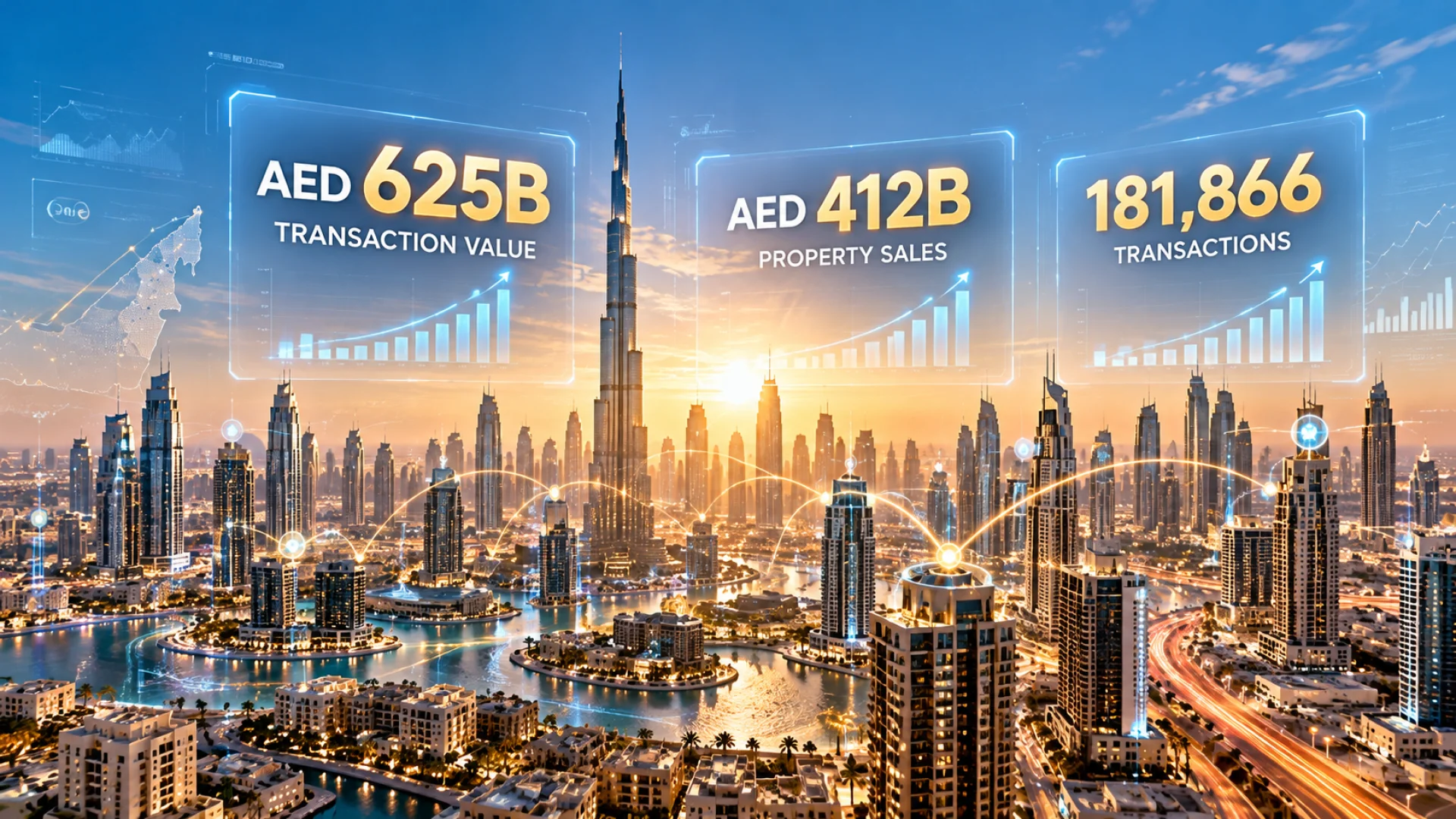
Dubai’s property market is moving at remarkable speed. During the first ten months of the reported period, 181,866 transactions reached a combined value of Dh625 billion, equivalent to roughly €157 billion. Sales alone accounted for Dh412 billion, or about €103 billion, highlighting sustained demand across apartments, villas, land, commercial property and new development communities.
Before the heat settles over Sheikh Zayed Road, Dubai is already moving. Cars stream between mirrored towers. Cranes turn slowly above half-finished neighbourhoods. In a sales lounge near the marina, a buyer studies a floor plan while the coffee machine hisses behind him.
“Can I reserve it today?” he asks.
That small exchange captures the energy behind a much bigger story. During the first ten months of the reported period, Dubai registered 181,866 real-estate transactions worth Dh625 billion. Sales reached Dh412 billion. Converted at a simple round rate, the total represents approximately €157 billion, while sales alone amount to around €103 billion.
These are not numbers generated by one spectacular penthouse or a handful of billionaire purchases. They describe a broad, active marketplace: apartments, villas, plots, offices, retail units, completed homes and properties still taking shape behind construction fences.
Dubai’s skyline often dominates the headlines, but the property market is much larger than its tallest towers. Established districts continue to attract international buyers, while emerging communities are expanding the map of the city. New roads, schools, parks and retail centres are turning previously undeveloped land into everyday places to live.
On a typical viewing, the conversation quickly moves beyond the colour of the kitchen cabinets. Buyers ask about access to major roads, commuting times, community facilities, service charges and rental demand. A family wants a garden and a school nearby. A professional wants a furnished apartment close to work. An investor wants a layout that tenants will understand immediately.
The figure of 181,866 transactions reflects this variety. Each deal represents a different decision: a company securing space, a resident buying a first home, a developer acquiring land or an investor reshaping a portfolio. Together, the transactions form a detailed map of confidence, mobility and long-term urban growth.
The Dh412 billion sales figure is especially revealing because it shows where buyers committed capital directly. Dubai’s offer stretches from relatively compact apartments to expansive villas with private pools, from practical offices to high-end waterfront residences. The international profile of the city brings a wide range of motivations to the same market.
Some buyers arrive because of employment. Others are drawn by global air links, lifestyle, business opportunities or the city’s expanding population. For many, property is both a home and a financial asset. That dual role helps explain why location and usability matter so much.
At a new development, the future is often visible before the streets are complete. A scale model shows towers, landscaped paths and a community centre. A sales adviser points to a blank section on the map.
“This is the next phase,” she says.
In Dubai, tomorrow is frequently part of today’s sales pitch.
The market’s resilience rests on several pillars. Dubai continues to attract companies, entrepreneurs, skilled professionals and high-net-worth individuals. Its infrastructure is constantly being upgraded, while tourism, logistics, technology and financial services support a broad employment base. More people create more demand for homes, offices, shops and services.
Product diversity adds another layer. A buyer can choose a completed unit and move in quickly, or enter an off-plan project with a longer delivery horizon. A plot may appeal to a developer, while a ready apartment may suit an investor seeking immediate rental income. Each option carries its own timetable, costs and risk profile.
Developers are responding with increasingly varied concepts. The city is seeing compact urban apartments, family-oriented villa communities, branded residences and mixed-use districts where living, shopping and leisure are designed to overlap. The result is a market that feels less like one property sector and more like several interconnected markets.
Strong transaction figures do not make every property a good purchase. Dubai is a competitive market, and buyers are becoming more selective. A spectacular lobby cannot replace reliable construction. A rooftop pool cannot compensate for weak access or limited rental appeal. The real test begins after the brochure is folded away.
Investors increasingly examine the developer’s record, handover schedule, service charges, maintenance standards and the depth of demand in a specific location. End users look at natural light, storage, noise, schools and daily convenience. The most persuasive projects combine presentation with practical quality.
This shift is important for the next phase of the cycle. As more homes enter the market, differentiation will become sharper. Well-planned communities may outperform projects that rely on a striking image alone. Good management and a functioning neighbourhood can matter as much as the view.
At dusk, the Burj Khalifa catches the last light. Along the marina, balconies begin to glow one by one. Residents return from work, deliveries arrive in polished lobbies and restaurants fill with conversations in several languages. The city’s property market is not an abstract spreadsheet here. It is the sound of lifts, the movement of traffic and the quiet ritual of keys changing hands.
The Dh625 billion transaction value demonstrates the scale of capital moving through Dubai’s real-estate ecosystem. The 181,866 deals show that the activity is spread across a large number of participants rather than concentrated in a single luxury niche. The Dh412 billion sales figure confirms that buyers are continuing to place substantial money into homes and commercial assets.
The question for the months ahead is not simply whether Dubai can maintain its pace. It is whether supply, infrastructure and demand can continue to develop together. New projects will add choice. Buyers will compare more carefully. Developers will need to deliver not only attractive buildings, but complete and liveable places.
For investors, the latest results send a powerful market signal. A total transaction value of Dh625 billion, supported by Dh412 billion in sales, points to deep activity and strong participation. Dubai remains visible to international investors seeking exposure to a global city with a growing population and diversified economy.
The headline numbers are enormous, but their most interesting meaning is human. A family chooses a neighbourhood. A company signs a lease. An investor takes a calculated step into a city that is still expanding. Between the first light on Sheikh Zayed Road and the final shimmer on the marina, Dubai continues to turn ambition into real estate.